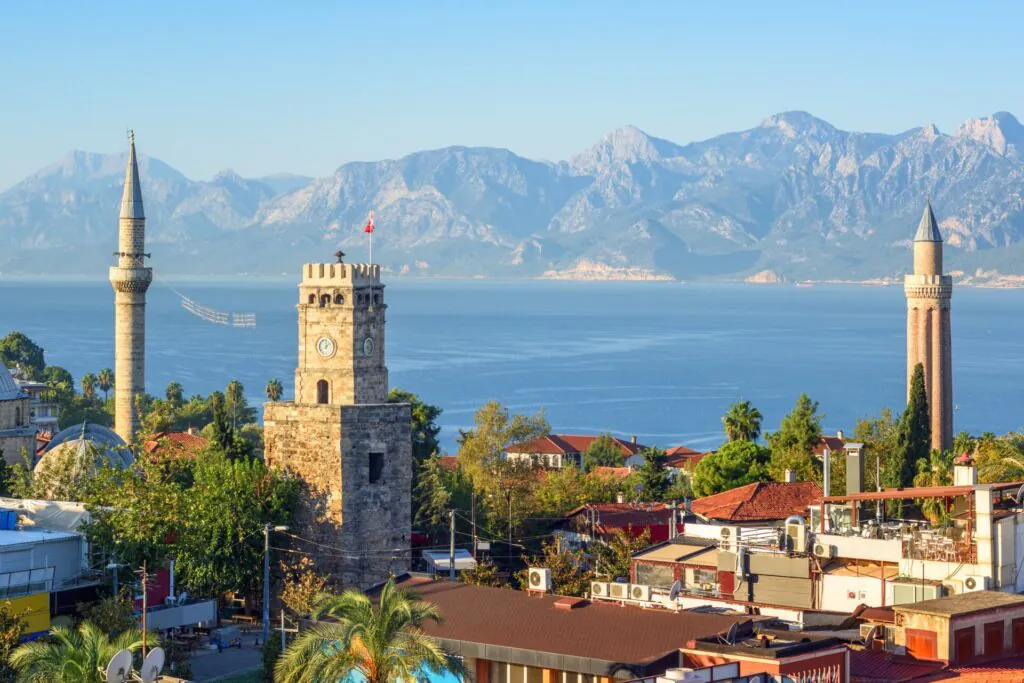
COP31 must move from commitments to concrete delivery. Three key tests for measuring its success:
1. Deliver a credible response to climate science. COP31 must respond to accelerating impacts, the threats posed by El Niño and the growing risk of a significant 1.5 °C overshoot.
2. Show progress on climate finance, moving from commitments to implementation. Progress across all areas outlined in the first test depends on improving the quality, accessibility and affordability of finance.
3. Demonstrate that the UN climate process is evolving to meet the demands of the implementation era and establish a pathway to GST2 in 2028.
E3G CEO, Nick Mabey, reflects on COP31 outcomes

As the COP outcome headlines ripple around the globe, Nick Mabey writes post-COP reflections.
“It is always easy for countries to blame others and hide inside their negotiating blocs when talks fail. The truth is leaders from all countries have failed to invest in the climate regime leaving negotiators to try and resolve the irreconcilable.
2027 needs to see climate diplomacy between capitals step up to match the pace of clean economy action. Leaders can’t outsource their climate security to the market – they need to take back control.
After Antalya: An Opportunity for a Climate Diplomacy Reboot
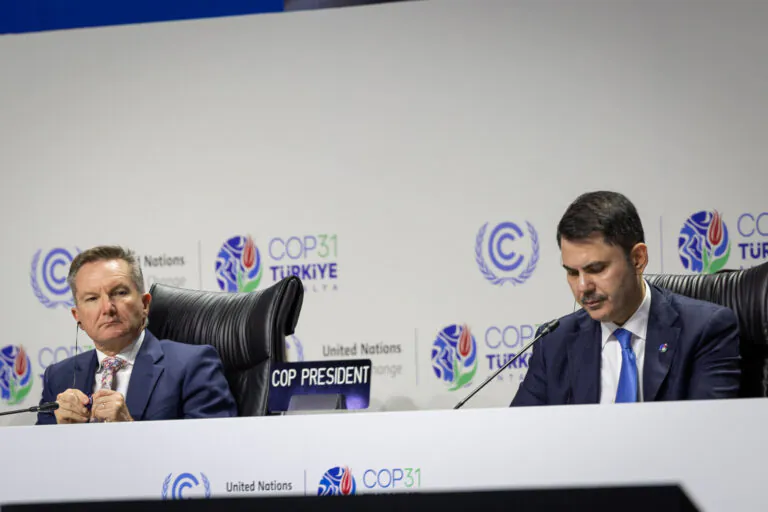
Kaysie Brown and Cosima Cassel write on the meaning of the outcome, what happens next for climate diplomacy, and why the ‘failure’ of this COP can lead to better things.
Antalya showed that the regime can still say no to a bad deal. The harder test is whether governments can say yes to the changes that make good deals possible again. That work starts now, not in the weeks before Addis Ababa.
‘Implementation COP’ ends without overall consensus as real economy action races ahead
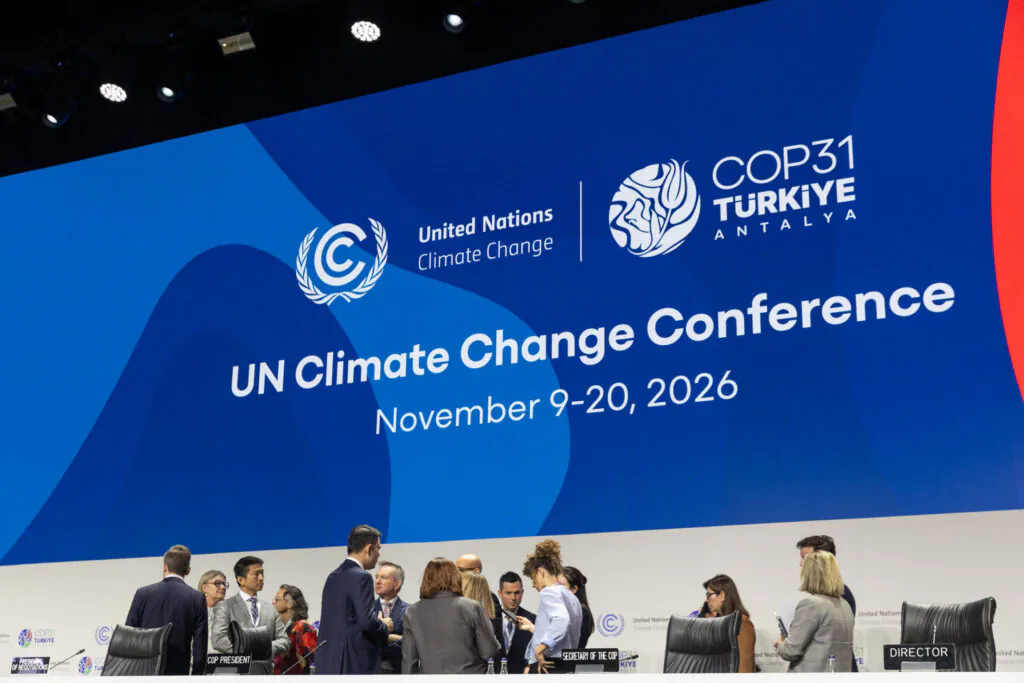
Hard-fought negotiations in Antalya ended without reaching consensus on an overarching outcome and only procedural progress on some negotiation items. Against a backdrop of worsening climate impacts, geopolitical instability and a second fossil fuel-driven energy crisis in four years, COP31 failed to secure the necessary political and diplomatic leadership in the negotiations to accelerate implementation of the Paris Agreement and demonstrate the collective response needed in this era of overshoot.
COP goes into overtime
COP31 heads into overtime as negotiators wait for a new cover decision text later today following a suspended late-night closing plenary and intensive shuttle diplomacy.
While some less controversial agenda items were adopted and others pushed to the Bonn SBs or COP32 in 2027, the most contentious items remain under negotiation , including the Just Transition Mechanism, the Climate Finance Work Programme, Response Measures, and elements of the Global Goal on Adaptation. With a final call for inputs to the cover decision, the presidency team worked throughout the night on the third draft which should be released today with other texts, to be followed by the second part of the closing plenary.
Finance and just transition are still to be agreed, but latest texts are effectively kicking the can down the road, with key decisions mandated at COP30 in Belém to be decided here in Antalya being pushed to COP32 in Addis. This is fuelling frustration among vulnerable countries, particularly over the failure to resolve a baseline and define a trajectory for delivery on the pledge by developed countries to triple adaptation finance.
The real delivery story is outside the formal negotiations in the Action Agenda. Around 25 countries now have TAFF roadmaps underway or completed and more countries continue to back the roadmap process. Nearly 90 countries have joined the electrification pledge, and wider action on electrification delivery, clean industrialisation, cutting methane emissions, halting deforestation building resiliency to mounting climate impacts, and other issues picked up pace over the last two weeks.Many observers see these implementation signals as some of the most tangible outcomes of COP31.
Fault lines remain clear: the EU and several developing country groups argue the package is weak on mitigation and the transition away from fossil fuels, while the G77 says it falls short on finance.
Carbon dioxide removal, in particular carbon capture, usage and storage references remain contentious in the current cover text – CCUS is a false substitute for halting fossil fuel extraction . Without any reference to transitioning away from fossil fuels, the text is unbalanced. It should complement and not substitute for or delay deep emission reductions.
Watch for whether the final package maintains framing around overshoot and the 1.5C goal, references to the IPCC, strengthens language on electrification and whether governments can bridge remaining divides on finance before the gavel comes down.
Ethiopia shared its priorities
A positive signal for the road to COP32 came from Ethiopia in the plenary, referencing the best available science, the Action Agenda and implementation, and to a COP rooted in the real world where climate action takes place alongside economic development. Setting out three priorities – restore hope, renew trust, mobilise collective action, he stressed they would boost confidence in multilateral climate implementation and its delivery vision. He also referred to course correction and to a limited number of high impact presidency initiatives as part of their economic agenda.Also to Medemer, Ethiopia’s contemporary political philosophy of “synergy” or “coming together,” introduced by Prime Minister Abiy Ahmed as a modern governing framework to unite the country across ethnic and political divides.
Key energy questions - reactions to US-China-Russia oil deal, and CCUS
As we approach the endgame for COP31, key questions are being posed – what does the US-China-Russia oil deal mean, and is CCUS a credible solution?
In reaction to the US-China-Russia oil deal, Dr Matt Webb , Associate Director, Global Clean Power Diplomacy, E3G, said:
“The fuel deal between the U.S., China, and Russia is yet another symptom of the global crisis driven by our continued dependence on volatile fossil fuels.With U.S. refineries maxed out at 95% to 96% utilization, Washington is essentially asking Beijing to mobilize its estimated 4.8 to 5.1 million barrels per day of spare capacity to offset the Strait of Hormuz shock—a conflict that cut global supply by 16.1 million barrels per day at its peak and which the IEA’s World Energy Outlook 2026 calls the largest energy supply shock in history. One would question why China, as the world leader in clean energy technology, would want to take this approach – ather than doubling down on fragile, geopolitically vulnerable supply chains, COP31 must accelerate the transition to clean energy—the only lasting insulation against fossil fuel volatility.”
In reaction to the CCUS proposals in the draft cover text, Dr Matt Webb , Associate Director, Global Clean Power Diplomacy, E3G, said:
“Keeping 1.5°C within reach and minimizing temperature overshoot requires cutting global emissions rapidly from over 38 billion tonnes a year and it means getting our priorities right. Electrification will slash end-use emissions by 60 per cent in 2035, and wind and solar already avoid 65 times more CO₂ than CCUS can capture. By contrast, CCUS handles barely 0.1 per cent of emissions often to pump more oil out of the ground, while gas power with CCUS costs significantly more than solar. CCUS requires strict guardrails so that it is reserved only for unavoidable process emissions like cement. We must advance real dialogue on accelerating the transition away from fossil fuels because relying on carbon capture without phasing down fossil fuels is like trying to quit smoking without putting down the cigarettes.”
Final day of COP31: E3G press conference
E3G hosted a press conference at 14.00 (local time) in Yunus Emre press conference room and live streamed on the UNFCCC website.
Our experts have witnessed real momentum on the ground: countries are sharing plans to electrify their economies and move away from fossil fuels. However, the formal negotiations are a different story. Progress on adaptation, the just transition and finance is stuck. The latest draft decision falls short of what the science demands. It is strong on electrification, but it says nothing about transitioning away from fossil fuels and includes places disproportionate emphasis on carbon capture.
In the final hours, countries need to agree a deal that makes balanced progress on all of these issues. That means delivering on the promises made at last year’s COP in Belém, protecting strong language on science, and making space to keep talking about how to move away from fossil fuels. On finance, countries need to agree on action rather than more processes, so that investors and institutions have the confidence to act. A well-worded cover decision cannot hide failure in the negotiations.
Watch the recording of the press conference below.
Fossil fuels dropped as the second draft cover decision is cut by almost half
The second draft of the cover decision, released after a delay, has been cut by almost half, going from 144 to 79 paragraphs. Although this can be read as an attempt to make the text more focused, it has clearly taken a step back on some key elements.
The presidencies have deleted all references to fossil fuels, dropping transitioning away from fossil fuels (TAFF) and roadmaps from the text and putting the emphasis on carbon capture and storage. The text also leaves out mentions of the first global stocktake. The Turkish presidency’s 35 by 35 target survived the cut.
The text that is silent on TAFF risks sending the wrong signal.
Matt Webb, Associate Director, Global Clean Power Diplomacy said:
“The text is weak and unbalanced on the need to accelerate the transition away from fossil fuels through, including through the continuation of roadmap dialogues, combined with an unacceptable emphasis on the role of carbon capture and storage. This needs to be addressed in the final text to give a coherent and balanced outcome.”
Finance remains one of the most difficult areas of negotiation, especially around developed-country obligations and adaptation finance.
Still, some areas show improvement: adaptation asks are stronger than the starting point, with a process to agree a baseline and an implementation pathway for tripling adaptation finance by CMA9. Text on access to finance is quite specific and includes concrete asks. However, stronger accountability is still missing, with much of the onus placed on multilateral funds and MDBs.
The text also includes the new Antalya-to-Addis adaptation and resilience finance roadmap. This is progress, but it could delay implementation unless it includes clear milestones, timelines and accountability.
Heather McKay, Programme Lead, Finance and Resilience said:
“Antalya will only earn its name as the COP of implementation if there is agreement that climate finance needs to reach the people who need it most, on terms countries can afford. The Presidency-led Antalya-to-Addis roadmap is most likely what was left once Parties couldn’t agree on a negotiated mandate. However, committing to another roadmap, without clear milestones and timeframes, risks kicking the can down the road.”
Our experts encourage the presidencies to step up as COP31 reaches its endgame.
Alden Meyer, Senior Associate, Climate Diplomacy and Geopolitics said:
“The new text must be viewed in conjunction with progress (or the lack of it) on the formal negotiations here in Antalya, including on the operationalization of the Just Transition Belem to Antalya Mechanism, the Climate Finance Work Program, and the Global Goal on Adaptation. If the deep splits on these issues are not resolved, no cover decision will be able to cover up the lack of progress at this COP.
While it seeks agreement on a final cover decision, the COP31 Presidency must intensify its work with ministers to craft an ambitious and balanced package of decisions that shows the world that this process can deliver the action needed to address the escalating climate crisis. ”
Transitioning away from fossil fuels (TAFF) gains momentum
Over 20 TAFF roadmaps at COP31
18 November, Ireland launched its roadmap for transitioning away from fossil fuels (TAFF), following Denmark’s launch yesterday. Luxembourg, Spain and Portugal announced that they will present their own roadmaps soon. The Pacific Island countries will publish their regional roadmap before the 2nd International Conference on Transitioning Away from Fossil Fuels in Tuvalu in July 2027. Together, the ministers called on the COP31 Presidencies to carry the roadmap work forward in the COP outcomes and beyond.
France, Germany, Finland and the Netherlands have already published national roadmaps. Ahead of COP31, Brazil’s COP30 Presidency released a voluntary global roadmap for transitioning away from fossil fuels.
EU Commissioner Hoekstra said the EU also has a roadmap “by another name”: its 90% target for 2040.
Matt Webb, Associate Director, Global Clean Power Diplomacy said:
“Ireland joining a growing number of countries announcing national plans to transition away from fossil fuels shows increasing recognition of the economic and resilience benefits. Countries are giving a clear signal that roadmap dialogues must be taken forward by the COP31 presidencies and reflected in a COP31 outcome here in Antalya.”
The growing number of countries producing or announcing national roadmaps is a positive sign that TAFF momentum is building at COP. But turning this into a numbers game would be a mistake. What matters more is whether countries follow through, whether their roadmaps are comprehensive, ambitious and actually used, and whether they come from a wide range of countries, not just the EU.
Looking ahead to the second TAFF conference
Colombia and the Netherlands, hosts of the First International Conference on TAFF, have also formally handed over the process to Tuvalu and Ireland, who will co-host the second conference in Tuvalu in July 2026. Tuvalu has also announced its own national TAFF roadmap, alongside the regional roadmap being developed by the Blue Pacific.
Katrine Petersen, Programme Lead, Global Clean Power Diplomacy said:
“The handover of the Santa Marta Process shows that, whatever happens in COP negotiating texts, the transition away from fossil fuels is already a global agenda for prosperity and resilience.
By also announcing its own national roadmap, Tuvalu joins a growing list of governments that see the climate, economic and security risks of fossil fuel volatility, and the clear strategic benefits of proactively managing the move away from coal, oil and gas dependence.
Next year’s TAFF conference offers countries that want to get on with practical action a place to cooperate so they can reap the benefits of a just and orderly transition – rather than wait and risk further volatility and fossil fuel supply shocks. The COP31 Presidencies should take note for an outcome in Antalya – countries want continued dialogue international cooperation on the transition, not less.”
35 by 35 global electrification pledge: Continuing the dialogue
The EU has endorsed the COP31 Presidency’s pledge to increase electricity’s share of global final energy consumption to 35% by 2035. More than 70 countries support the pledge so far.
However, some parties are still concerned about including the specific 35% figure. Countries will need to set out more clearly what the electrification commitment will deliver, for example by improving energy access or driving investment in grids.
The announcements on fossil fuel roadmaps from Ireland, Denmark, Spain, Portugal and Luxembourg add further weight to the case for using clean electrification to speed up the transition away from fossil fuels. They send a clear signal that countries want to continue the dialogues that follow up on Brazil’s COP30 Roadmap, and that this should be reflected in the outcome of COP31.
At today’s press conference, EU Commissioner Hoekstra also said he had spoken with the Small Island Developing States (SIDS) and Least Developed Countries (LDCs) about the need for clean electrification. He acknowledged the need to build out more renewables and electrification, and stressed the benefits for national security and the economy as well as the climate. He pointed out that three quarters of countries worldwide are fossil fuel importers, which leaves them vulnerable to shocks from abroad, and said this dependence has to end.
Lidia Pereira MEP described clean tech and renewables as solutions for the present, not the future, and as the only way to build resilience to shocks.
Anton Jaekel, Policy Advisor, EU and German Climate Diplomacy and Foreign Policy, said:
“The EU’s endorsement of the pledge is another signal that countries are seeing the benefits of electrification aligned with a 1.5 °C pathway. It is in the EU’s own interest to advance a COP31 outcome that ties faster electrification of end use sectors to scaled-up deployment of clean power as a means to accelerate the transition away from fossil fuels. Securing a balanced and ambitious outcome at COP31 requires smart, strategic engagement from the EU with partners and the will to compromise, for example by advancing adaptation finance and resilience.”
Climate Weeks unite to accelerate global climate action between COPs
Organisers of nine Climate Weeks have issued a joint statement, setting out a shared commitment to accelerate implementation of the Paris Agreement. The Climate Weeks announce they will work more closely together, including by drawing on the six thematic axes of the Action Agenda agreed at COP30 as a common framework.
Climate Weeks have become vital platforms for real-world implementation, bringing together governments, businesses, civil society and communities to translate global climate priorities into action at national, regional and local levels. The participating climate weeks have agreed to share experience and best practice, communicate progress and outcomes, and broaden participation.
London Climate Action Week, which is hosted by E3G, is among the Climate Weeks supporting the statement.
Comprehensive first draft of text leaves work to be done to reach agreement
Parties held consultations on 16 November on the Presidency’s draft COP31 cover decision. The draft text is 144 paragraphs long, drawing on more than 45 submissions. Nearly every group described the draft as long, repetitive and in need of clearer structure, and that they were given too little time to review it.
A broad group – including the EU, UK, Norway, New Zealand, Canada, the Alliance of Small Island States (AOSIS), the Least Developed Countries (LDCs), the Independent Association of Latin America and the Caribbean (AILAC), and Brazil – backed a strong response to temperature overshoot and the goal of keeping 1.5 °C of warming within reach. Japan said the overshoot section could be an area of convergence. Vulnerable countries also pressed for delivery on tripling adaptation finance, with clear timelines and resources.
Cosima Cassel, Programme Lead, Climate Diplomacy & Geopolitics, said:
“The science is clear: we are in the era of overshoot with every increment of warming adding to the risks. The cover decision has strong language on the importance of science and calls on the IPCC to provide all three working group contributions to its reports to inform the second Global Stocktake, Nationally Determined Contributions, and climate finance.
It is critical, in the cover decision, that Parties defend full delivery and consideration of IPCC reports for the crucial years of decision to come.
The draft also proposes a new work programme on the science of 1.5 °C, which is less necessary. The IPCC is the right body to assess the best available science, including on overshoot. A parallel process risks politicising and fragmenting the shared science base for UNFCCC process.”
The Arab Group, the Like-Minded Group of Developing Countries (LMDCs) and Russia reiterated red lines from last week on no new mandates or work programmes, no new global targets such as electrification, no text singling out particular energy sources, and no references to external reports or the International Court of Justice (ICJ) advisory opinion. The Arab Group, LMDCs, Burkina Faso and India called for the draft to be rejected or restarted.
Several groups also raised unilateral trade measures and the relationship between the cover decision and negotiations running elsewhere. Points of order on process and decorum added tension to the session.
Oyku Senlen, Senior Researcher, Türkiye Strategy and Global Analysis said:
“It is great to see overshoot, clean electrification, transitioning away from fossil fuels, and paragraph 28 of the first Global Stocktake all referenced in the first draft. But it’s only the starting point. Turning it into a text that all Parties can agree on will be a challenge for the Presidency. Türkiye and Australia will need to work in sync, and countries need to hear one clear voice from the top.”
The state of play at the beginning of week 2
Week 1 closed with divisions still prominent and much work to be done to bridge the divides and land a credible COP31 Package. Challenges to the legitimacy of the Presidency strategies on the cover decision and the consultations on ways to improve the effectiveness of the UNFCCC were on full display in the late Saturday plenary.
Ministers now arrive at the start of week 2 to bring some greater political momentum to the negotiations.
Key flashpoints include: finance (including tripling of adaptation finance); science and addressing overshoot of 1.5 degrees of global warming; the role of electrification, transition away from fossil fuels and detailed language on clean energy; and whether there should be a cover decision at all. Several parties – including the Like-Minded Group of Developing Countries (LMDCs), Arab Group and Russia – continue to question the legitimacy of a cover decision, arguing it is not formally on the agenda. President of Negotiations Bowen has signalled that the text expected today should be seen as the start of negotiations rather than the final landing zone.
There are also sharp divides on many of the key negotiation issues, on the Climate Finance Work Program, the Just Transition Mechanism, the Mitigation Work Program, response measures, adaptation and other fronts.
Türkiye continues to push back on reports of limited appetite for its 35% by 2035 electrification pledge and to push for the goal to be included in the cover decision. Over 30 countries now support the pledge, with more expected.
The Presidency is under growing pressure to both clarify how the formal negotiations, cover decision, and Action Agenda initiatives on electrification and other issues fit together, and to resolve the deep splits on many key issues.
Oyku Senlen, Senior Researcher, Türkiye Strategy and Global Analysis said:
“Türkiye will really want to put electrification in the cover decision. If it doesn’t land it will be a disappointment for them. Separately, so far the Australian and Turkish Presidencies have been working in sync with no divergences. Bowen and [COP31 President-Designate] Kurum have some sort of bromance, but maybe when things get heated that will be tested this week. That will be one to watch.”
Finance a sticking point going into week 2
Seleha Lockwood, Programme Lead, Public Banks and Development, said:
“Connecting the negotiations and implementation will be critical. Negotiators need to find common ground on how to turn climate finance targets into affordable investment in resilience and clean energy where it is most needed. Shareholders of multilateral development banks need to ensure that banks work with finance ministries on whole-of-economy approaches and national development banks to support regional, country and subnational-led plans, scale finance, get finance out faster, and use grants, highly concessional finance and guarantees to lower borrowing costs and protect countries from climate shocks without deepening debt.”
Insights from Finance Day and what to look for
Negotiation rooms are gridlocked, which is not unusual as we reach the first Saturday. Going into week 2, Parties will need to show more flexibility, and the Presidency will need to provide strong leadership. The first two negotiation items have closed: adaptation communications, and the joint annual report of the WIM Executive committee on loss and damage and the Santiago Network. Real divides remain on the cover decision and adaptation finance.
Every COP comes back to money. Yesterday’s key message was that climate finance must flow faster, more affordably and without deepening debt vulnerabilities. At the same time, Moody’s 2027 Global Credit Outlook shows interest rates are biting. Likely increased spending on adaptation and resilience will put pressure on already constrained government spending.
Our take is that what is missing is a holistic view of finance in the negotiations, which are narrowly focused on targets and process. Adaptation finance is debated almost entirely through the tripling target, its baseline and where it should be discussed. How that finance is delivered is largely absent from negotiations, but has been captured in multiple events from the private sector and multilateral development banks.
More implementation language needs to appear in the negotiations. Right now the language in the text is detached from the strong implementation discussions in the pavilions, for example on affordability, cost of capital and difficulty of access.
Chiara Falduto, Programme Lead, Climate Finance and EU Investment Strategy, said:
“We need to see a strong outcome in finance in the cover decision that links to the reality that countries face: high borrowing costs, rising debt, shrinking fiscal space, and increasing weather events. The Climate Finance Work Programme gives a chance, if designed properly, for negotiators to have more discussions on implementation in the run-up to COP32.”
Next steps for the Baku to Belém Roadmap
The COP30 Presidency has released the Implementing the Baku to Belém Roadmap to 1.3T report, showing that mobilising $1.3 trillion in annual climate finance for developing countries by 2035 is within reach if governments, financial institutions and investors take the necessary measures. A discussion on Finance Day focused on the financial pathways and policy interventions needed to turn that global ambition into concrete reality.
Speaking at the Seventh biennial high-level ministerial dialogue on climate finance, UN Climate Change Executive Secretary Simon Stiell said the roadmap must help countries break free from a “downward loop of debt, disaster and devastating capital costs”.
The access challenge
Australia had planned to launch an Access to Finance Declaration and Action Plan, aimed at making climate finance faster, simpler and more accessible. However, a lack of countries coming forward to endorse the initiative – particularly Small Island Developing States (SIDS) and Least Developed Countries (LDCs) – meant it did not get off the ground. Instead, Australia announced an advisory Committee on Access to Finance to continue working on the issue. Committee members so far include Australia, Cabo Verde, Ireland, Nepal, Palau, Saint Lucia, Timor-Leste, and the UK.
Where is the money?
Meanwhile, COP31 has yet to see sufficient concrete pledges. Philanthropy announced $5m towards the Pacific Resilience facility, which is still far short of its $500m target. Notably, the first pledge to the next Green Climate Fund was $400,000 from the Solomon Islands, a SIDS itself, which speaks volumes about the lack of commitments so far from developed countries.
Australia has broken the established tradition of Presidencies from the Western European and Others Group (WEOG) of leading on climate finance and mobilising other wealthy countries to follow. Without a significant Australian pledge, the political leadership needed to unlock broader commitments from developed countries is missing.
Meanwhile, the Action Agenda is highlighting how climate finance is moving through vehicles such as country platforms, unlocking billions in climate finance. Export credit agencies with combined portfolios of $376 billion have committed to net zero.
Implementation joins with local action
Climate Week organisers – from Baku, Bangkok, Sydney, NYC, London, Mumbai, Rio and São Paulo Climate Weeks, alongside the UNFCCC Climate Weeks and High-Level Champions – joined together to discuss how to move climate action with global processes, maintain momentum between COPs, and broaden participation, particularly from the Global South, ahead of COP32 and the second Global Stocktake.
Information integrity
The Global Initiative on Information Integrity for Climate Change launched two instruments which seek to strengthen transparency in access to climate-related information at Antalya.
- Priorities for Action and Climate Information Integrity, which lays out actions to address the AI information gap. One is to ensure AI makes science clearer; the other is to address the environmental footprint of AI.
- Charter for Climate Information Integrity in Advertising, providing five areas for action, including safeguards against greenwashing, accountability, supply chain transparency, healthy incentives and human rights safeguards. It also lays out a clear message to AI companies to stop funding climate disinformation. This charter seeks to address three problems: the monetisation of disinformation and denial, the verification of advertising, and the lack of transparency in fossil fuel advertising.
Visibility for electrification continues at the Leaders' Summit, but consensus in other areas needed
The UK’s new electrification roadmap, Prime Minister Andy Burnham’s interventions, and support for Türkiye’s electrification pledge all reinforced the vital link between the transition away from fossil fuels (TAFF) and clean electrification.
UN Secretary-General António Guterres and Brazilian President Lula both made calls that the COP30 Presidency TAFF roadmap must be taken forward by the next Presidencies. However, most leaders speaking at COP were more quiet on the urgent need to transition away from fossil fuels.
Ethiopia, as the next COP Presidency, focused primarily on access to climate finance – a significant sticking point at this COP with Finance Day now under way.
Türkiye and Australia have proposed for COP31 to agree a comprehensive cover decision, in addition to the mandated decision on negotiations issues. The Presidency-driven approach has drawn criticism, however.
On the substance, differences persist over references to overshoot of 1.5 °C of global warming, and the role of the Action Agenda in the final package. Nevertheless, conversations are continuing across the Action Agenda on how countries are tackling the transition. Progress is also visible in the Just Transition and Mitigation work programmes.
Strong momentum behind clean electrification and transition away from fossil fuels on Day 2
Natasha Green, Programme Lead for Australia, said:
“Electrification, powered by renewables, is emerging as a central message at COP31: it is the route to energy security, affordability and access. With Palau, Ethiopia and Kenya backing Türkiye’s 35 by 35 pledge today, momentum is building. COP31 must now show that methane action, clean power and electrification, and the transition away from fossil fuels reinforce one another, and are all key to responding to 1.5 °C overshoot.”
Many credible clean energy and electrification projects struggle to reach investment readiness. Important initiatives on Energy Day included the launch of the Electrify Now Finance Coalition, which aims to unlock investment in clean electrification in developing countries. The coalition is backed by the COP31 Presidency and COP32 hosts Ethiopia.
Ethiopia also joined the UK and Brazil-led Global Clean Power Alliance (GCPA) Finance Mission, at an event where the mission announced support packages for clean power and electrification projects in several partner countries and regions.
Coalitions provide a bridge from ambition to action
Fulfilling the promise of an “Implementation COP” is not just about investment, but also about countries, businesses and others working in partnership. Other new coalitions announced on Energy Day include the Powering Past Coal Alliance’s (PPCA) Coal Transition Partnerships, and the Global Rooftop Solar Declaration initiative to double solar-powered households to 300 million by 2030.
Agile, cross-country collaborations can turn shared interests into faster clean power deployment, stronger energy security and more resilient economies – an important finding in our report Powering Across Divides.
Our Programme Lead Katrine Petersen touched on many of the above themes in conversation with TRT about what is needed to make the green transition happen. She also made the point that cooperation needs to extend to those countries whose economies are currently dependent on fossil fuel revenues. We analyse the likely dynamics of a declining oil market, and its implications for climate diplomacy, in our report Playing the Oil Endgame.
What to look out for from the Leaders' Summit
Kaysie Brown, Associate Director, Climate Diplomacy and Geopolitics, comments on what leaders must do at COP31:
“World leaders arrive in Antalya at COP31 at a critical inflection point for climate action, ambition, and delivery.
This climate summit, billed as an essential ‘implementation and delivery COP’ is also the first to take place since the science confirmed the growing risk of a significant 1.5 °C overshoot. Heads of state and world leaders must take these realities into the summit, showcasing solutions, commitments, and proposals that can be scaled, move quickly, and make an impact.
They must also speak directly to people, in demonstrating how climate action is also about health, prosperity, security, stability, and affordability.
That includes tackling the global energy crisis through efforts aimed at clean electrification, building the momentum needed in transitioning away from fossil fuels, and accelerating methane cuts. It must see adaptation and resilience as a central priority, through solutions aimed at delivering finance including to those most vulnerable, in elevating and integrating oceans, heat, and health, and strengthening early warning systems – all critical in this El Niño moment.
And it is in showing that financing can flow and move, particularly for developing and climate-vulnerable communities.
Leaders must show bravery and commit to both acknowledge the progress made because of Paris and the work that must be done to ensure statements are more than platitudes, but deliver.”
Follow E3G's insights and analysis from COP31
E3G will have a delegation in Antalya along with teams tracking and analysing from our offices around the world. Our delegation will be hosting and participating in events, in addition to inputting to and tracking a number of the negotiation workstreams and implementation initiatives across the wider COP programme. Follow us as we report on how the COP is measuring up against the three tests set out in this Briefing. See below for the full list of events and our spokespeople.
Subscribe to our newsletter | Follow us on Linkedin | Bookmark this page
Media should sign up to our WhatsApp updates | E3G press conferences will also be live streamed on the UNFCCC channel | Email press@e3g.org or phone +44 (0)7783 787 863
E3G's spokespeople and delegation at COP31
Available for comment from Antalya
Week One
- Kaysie Brown (EN), Associate Director, (multilateral climate diplomacy, geopolitics, US foreign policy) | e: kaysie.brown@e3g.org
- Cosima Cassel (EN, DE, ES), Programme Lead,(Multilateral venues, Climate Diplomacy and Geopolitics, UNFCCC and COP) m: +49 160 339 0883 | e: cosima.cassel@e3g.org
- Alden Meyer (EN), Senior Associate, (multilateral climate diplomacy, geopolitics, US federal & subnational policy) m: +1(202)-378-8619 | e: alden.meyer@e3g.org
- Anton Jaekel, Policy Advisor, (COP31 negotiations, EU at COP, climate security) m: +49 160 242 1044 e: anton.jaekel@e3g.org
- Katrine Petersen (EN, DA), Programme Lead, Global Clean Power Diplomacy, E3G, (global fossil fuel phaseout diplomacy, power sector transitions, multilateralism) m: +44 7961754452 | e: katrine.petersen@e3g.org
- Natasha Green (EN), Programme Lead for Australia, Engagement and Diplomacy. Australia (COP31, Australia-Türkiye partnership, global energy transition, Australia) | e: natasha.green@e3g.org
- Öykü Şenlen Gundogen (EN, TR), Senior Researcher (Türkiye strategy, global clean energy transition, Türkiye climate and energy policy) | m: +44 7444439202 e: oyku.senlen@e3g.org
- Gustavo Pinheiro (EN, PT, ES), E3G Senior Associate, (Brazil diplomacy, COP30/COP31, G20 dynamics, BRICS) +55 (61) 98338 8586 | gustavo.pinheiro@e3g.org
- Leo Roberts, Associate Director Energy Transition, (energy transition, energy geopolitics, TAFF, roadmaps Coal phase-out, power sector transitions)
m: +44 (0) 7908 664 334 | leo.roberts@e3g.org - Madhura Joshi, E3G Asia Lead, (Indian geopolitics and policy, energy transition) m: +91 9650783893 | madhura.joshi@e3g.org
- Seleha Lockwood, Programme Lead – Public Banks and Development (MDBs, Country platform approaches) m: +44 7927671887 | seleha.lockwood@e3g.org
- Chiara Falduto (EN, FR, IT) Programme Lead for Climate Finance and EU Investment Strategy. Brussels (bilateral climate finance, EU policy, NCQG, adaptation finance and access to finance)
Week Two
- Kaysie Brown (EN), Associate Director, (multilateral climate diplomacy, geopolitics, US foreign policy) | e: kaysie.brown@e3g.org
- Cosima Cassel (EN, DE, ES), Programme Lead, (Multilateral venues, Climate Diplomacy and Geopolitics, UNFCCC and COP) m: +49 160 339 0883 | e: cosima.cassel@e3g.org
- Alden Meyer (EN), Senior Associate, (multilateral climate diplomacy, geopolitics, US federal & subnational policy) m: +1(202)-378-8619 | e: alden.meyer@e3g.org
- Tefta Kelmendi (EN,FR), Programme Lead Foreign Policy and Climate Cooperation, (EU Foreign Policy, Geopolitics, Climate Security) tefta.kelmendi@e3g.org
- Gustavo Pinheiro (EN, PT, ES), Senior Associate, (Brazil diplomacy, COP30/COP31, G20 dynamics, BRICS) +55 (61) 98338 8586 | gustavo.pinheiro@e3g.org
- Anton Jaekel, Policy Advisor, (COP31 negotiations, EU at COP, climate security) m: +49 160 242 1044 e: anton.jaekel@e3g.org
- Öykü Şenlen Gundogen (EN, TR), Senior Researcher (Türkiye strategy, global clean energy transition, Türkiye climate and energy policy) | m: +44 7444439202 e: oyku.senlen@e3g.org
- Matt Webb (EN), Associate Director, Global Clean Power Diplomacy | matthew.webb@e3g.org
E3G experts can respond to your questions on topical questions of politics, energy transition, finance, trade, as well as on the geopolitical dynamics (Asia, Africa, Europe, India, Brazil, China, US, UK, Pacific and SIDS).
For further enquiries email press@e3g.org or phone +44 (0)7783 787 863
Leads representing the following E3G hosted Secretariats and coalitions will also be present:
• Powering Past Coal Alliance (Julia Skorupska (PPCA) julia.skorupska@poweringpastcoal.org)
• International Transition Plan Network (ITPN) (Jacques Morris jacques.morris@e3g.org)
• International Climate Councils Network (ICCN) (Ben Rhodes ben.rhodes@climatecouncils.org)
• Clean Energy Transition Partnership (CETP) (Charley Roberts charley.roberts@e3g.org)
• Global Clean Power Alliance-Finance Mission (GCPA-FM) (Ujunwa Ojemeni ujunwa.ojemeni@e3g.org).
As COP31 kicks off, E3G is calling for leaders to show how they will turn ambition into action.
The incentives for real progress on climate action are increasingly clear.
Clean energy, electrification and building resilience can help countries address major challenges, including economic and energy security, competitiveness and climate impacts. At the same time, the likelihood that global temperatures will exceed 1.5 °C of warming this decade makes it more urgent to act now. Yet in geopolitically fraught times, cooperation is becoming harder to achieve.
The challenge for COP31 is to turn shared interests into collective action, supporting delivery of solutions where they are most needed.
Our Briefing highlights three tests that can help to evaluate the success of this COP: Bridging Ambition and Action at COP31.
Find E3G at these events
The Next Phase of TAFF: From Roadmap to Implementation and Global Cooperation
With Istanbul Policy Centre, Climate Analytics, ECCO, IISD and E+ Energy Transition Institute.
18 Nov | 16:15-17:15 IST
Regional Climate Foundations Pavilion
Learn more

Building a Pathway to GST2: Official Side Event
Co-hosted with ECCO and LACLIMA.
19 Nov | 11:30-13:00 IST
Side event room 8
Clean Electrification for Development, Prosperity, and Energy Security – A People-Centric Approach
With International Solar Alliance.
19 Nov | 15:00-16:00 IST
International Solar Alliance Pavilion
Bottom-up approaches to fossil fuel phase-out in China, the United States, and Europe (side event)
With Peking University Institute of Energy, Climate Change and Energy Transition Program, and University of Maryland Center for Global Sustainability
9 Nov | 10:30-12:00 IST
America's All In Pavilion
Powering Progress: Mobilising Investment in Clean Electrification
Global Clean Power Alliance (GCPA) Finance Mission event collaborating with WB and GFI
10 Nov | 11:45-12:45 IST
UK Pavilion
Find out more
Why Asia is Scaling Clean Electricity Amid the Fossil Fuel Crisis
With Solutions for Our Climate (SFOC)
11 Nov | 11:45-12:15 IST
Asia Climate Solutions Pavilion
Register here

The Future of Grids: Accelerating Grid Infrastructure Investment and Demand Flexibility
Global Clean Power Alliance (GCPA) Finance Mission event.
11 Nov | 13:00-14:00 IST
UK Pavillion
Find out more
From Commitments to Implementation: Unblocking the Fossil-Fuel Transition Through Coordinated Action on ISDS
With the International Institute for Sustainable Development (IISD) and Centre for International Environmental Law (CIEL)
13 Nov | 09:00-10:00 IST
Global Futures Pavilion / Arizona State University
One Action Agenda, Year-Round: Climate Weeks Driving Implementation in 2027
With Climate High-Level Champions, Climate Group, Project Mumbai, OFuturo and the COP30 and COP31 Presidencies
13 Nov | 10:15-11:15 IST
Brazil Pavilion
Electrification and the “renewables tripling” in the Mediterranean: Trends, gaps and partnerships for delivery
Co-chaired with ECCO and Carboun Institute.
16 Nov | 10:00-11:00 IST
Mediterranean Pavilion
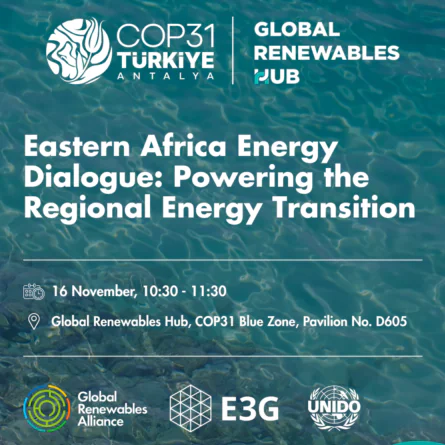
Eastern Africa Energy Dialogue: Powering the Regional Energy Transition
With Global Renewables Alliance and UNIDO.
16 Nov | 10:30-11:30 IST
Global Renewables Hub
Find out more
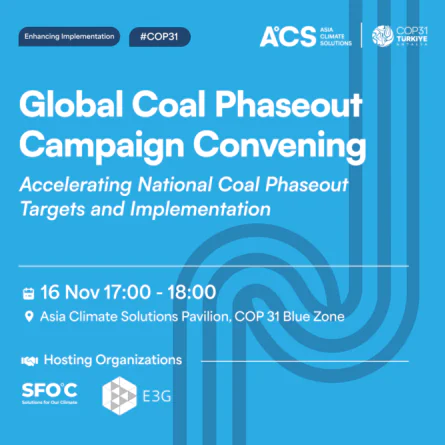
Global Coal Phase-Out Campaign Convening: Accelerating National Coal Phase-Out Targets and Implementation
With Solutions for Our Climate (SFOC).
16 Nov | 17:00-18:00 IST
Asia Climate Solutions Pavilion