

Oil demand is nearing a turning point, but governments are not prepared for the global impacts of declining revenues for producing countries. Energy markets are already being reshaped by changing demand, geopolitical conflict and supply disruptions. The major risks arise from the disorder in the transition, rather than the rate at which demand declines. The choices importers and financial institutions make now will shape how producers respond – and whether the oil endgame is orderly or destabilising.
- Peak oil demand is a risk to producer economies
- Producer vulnerability becomes importer insecurity
- Governments and other international actors can shape a more orderly oil endgame
- E3G’s Oil EndGame simulation
- Explore the key findings from the report
- Explore the report recommendations
Our report Playing the Oil Endgame analyses the dynamics that are likely to shape the oil endgame. We draw on insights gained through our Oil EndGame simulation, which allows participants to experience the trade-offs producers face and thereby suggests how different producers might respond to the pressure of declining demand. These insights are combined with several years of research into producer vulnerability, security risks and the geopolitics of declining demand.
One of the most important take-aways: how this unfolds is not predetermined. Both producers and consumers have choices to make, in the context of complex security, economic and diplomacy dynamics. Importers, financial institutions and climate diplomats need to construct a governance architecture to manage declining demand, to support less volatile and more equitable outcomes.
Peak oil demand is a risk to producer economies
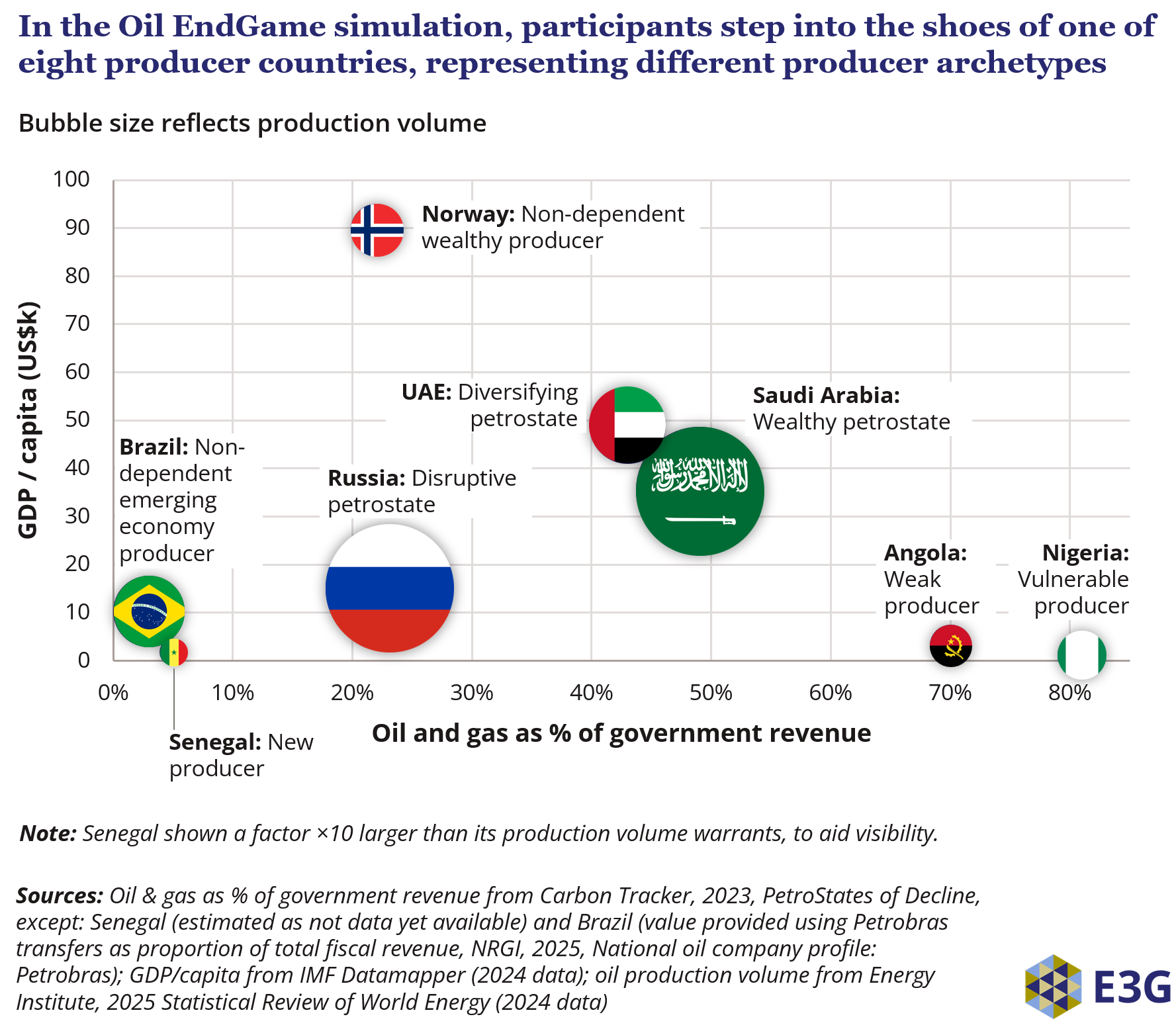
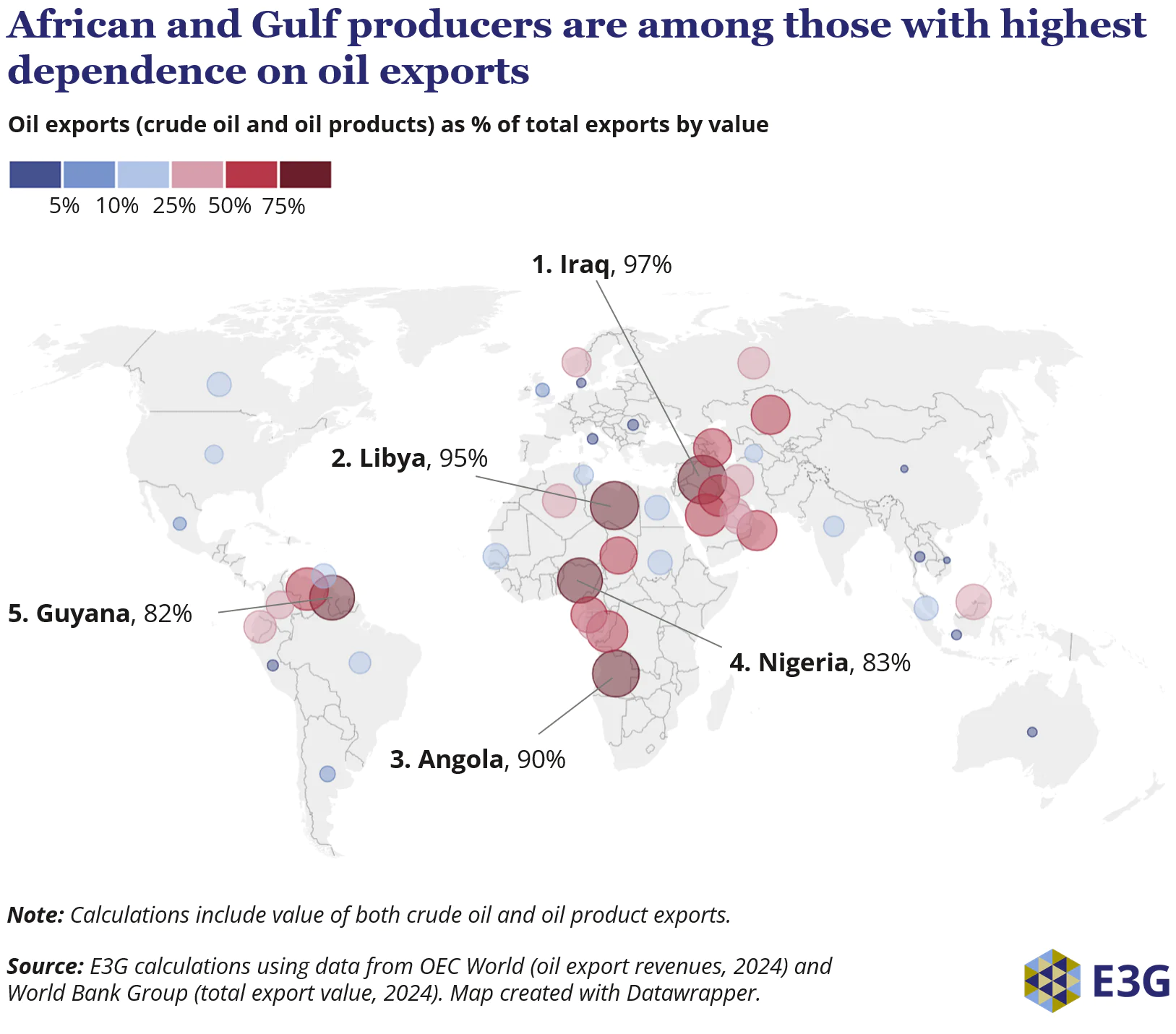
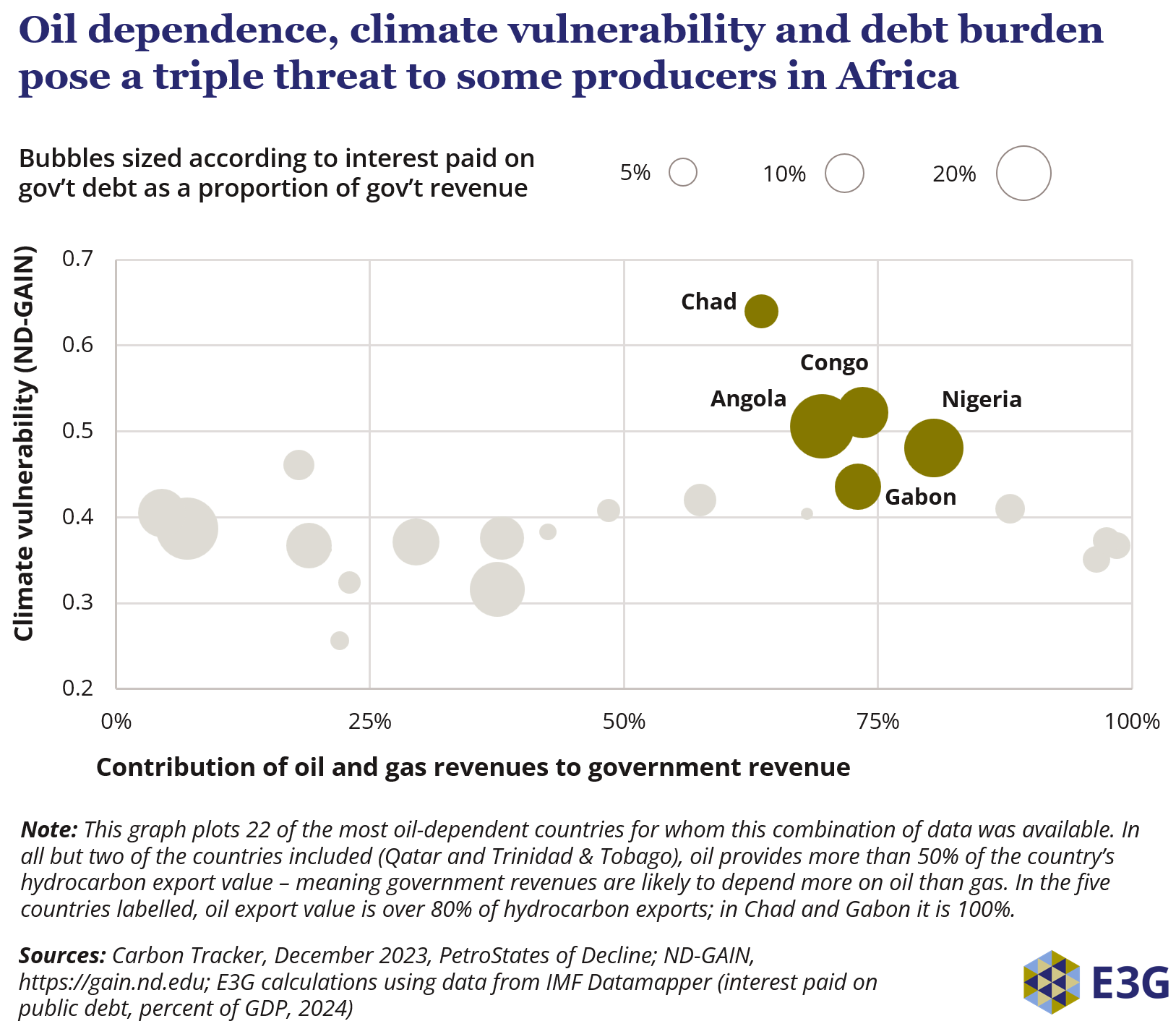
Oil and gas generate more than 40% of government revenue in 17 producer countries. These revenues pay for public salaries, subsidies, imports, debt service and political settlements.
These countries cannot count on these revenues for the long term. Global “peak oil” is expected between 2030 and 2035; indeed it happened over two decades ago in advanced economies. China, the largest source of global oil demand growth in recent decades, is also approaching a turning point.
Oil supply shocks, such as currently happening due to the disruption in the Strait of Hormuz, may bring the turning point forward. Importers are proving vulnerable to globally priced oil and chokepoint disruption. Several major oil importers, including China, are signalling that transition is their way to economic resilience.
Producer vulnerability becomes importer insecurity
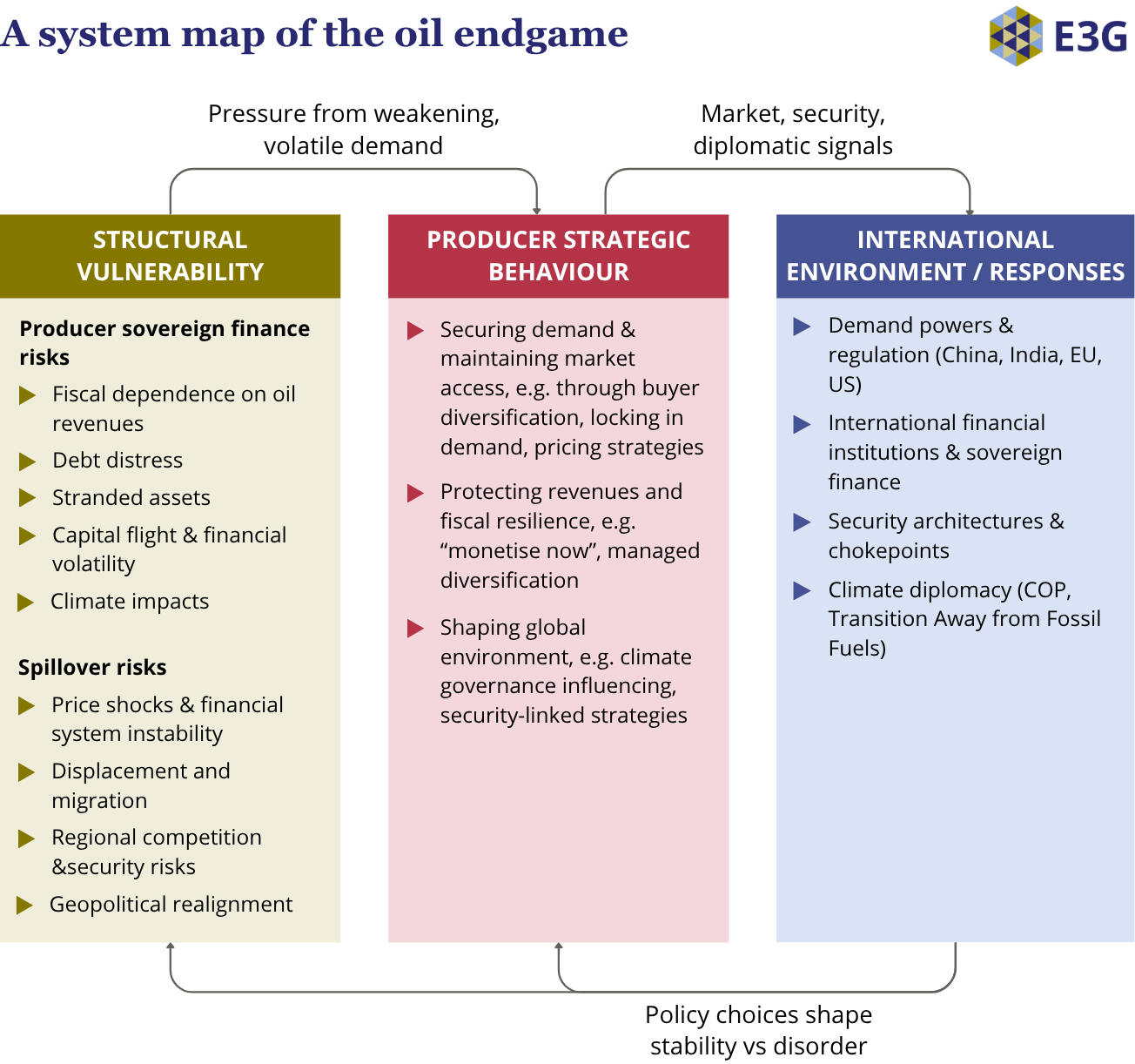
The oil endgame requires a shift in risk management, to address the likelihood of instability in the political economies built around oil revenues. Declining producer revenues can lead to unrest, debt distress and migration pressures.
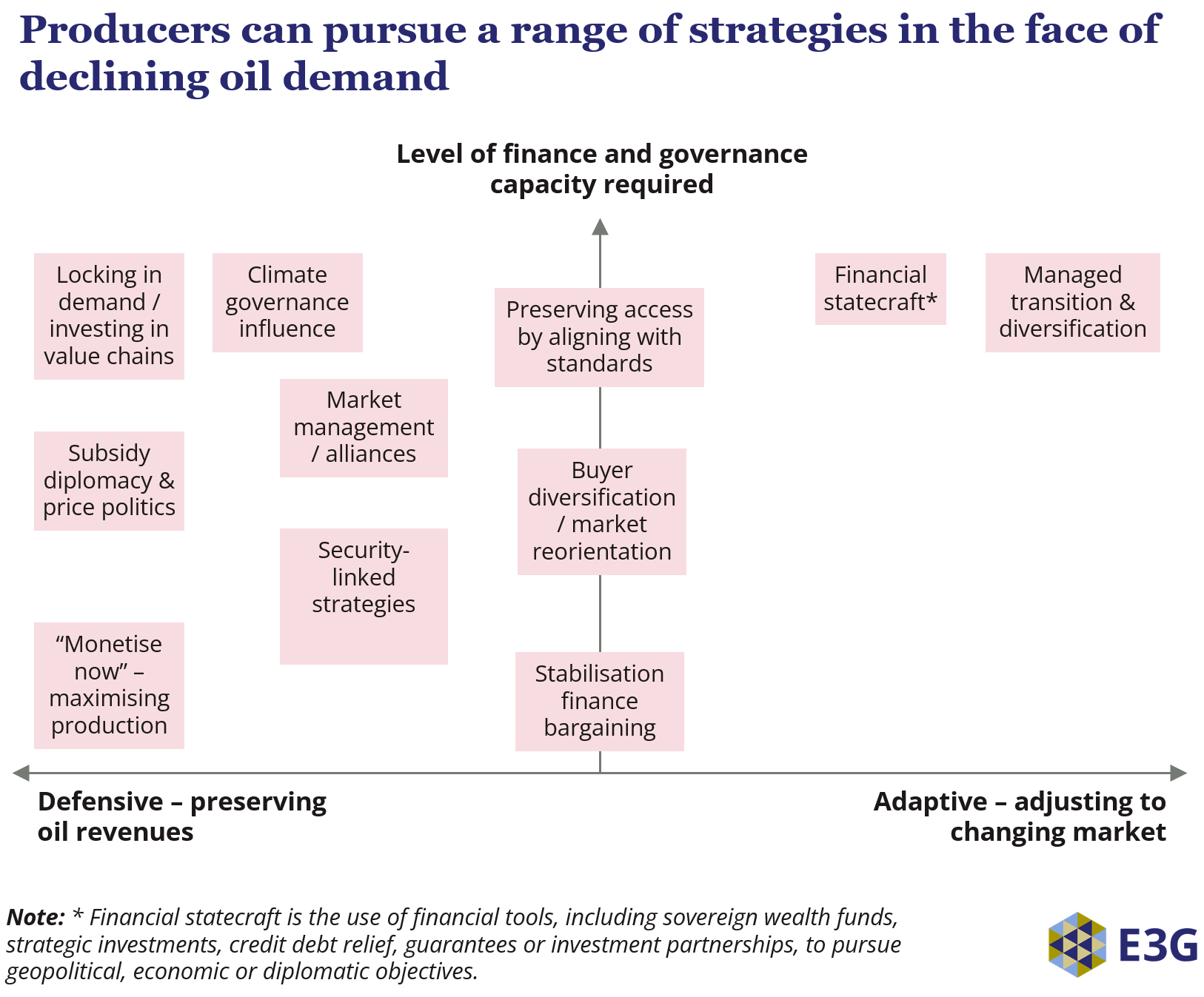
Moreover, producers will not simply accept lower income, and may not wish or be able to diversify independently. Many producers will therefore act strategically to try to protect their economies, including maximising short-term revenues, maintaining market access, or turning to more transactional geopolitical relationships. Meanwhile, demand powers will increasingly shape the terms of market access.
The result is a volatile mix that can easily lead to widespread macro-financial and security risks.
Governments and other international actors can shape a more orderly oil endgame
In the Oil EndGame simulations, producers consistently only pursued more cooperative and stabilising strategies where they had credible alternatives to doubling down on oil production.
Importers and other actors can therefore reduce the risk of disorder by creating such alternatives. This can be done, for example, through transition finance, diversification investment, and clearer demand signals.
A new architecture will be needed to manage oil decline. This must comprise coordinated action between producers, consumers and international financial institutions in three areas.
- More proactive diplomacy from major consuming economies toward producer countries, especially mid-tier producers. Diplomacy should move beyond setting emissions targets, to cooperation with producer economies to manage declining revenues. Recognising producer diversity, agency and incentives is key.
- Better integration of transition risks into macroeconomic policy. Governments and international financial institutions should use existing macro-financial tools more systematically to stabilise producer decline, especially through credible economic partnerships.
- A climate diplomacy framework that aligns the above efforts. Major importing economies should coordinate to send clear and credible signals about future demand, and manage crisis responses.
E3G’s Oil EndGame simulation
The Oil EndGame simulation puts decision makers through the dilemmas producer governments will actually face. They play the role of a government in one of eight different oil-producing countries, ranging from high-income Gulf exporters to more fiscally vulnerable and emerging producers.
Each run of the simulation takes place over four rounds set over the time period 2028–2040. For each run, one of three scenarios is chosen: a rapid transition, a messy transition, or a slower, more fragmented transition. These scenarios combine global energy market pathways based on IEA projections with geopolitical, financial, security and climate variables that shape the choices available to producer governments.
E3G has run the simulation with over 100 participants in total from governments, international institutions, academia and civil society.
The insights from the simulations have been tested with representatives from both producer and importer governments.
E3G is available to convene and facilitate tailored Oil EndGame simulation workshops with governments, international financial institutions and other partners, to explore producer strategies under different energy transition scenarios, stress-test international responses and identify implications for engagement and near-term policy choices.
Explore the key findings from the report
Download the full report for more detail about the key findings.
The spillover risks from producer fragility raise the prospect of an uncertain, volatile future for importers as well as producers.
Declining or less predictable demand can lead to fiscal stress in countries that depend on oil revenues. This can quickly spill over into weaker governance, eroded public services and domestic unrest, which can generate regional or even global spillovers.
Even in times of declining demand, producer instability can lead to perceived risks of disruption to supply, transport or investment. The world’s financial system remains exposed to successive energy price shocks.
Regional tensions due to displacement of people (as for example the migration crisis in Venezuela) or competition for declining rents may cause wider ripples. Overall, geopolitical relations are likely to become more transactional, reducing options for diplomacy.
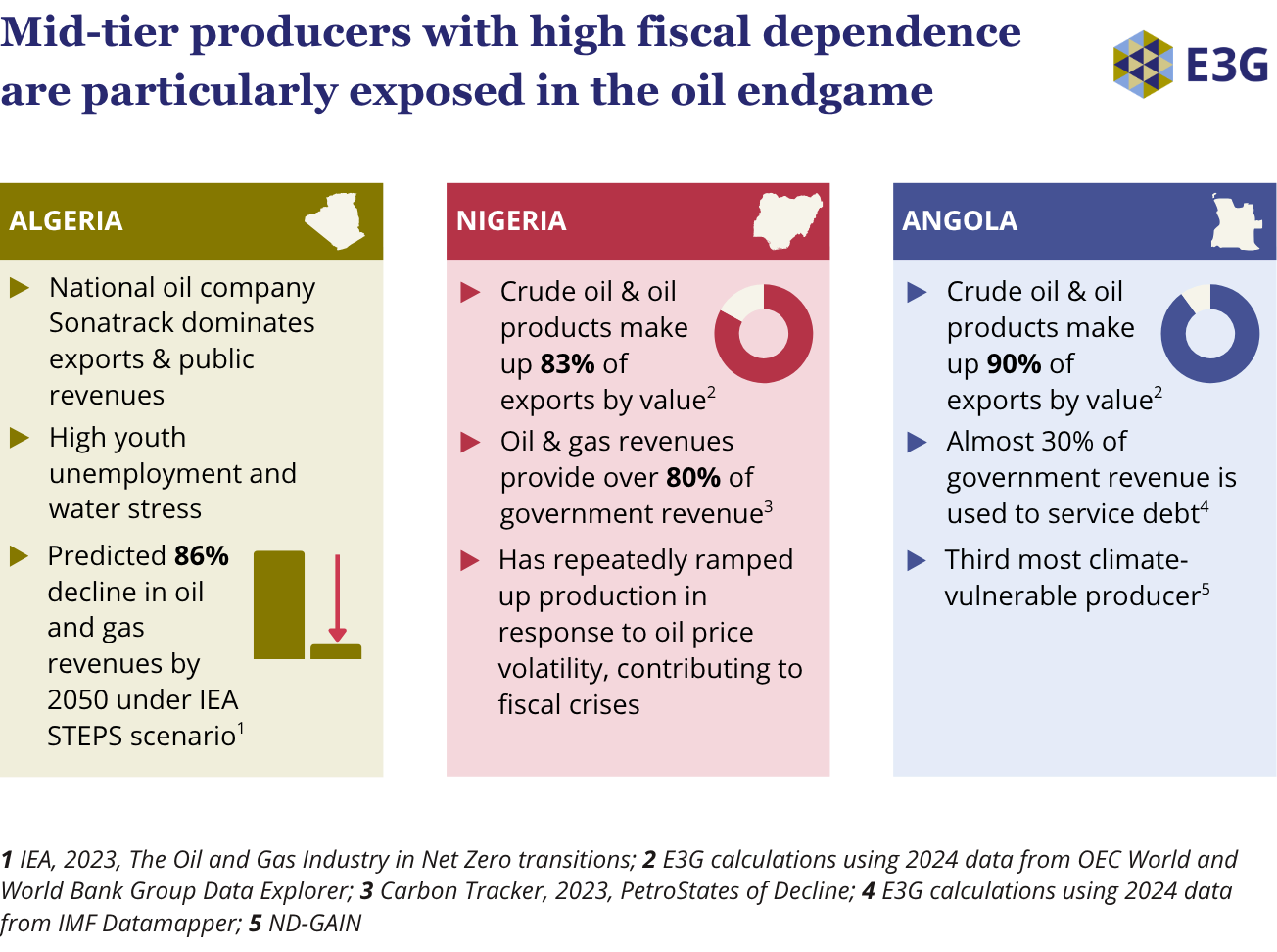
Many producers, including core suppliers of the EU such as Algeria, are in a “risk zone”. Instability in North Africa resulting from declining fossil fuel demand can become a European security concern.
The pressures of the oil endgame are likely to show up first on sovereign balance sheets, not in physical supply disruptions. Oil-dependent economies are exposed through their debt burdens, exchange rates, investor confidence and the fiscal role of national oil companies. This places macroeconomic stability at the centre of the transition.
Many oil-dependent economies face a “double exposure”: exposed to physical climate risk as well as transition risk. African producers such as Chad and the Republic of Congo are vulnerable in this regard.
Mid-tier producers with high fiscal dependence and weaker diversification options deserve particular attention. Nigeria, Angola and Algeria, for example, are systemically dependent on exports, and have relatively limited fiscal buffers.
The transition is a political contest over shrinking and less predictable revenues.
Producer countries still see continued upstream investment as a better option than diversification. Oil offers relatively large and immediate revenues, while the gains from diversification are longer-term, uncertain and politically hard to claim credit for. For recent market entrants, such as Guyana and Senegal, plateauing demand spells stranded expectations as much as stranded assets.
As demand declines, producers may seek with greater urgency to protect revenues. Strategies available include pricing strategies and subsidy reform, cleaner production, and more aggressive competition for shrinking market share. Gulf producers, for example, are increasingly investing in Asian refining and petrochemical capacity to lock in demand, while also diversifying into green investments.
Demand uncertainty is a more powerful driver toward monetisation even than shrinking demand. In the Oil Endgame simulations, demand uncertainty pushed producers to maximise output and make transactional deals – this being a safer political choice than launching costly reforms.
More cooperative behaviour only emerged in the simulations when more credible economic alternatives were on the table. Finance and market access were key, as were clear demand signals to reduce uncertainty.
In a contracting market, major importers increasingly shape the conditions under which oil remains marketable, financeable, insurable and politically acceptable.
Demand power will be distributed, with the major demand centres exercising different kinds of leverage.
- China will be key not just because of the scale of its demand. It exercises influence through its refining and petrochemical strategy, and its ability to anchor producer relationships through investment and long-term commercial ties.
- India is the largest potential future growth market. Its trajectory is uncertain, however, as electrification, efficiency and clean power deployment are speeding up.
- The EU is one of the largest importers today, though its projected demand is rapidly shrinking. It remains influential, however, through regulatory frameworks, standards, finance-linked market access and its role as a high-value import market.
- The US continues to shape the system through sanctions, financial governance, security guarantees and its dual role as a major producer and consumer.
Producers face not just a shrinking market, but a more selective and political one. Market access becomes a growing source of geopolitical leverage. This influence can be more stabilising if demand signals, standards and financial rules are aligned. By contrast, fragmented sanctions, regulatory approaches or security postures can deepen market segmentation and disorder.
Declining demand does not make oil security less important, but it does change its core function. Security architecture will increasingly determine which producers can access shrinking markets and how producer fragility is contained.
This shift is already visible:
- The US – still the principal hard-security actor – is becoming more engaged in enforcing sanctions, deterrence and strategic competition.
- China is becoming a more important commercial, financial and diplomatic actor, though not yet replacing the US security umbrella.
- Russia’s ability to keep sanctioned barrels moving is demonstrating how oil trade can fragment into parallel systems when insurance and shipping governance are contested.
The result is a more layered and fragile oil-security order. “Paper chokepoints” – insurance, shipping services, port entry and the like – become as important as physical chokepoints.
Where coordination holds, these tools can strengthen market governance. However, they can also push trade into more opaque channels, weakening enforcement as well as increasing the risk of accidents and environmental harm.
In a volatile oil endgame, these dynamics could add further disorder. Fragile and emerging producers may become more exposed to transactional security bargains.
Importer coordination therefore becomes a preventative security tool, not only a crisis-response mechanism.
Explore the report recommendations
Download the full report for more detailed recommendations.
Recommendations for importer governments / demand centres
Governments should deploy coordinated macro-financial support, trade and investment partnerships, regulatory tools and security cooperation to help producer economies manage declining revenues and promote regional and global stability.
Declining fossil fuel demand will reshape geopolitical stability, not just energy markets. Governments should treat the transition as a core foreign, development and security strategy, especially in regions heavily dependent on hydrocarbon revenues.
Wealthy, low-cost producers with significant financial buffers face different incentives and opportunities than middle-income or vulnerable producers with high fiscal dependence on fossil fuels. Mid-tier, fiscally exposed producers are a critical group: they retain significant export capacity and regional importance, but lack sovereign wealth, institutional resilience and diversification options. Targeted partnerships with these countries will be essential to reducing systemic instability.
Recommendations for international financial institutions and finance actors
Governments and international financial institutions should deploy existing resource-governance and macro-financial toolkits earlier and more systematically to transition risk – rather than inventing new instruments – before shocks crystallise as full-blown fiscal or debt crises. Supporting producer adjustment is not development assistance alone; it is preventative security policy.
This includes fiscal stabilisation frameworks, stronger non-oil revenue mobilisation, national oil company governance, subsidy reform, debt sustainability analysis, contingent credit lines, transition-linked finance instruments and support for economic diversification.
The overall priority should be credible economic partnerships that change underlying incentives, not diplomatic signalling alone. A near-term priority can be incorporating oil-price and revenue-volatility scenarios into IMF surveillance, debt sustainability analysis and fiscal-risk assessments, rather than testing only smooth long-term decline or low-price pathways.
Recommendations for climate diplomacy and coalitions
Clear and credible signals about future demand, combined with coordinated crisis responses, can reduce uncertainty and limit destabilising behaviour. International processes such as the Transition Away from Fossil Fuels (TAFF) roadmap agenda provide an opportunity to institutionalise such coordination and align expectations between producers and consumers.
Bring together both early movers, including through initiatives such as the Beyond Oil and Gas Alliance (BOGA) and the TAFF process, and countries facing structural challenges to support peer learning, share resources and enable cooperation across different transition timelines. These coalitions will be most effective if they recognise the diversity of national circumstances while maintaining a shared commitment to a managed and equitable transition.
Negotiations over phase-down timelines and transition finance will continue to be arenas of strategic bargaining, not purely normative agreement. Recognising producer agency clarifies that transition outcomes are contingent on political choices. The pace and stability of demand decline will depend on whether governments, both producers and importers, treat the transition as a cooperative endeavour or a zero-sum competition for remaining rents.

