The transition to efficient, clean energy systems depends not only on raising ambition through multilateral processes, but also on building agile alliances and coalitions to address shared implementation challenges and fast track delivery – be it at bilateral, regional or sectoral level.
Middle powers matter in a new global order
Powering Across Divides: Clean energy cooperation in a fragmented world provides a political economy analysis of how the global clean power transition is being shaped in an increasingly fragmented and multipolar geopolitical context. Through an assessment of clean energy transition across 16 strategic economies, the report identifies common patterns in how national priorities, geopolitical dynamics and barriers to implementation are influencing progress.
Moving beyond national-level analysis, the report explores pathways for countries to turn shared strategic interests and complementary strengths into practical cooperation and reduced dependence on fossil fuels. Our analysis explores key areas to turn strategic alignment into delivery: identifying opportunities for new alliances and coalitions to accelerate the transition while strengthening energy security, economic resilience and prosperity.
Common energy transition dynamics across diverse economies
This report takes a diverse group of 16 economies as its starting point. It examines these countries, where they are in their transition journey, and what opportunities present themselves for international collaboration.
The first ten countries – Australia, Germany, Indonesia, Japan, Nigeria, Poland, South Africa, South Korea, Türkiye and the United Kingdom – are a cross-section of middle powers that are strategically important.
Six further countries – Brazil, China, Ethiopia, India, Mexico and the Philippines – are incorporated through shorter strategic spotlight analyses to reflect their particular systemic, diplomatic or regional relevance to the wider transition.
Bringing fresh impetus to international cooperation
Countries working together on clean power can strengthen energy security, reduce exposure to global supply shocks, support industrial competitiveness and build more resilient economies.
Partnerships can also allow countries to use their different strengths more effectively: bringing together broader renewable energy potential, demand, finance and technology. Connecting these complementary assets can create a cooperation dividend in which countries can achieve more, faster and at lower cost than they could by acting alone.
This means building a broader ecosystem of practical collaboration alongside the multilateral processes that set global ambition. Cross-country partnerships and coalitions can focus on the implementation challenges that are holding back the transition, from working on resilient supply chains and stronger grids to mobilising finance, developing technologies and integrating regional power systems.
Our analysis identifies four priorities for the next phase of the transition, for the international community as a whole and for countries acting jointly in smaller, more flexible groupings.
Recommendations
- Place the pursuit of clean energy security at the centre of international diplomacy.
- Support complementary pathways away from fossil fuels and towards electrification.
- Mobilise finance and investment through practical delivery partnerships.
- Use clean energy trade partnerships and regional infrastructure to diversify supply chains and accelerate investment.
Explore the country profiles
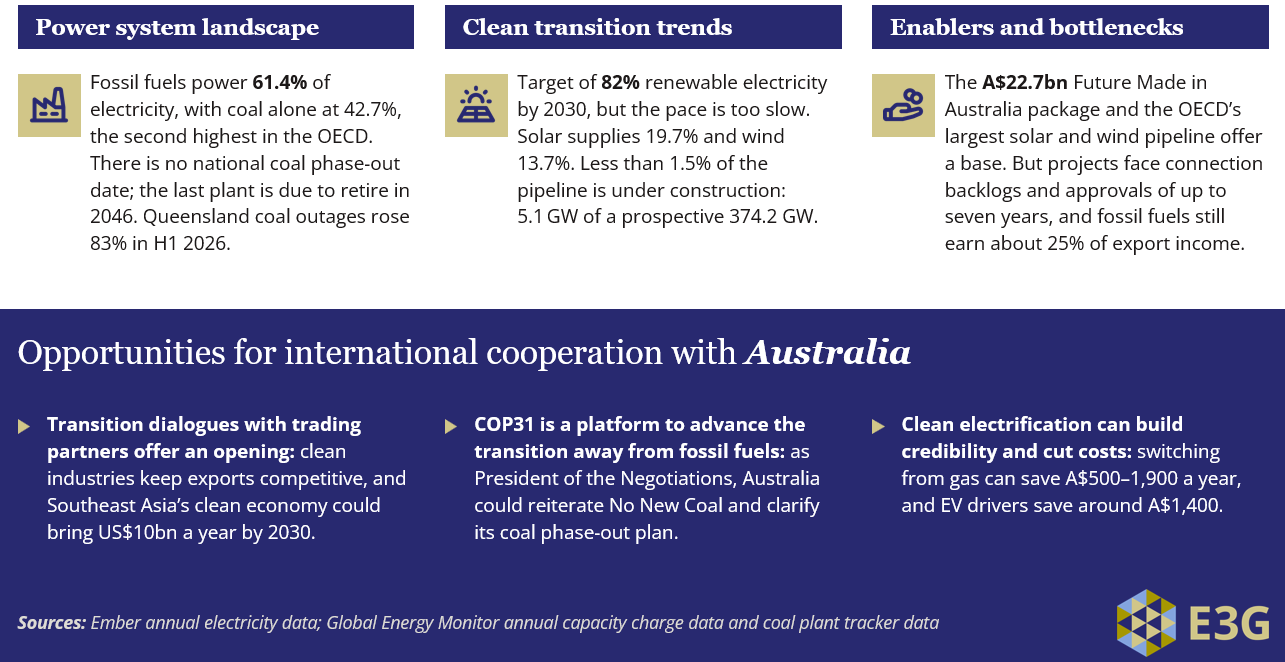
Australia is scaling renewables and critical minerals to pursue its clean energy superpower ambitions. Yet its dual identity as exporter of both fossil fuels and clean energy creates uncertainty as its transition is hampered by continued dependence on coal and LNG export revenue.
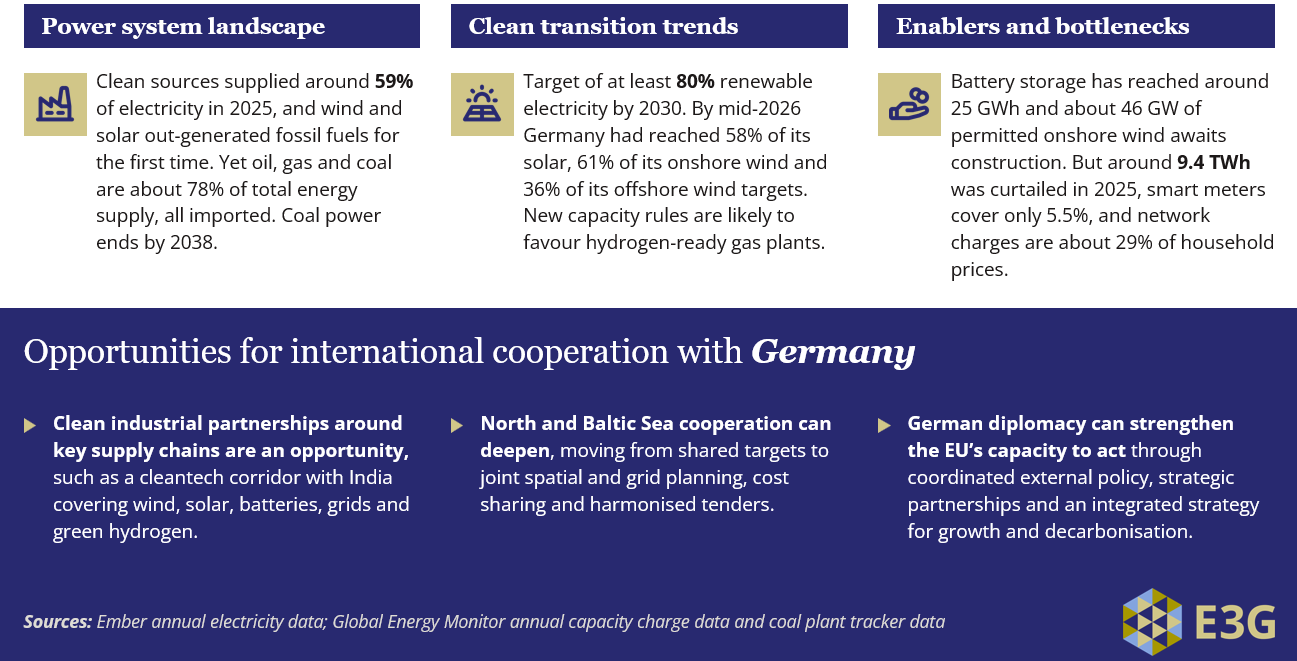
Germany has made strong progress toward a renewables-based power system. However, phasing out fossil fuels by 2045 will require further electricity system expansion, clean dispatchable power and flexibility. It will also require faster electrification of transport, buildings and industry.
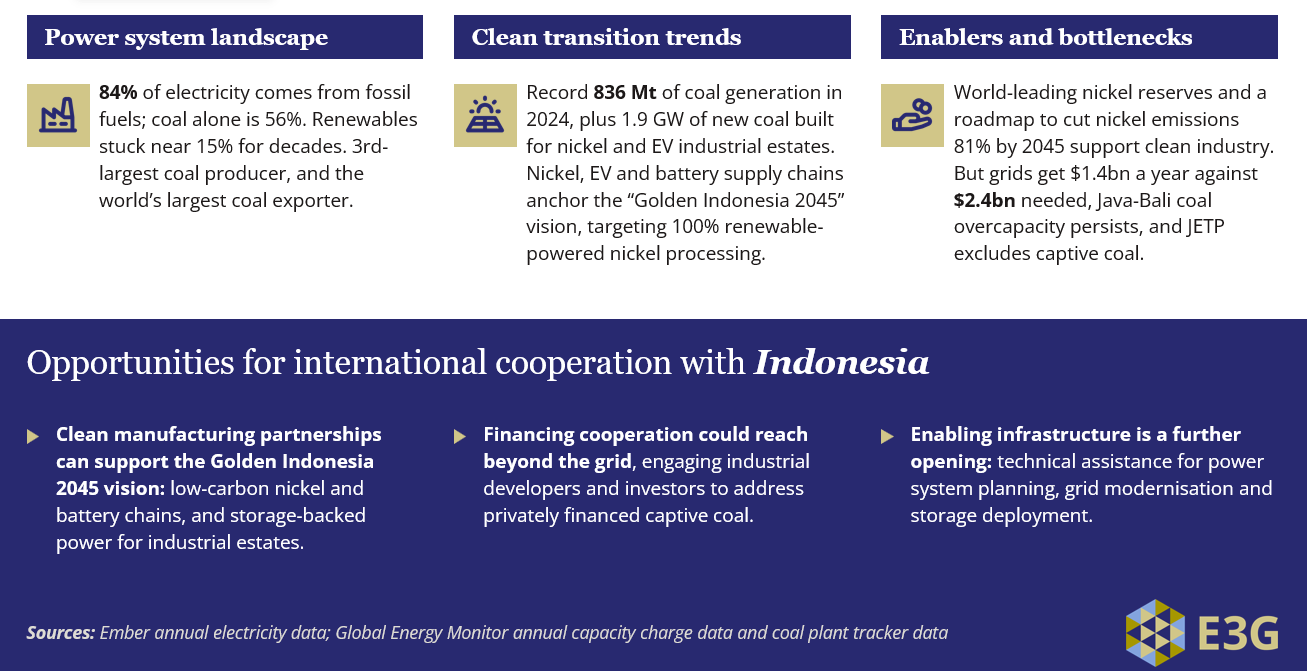
Indonesia is pursuing a development-led energy transition, scaling renewables and clean industries where they support industrialisation. However, coal remains central to electricity generation and the country’s cleantech economic transformation.
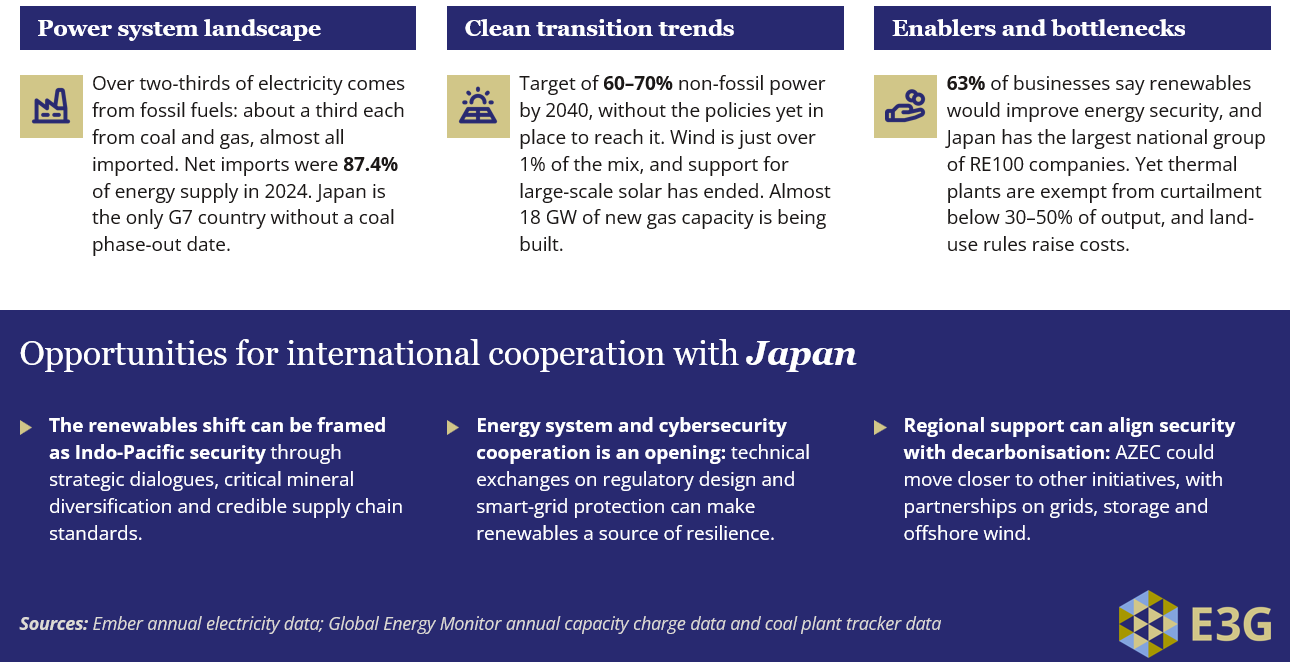
Japan’s transition is industry-led and security-driven, prioritising energy resilience and economic competitiveness over rapid decarbonisation. Fossil fuel-adjacent options receive strong policy support, while conventional renewables like wind and solar remain constrained by grid and regulatory barriers.
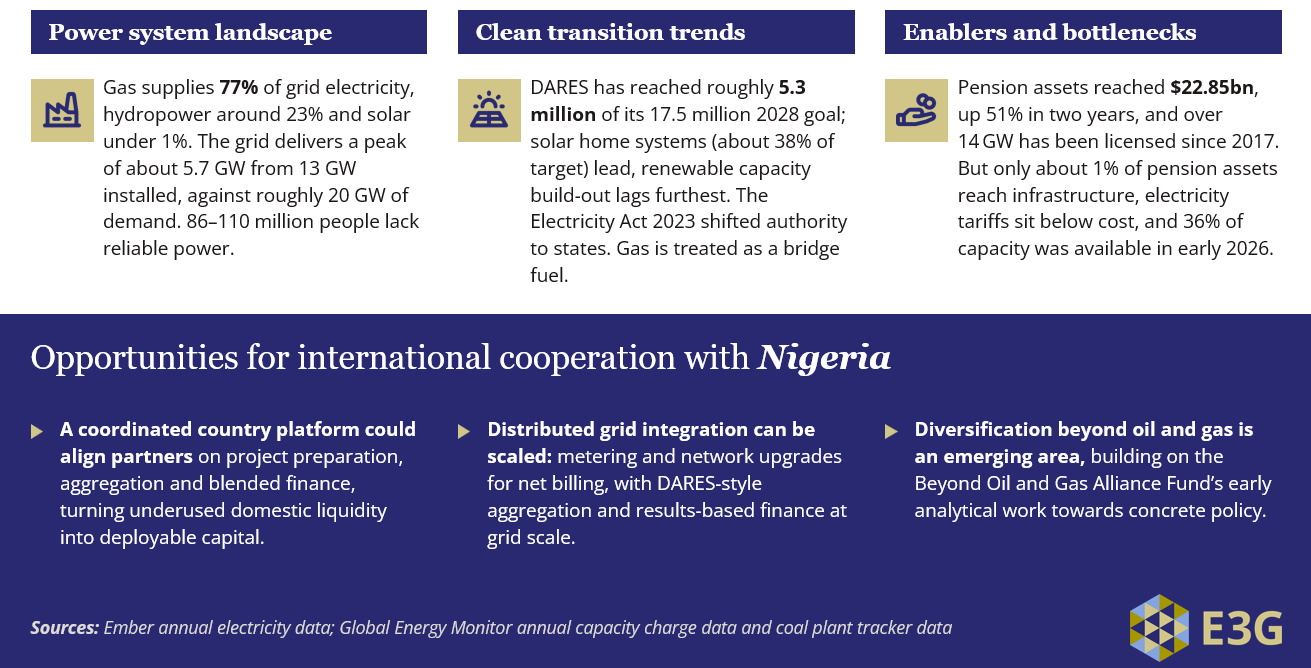
Nigeria’s transition is access-led and increasingly decentralised, with distributed renewables expanding around a fragile gas-dependent grid. Yet oil and gas remain central to economic security.
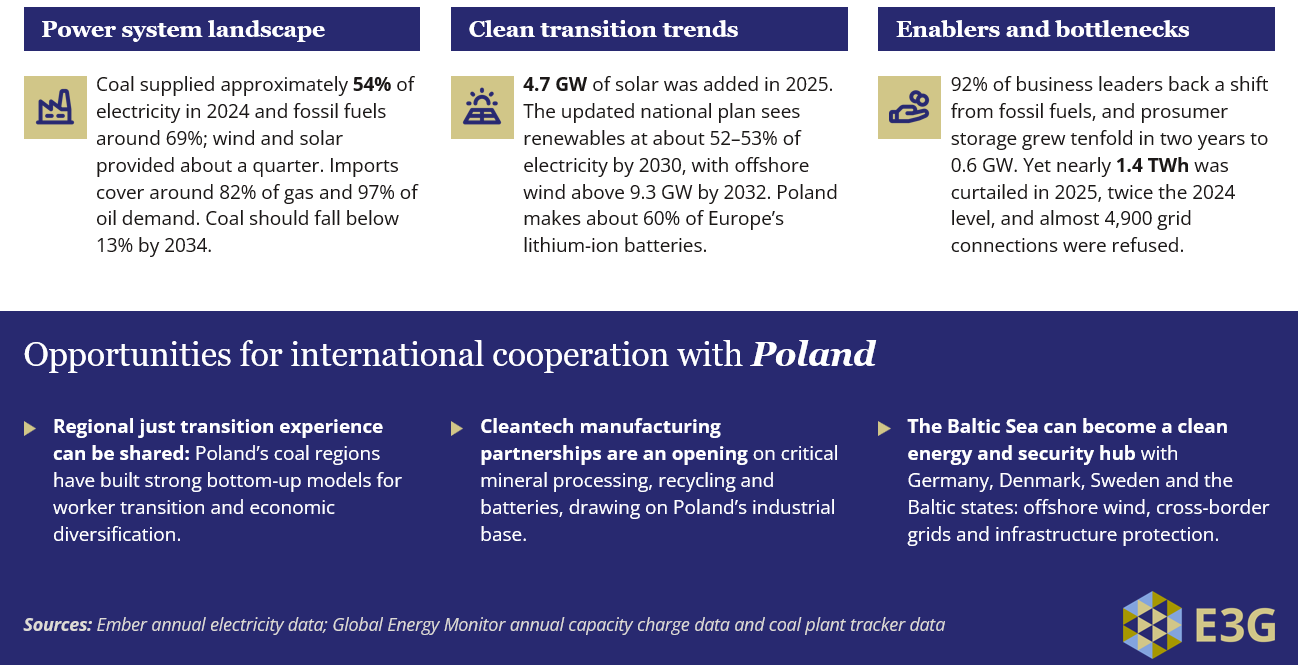
Poland is rapidly diversifying its power system. But its transition remains constrained by deep coal lock-in, energy security concerns, an ageing and inflexible grid, and major investment in gas infrastructure alongside its plans to scale renewables.
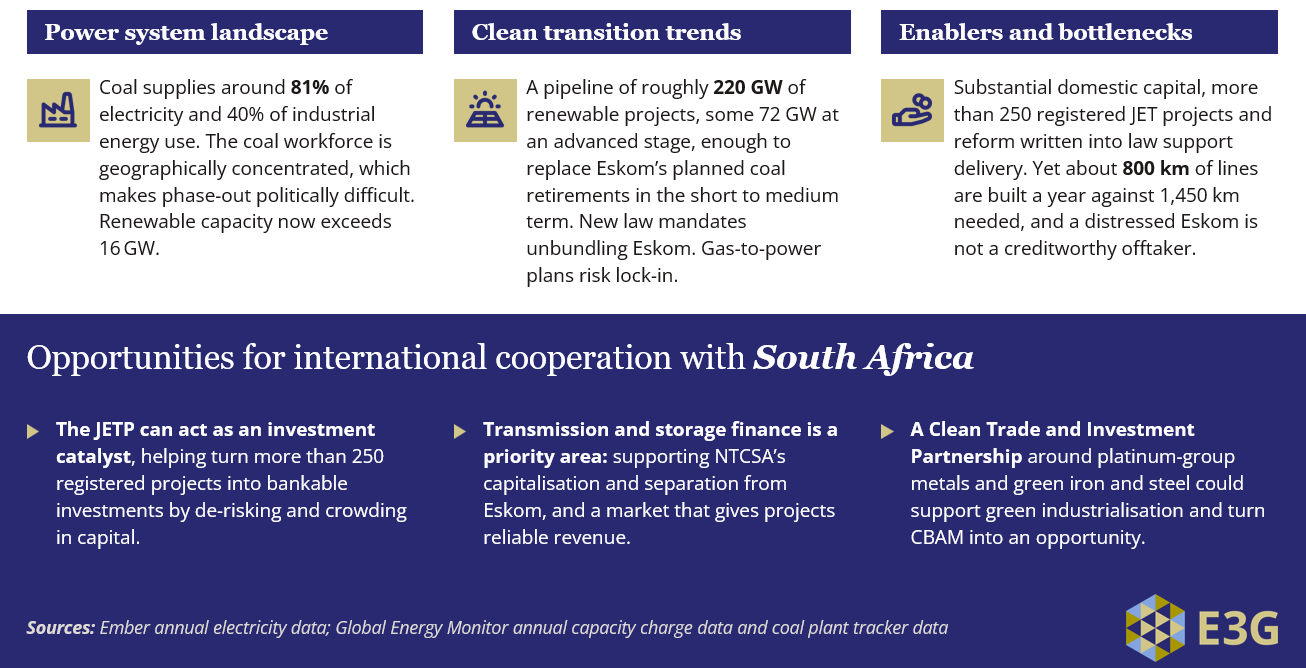
South Africa’s transition is progressing as energy insecurity and market reform are driving renewable deployment, while liberalisation is reshaping the balance between public and private participation in the power sector. However, coal remains entrenched, and expanding gas risks fossil lock-in.
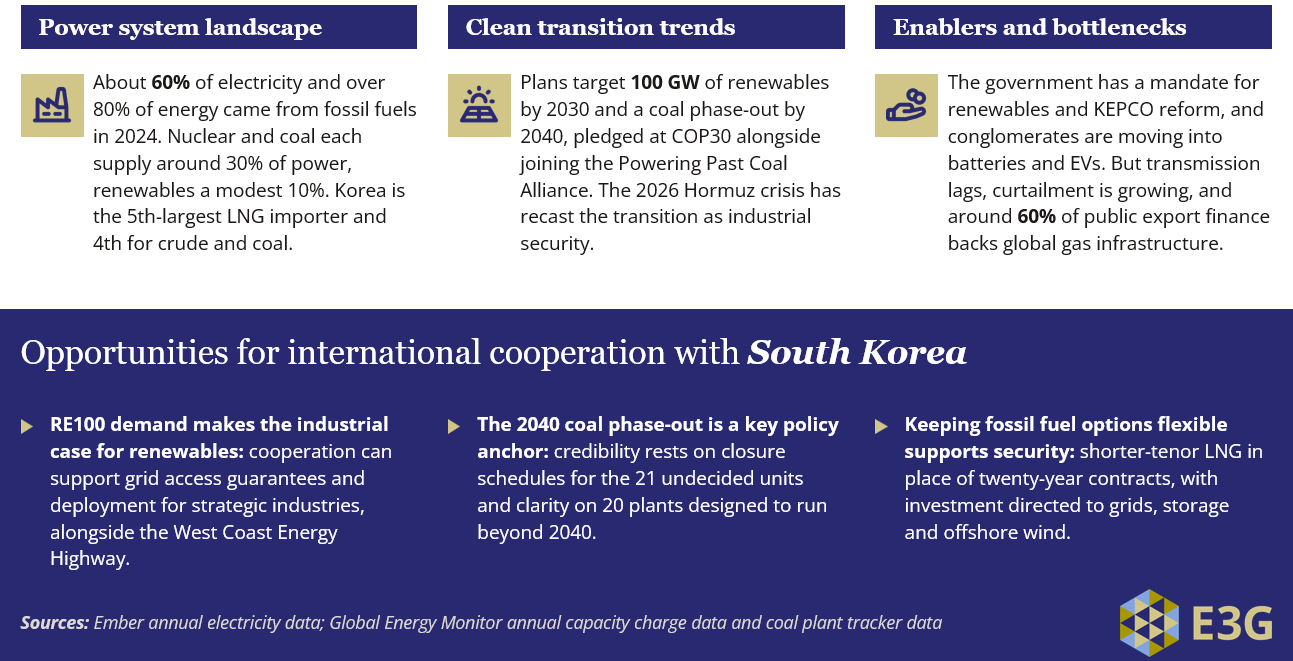
South Korea is advancing its energy transition with ambitious commitments, framing decarbonisation around industrial competitiveness and energy security. Yet structural dependencies on fossil fuels and energy-intensive industries necessitate a pragmatic, managed transition.
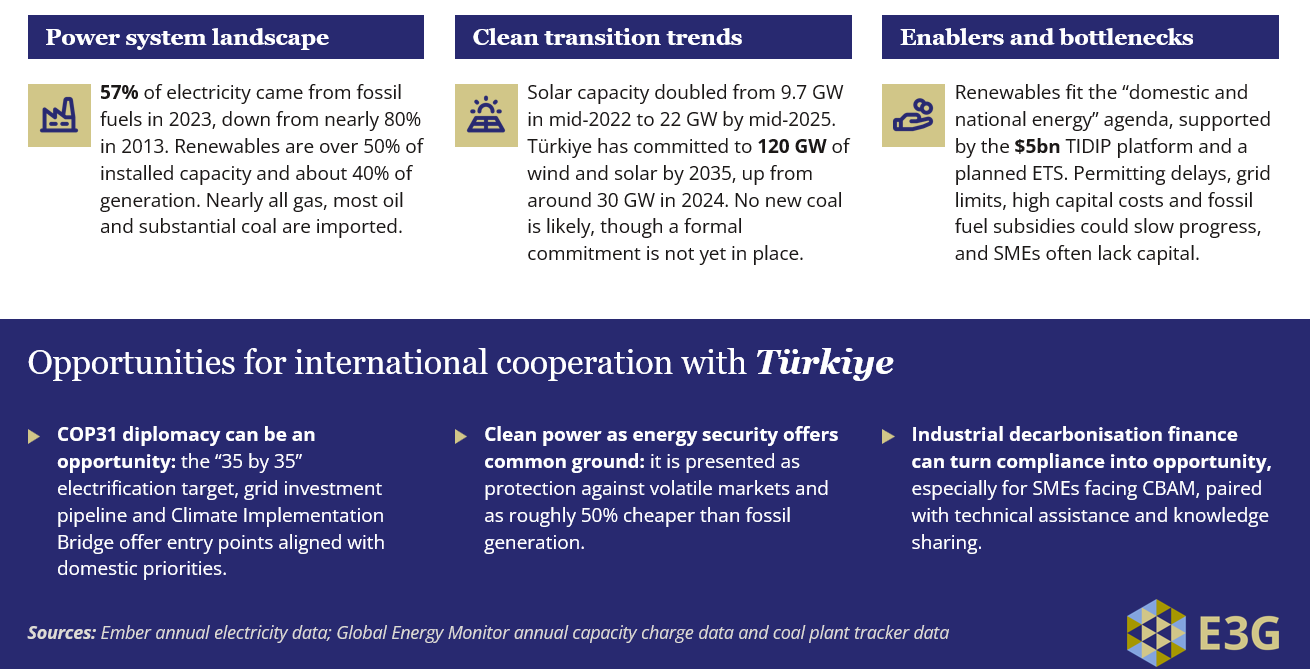
Türkiye’s transition has accelerated in line with its government’s priorities to strengthen energy security and advance towards a 2053 net zero target. However, progress has been uneven, as renewable energy expands alongside continued reliance on fossil fuels.
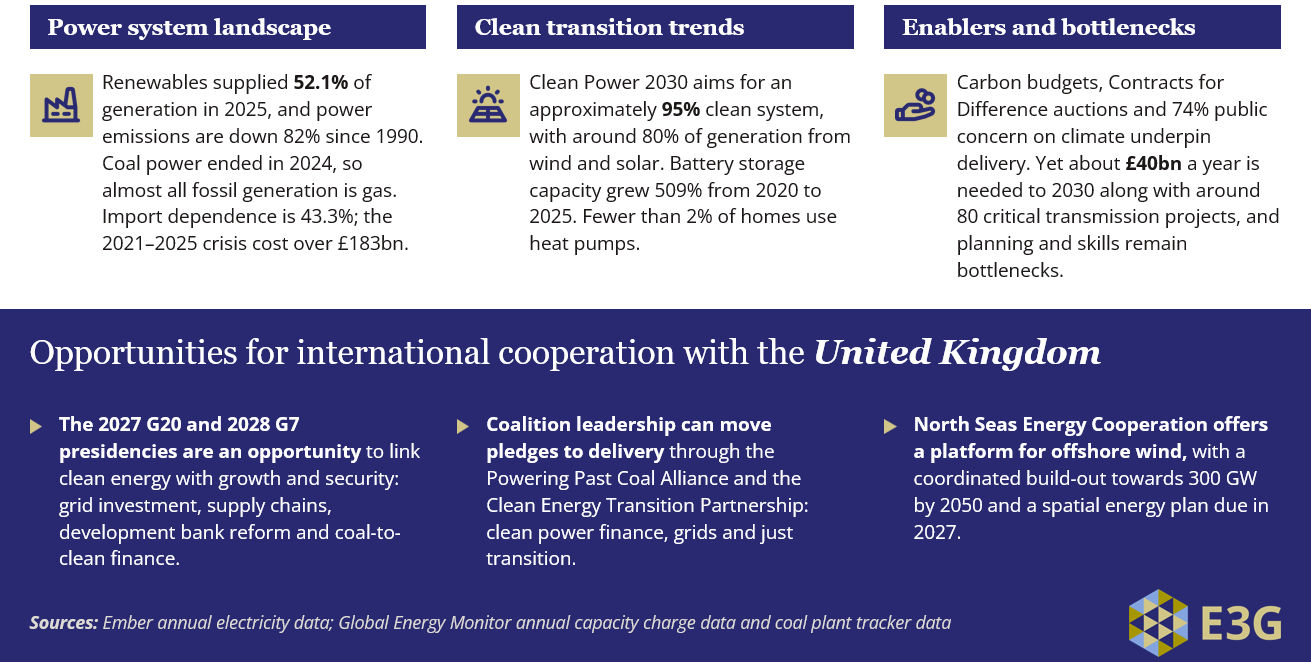
The UK’s transition has strong momentum from exiting coal and significantly expanding renewables, grids and storage. However, it now faces the challenge of delivering a fully clean power system to break away from gas dependence.
Explore the country snapshots
Brazil has a largely clean power system and is expanding renewables and clean industry. Yet its transition remains shaped by fossil fuel interests, including continued oil expansion, and a development model that seeks to advance clean and fossil fuel development in parallel.
China is scaling renewables, electrification and cleantech manufacturing at enormous scale. However, coal remains embedded in energy security, and grid constraints, along with market dynamics, limit the extent to which renewable growth displaces fossil generation.
Ethiopia is building on an almost fully renewable, clean power system to link clean energy with development and regional integration. But low rates of electricity access, affordability pressures, hydropower dependence and widespread biomass use constrain delivery.
India is rapidly scaling renewables and clean manufacturing to meet soaring electricity demand.
Yet continued coal expansion and grid and storage constraints risk fossil lock-in as its power system grows.
Mexico is linking renewable expansion to energy sovereignty and nearshoring-led industrial development. But gas dependence, grid constraints and a centralised, state-led power model limit the pace of clean energy investment and integration.
The Philippines is seeing rapid solar growth as high power prices and imported-fuel exposure strengthen the case for renewables. However, entrenched coal contracts, fossil-favouring market structures and grid constraints continue to slow displacement of coal and gas.