
The conclusion of the EU–India Free Trade Agreement (FTA) marks a significant step in strengthening the strategic relationship between two of the world’s largest economies. However, the real test of long-term EU–India partnership will be whether the FTA can deliver deeper real-world cooperation. Clean technology sectors offer the strongest opportunity to combine the EU and India’s complementary strengths to drive innovation, mobilise investment and build resilient industrial partnerships that will deliver mutually beneficial outcomes.
The EU and India are increasingly important strategic partners in the transition to a global clean economy. The completion of the FTA is an important milestone, signalling a shared political commitment to deepening long-term economic cooperation.
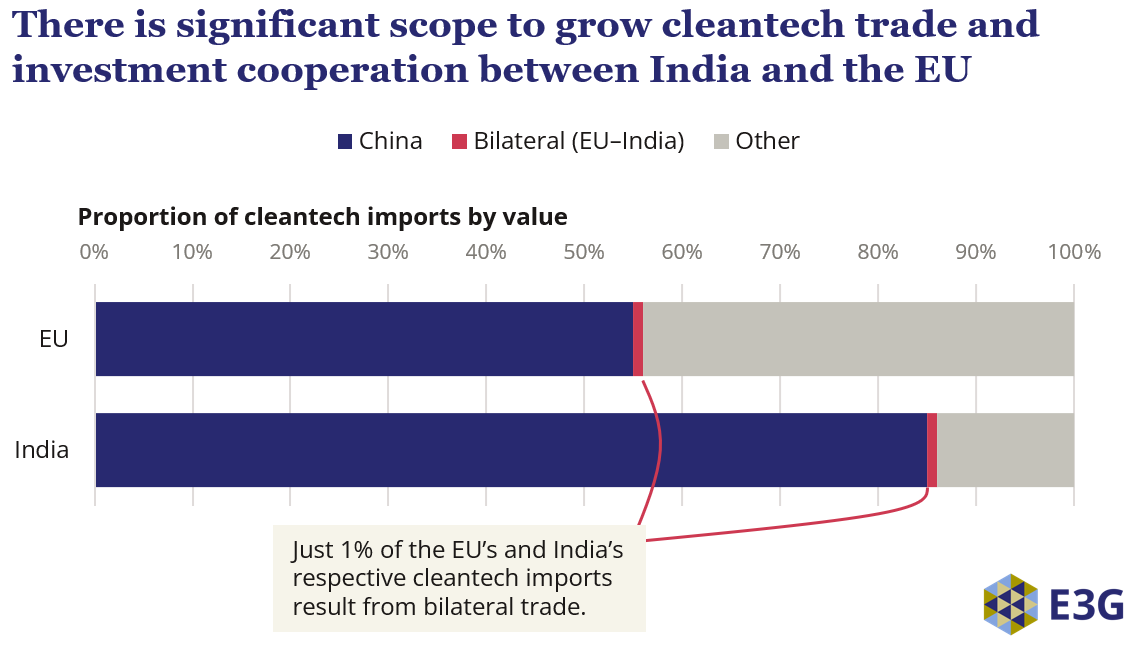
The EU and India currently rely on each other for just 1% of their respective clean technology imports (in value terms). There is therefore significant untapped potential to deepen trade and investment cooperation in the sector.
While the FTA improves market access and creates a more predictable investment environment for businesses, further action to scale up finance and integrate value chains will be needed to generate tangible benefits in the clean economy. In an increasingly competitive and volatile global context, the next stage of EU–India partnership must demonstrate the value of closer cooperation for driving innovation and mobilising investment.
Scaling EU–India clean technology cooperation: a phased approach
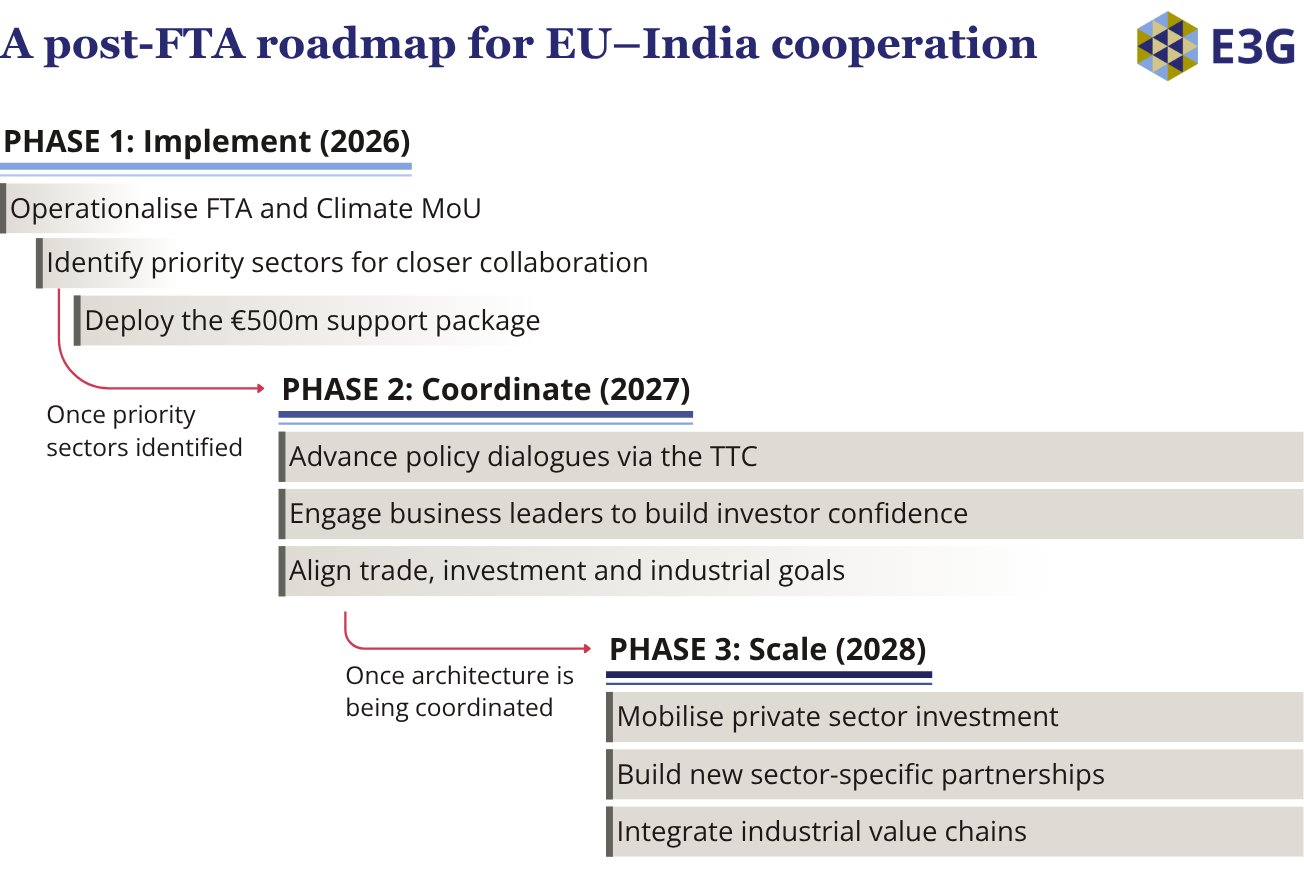
We recommend a three-phase approach: first, laying the foundations for deeper policy coordination and, over time, scaling up trade and investment in jointly identified priority clean technologies.
- Phase 1 – Implement: Prioritise efforts to operationalise the FTA and deliver the new platform for climate cooperation, announced alongside the FTA. This must include identifying priority sectors and deploying the €500m support package.
- Phase 2 – Coordinate: Before introducing new mechanisms, ensure that existing architecture provides a robust framework to align trade, investment and industrial goals. Policy dialogues can be advanced via the Trade and Technology Council (TTC), and increased private sector engagement will build investor confidence.
- Phase 3 – Scale: Additional instruments and institutional arrangements should be considered to mobilise private sector investment and integrate industrial value chains. This could include introducing new sector-specific trade partnership models and investment facilitation platforms to develop pipelines of bankable projects.
Read the full briefing for more detail about our proposed approach.
Beyond the FTA, the EU and India must continue to work together to address structural gaps that could constrain deeper integration. This includes collaboration on evolving industrial policy developments, such as the EU’s Industrial Accelerator Act, and addressing concerns from Indian stakeholders around the implementation of a Carbon Border Adjustment Mechanism by the EU. Given the EU and India’s shared ambitions to strengthen industrial resilience and diversify supply chains, there are strong incentives to deepen regulatory coordination, identify joint objectives and leverage complementary strengths.
Better alignment of EU–India cooperation architecture around the theme of a clean technology partnership would create a strong institutional foundation to drive investment, accelerate industrial projects and build resilient global supply chains.