
Gas power stations in Great Britain made approximately £4bn extra profit over 2021 and 2022, following the Russian invasion of Ukraine, as shown by new UCL analysis funded by E3G. This is due to the current energy market arrangements, which drive up bills for consumers by providing companies with unnecessary profits when gas prices surge on the international market. The excess profits came at a time when fuel poverty surged – rising 47% in England between 2020 and 2023. Therefore, E3G calls for the UK government to take the next step to a better market, by fixing gas power station earnings using contracts that offer fair, consistent returns.
Excess gas power station profits shown in new analysis from UCL
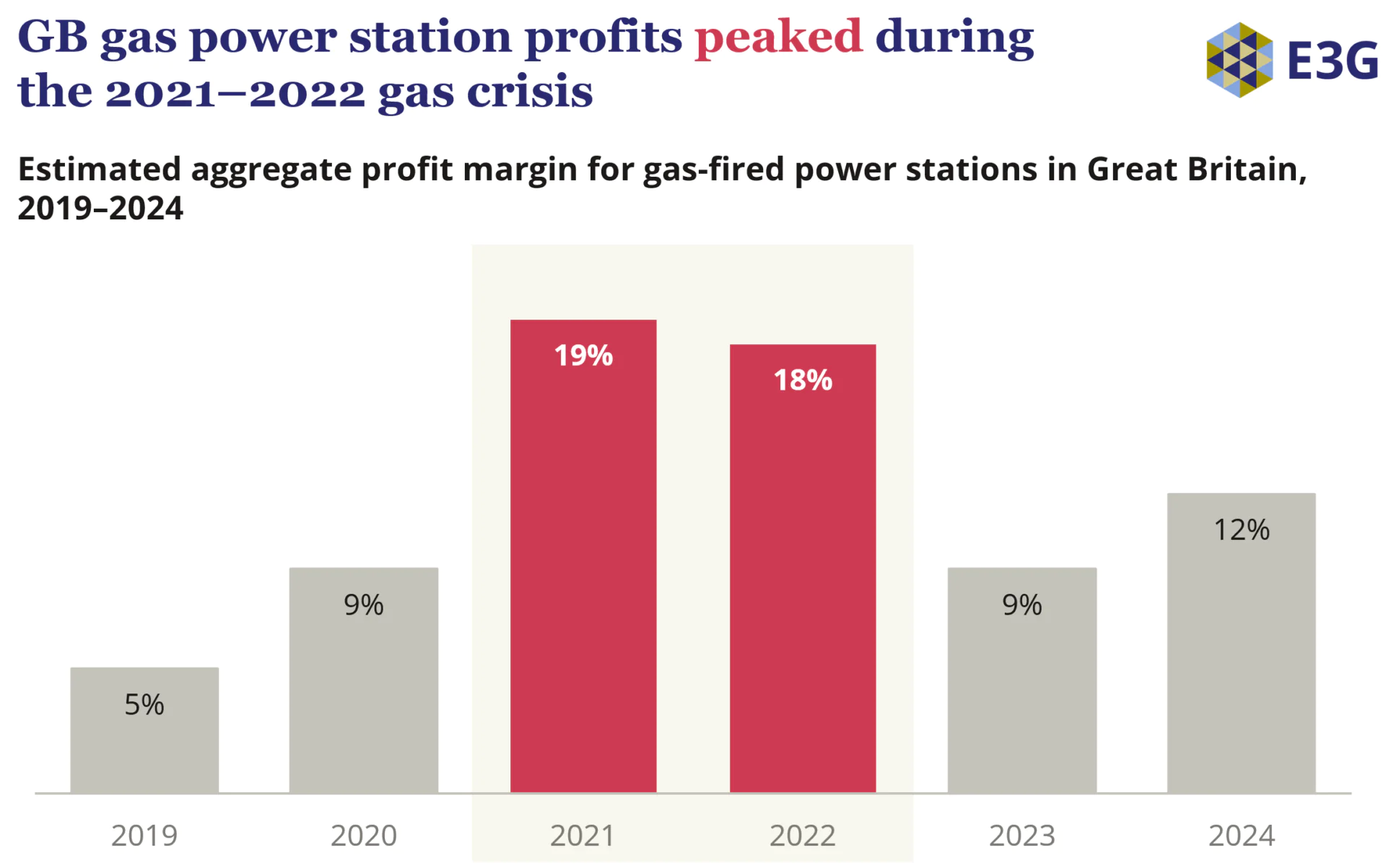
Researchers at University College London (UCL) Institute for Sustainable Resources found that gas power stations in Great Britain made £4bn profit over and above running costs and an 8.5% rate of return, over the period 2021–2022. Available profit benchmarks put the “normal” level of profits for gas-fired power generators at 7–10%, but at the peak of the crisis overall profits were twice that.
This was a significant finding in an assessment of annual profits of GB gas power stations over the period 2019–2024. The UCL study was supported by a grant from E3G and builds on earlier work by the same insitute.
The research found that the electricity market structure is the likely cause of the profits; there is no suggestion of malpractice on behalf of the power stations.
The excess profits will have come at the expense of households and businesses, in the form of higher than necessary bills. they increased electricity bills for households by around £49 per household in 2021 and £68 in 2022, over and above the increases caused by the higher cost of gas.
Profits were relatively low before the gas crisis (2019–2020), but increased substantially with margins approaching 20% in 2021 and 2022. Although profit margins have since declined, the level in 2024 was still higher than before the crisis.
E3G concludes: the electricity market is no longer working
In Great Britain’s electricity wholesale market, all generators earn the price set by the highest-cost generator. This was intended to provide profits to drive investment in new assets. However, in practice, investments now receive government support to make them viable, generally through contracts.
This means the consumer is paying twice: once for the government support, and once for market profits.
Moreover, the current arrangements are increasingly unhelpful for managing a renewables-based energy system that will require back-up power. Revenues for back-up power, including some gas power stations, are very uncertain under current arrangements. Paradoxically, this risks both under-investment if profits are very low, and consumers paying a premium when profits spike.
Fixing gas power station earnings using contracts is the first step to a new Consumer-First Power Market
A system based on fixed-price contracts would limit volatility for consumer bills and curb excess power station profits. This is a key element of a package of reforms we call the Consumer-First Power Market. The government would procure contracts for services provided by gas power stations using competitive auctions to get a good deal for consumers. Financing costs for power stations would also be lower as returns become consistent and low risk.
This is a well-established way to operate an electricity system, used by 89 countries globally. CommonWealth has found it could save £130–£270 per household on annual electricity bills in 2030.
Progressively moving generators onto contracts would ultimately make the wholesale market redundant, improving other problems with our current energy arrangements. For example, it would allow consumer energy suppliers to focus on providing high-quality customer service as their business would no longer be subject to the risk of buying power in the wholesale market. It would also help Britain build generators in the right place, as it would allow more coordination with network availability.
It is time for Great Britain to move away from incremental fixes and establish a new vision for the electricity market. We call for the government to take the next step by using contracts to fix gas power station earnings.