
UK homes’ reliance on gas represents an Achilles heel to the country’s national security. The energy shocks resulting from the Russian invasion of Ukraine and the disruptions in the Strait of Hormuz inflicted severe economic and social toll on the UK and its citizens. Moreover, the UK’s highly centralised import infrastructure is vulnerable to attack or sabotage, which could disrupt supply to millions of households. These risks compound in the UK’s energy inefficient housing stock, 85% of which relies on gas for heating.
In the face of complex contemporary threats and challenges, the UK must rethink what security means and how it can be resilient. The government must act urgently to mitigate this systemic threat through electrification and decentralising energy.
The UK’s “home front readiness” – the state of preparedness of its civilian population and domestic infrastructure to support, endure, and function – is a central pillar of national resilience. However, the UK housing stock’s dependence on gas is a significant, underestimated vulnerability. In our report, we conclude that it poses a severe and growing national security threat.
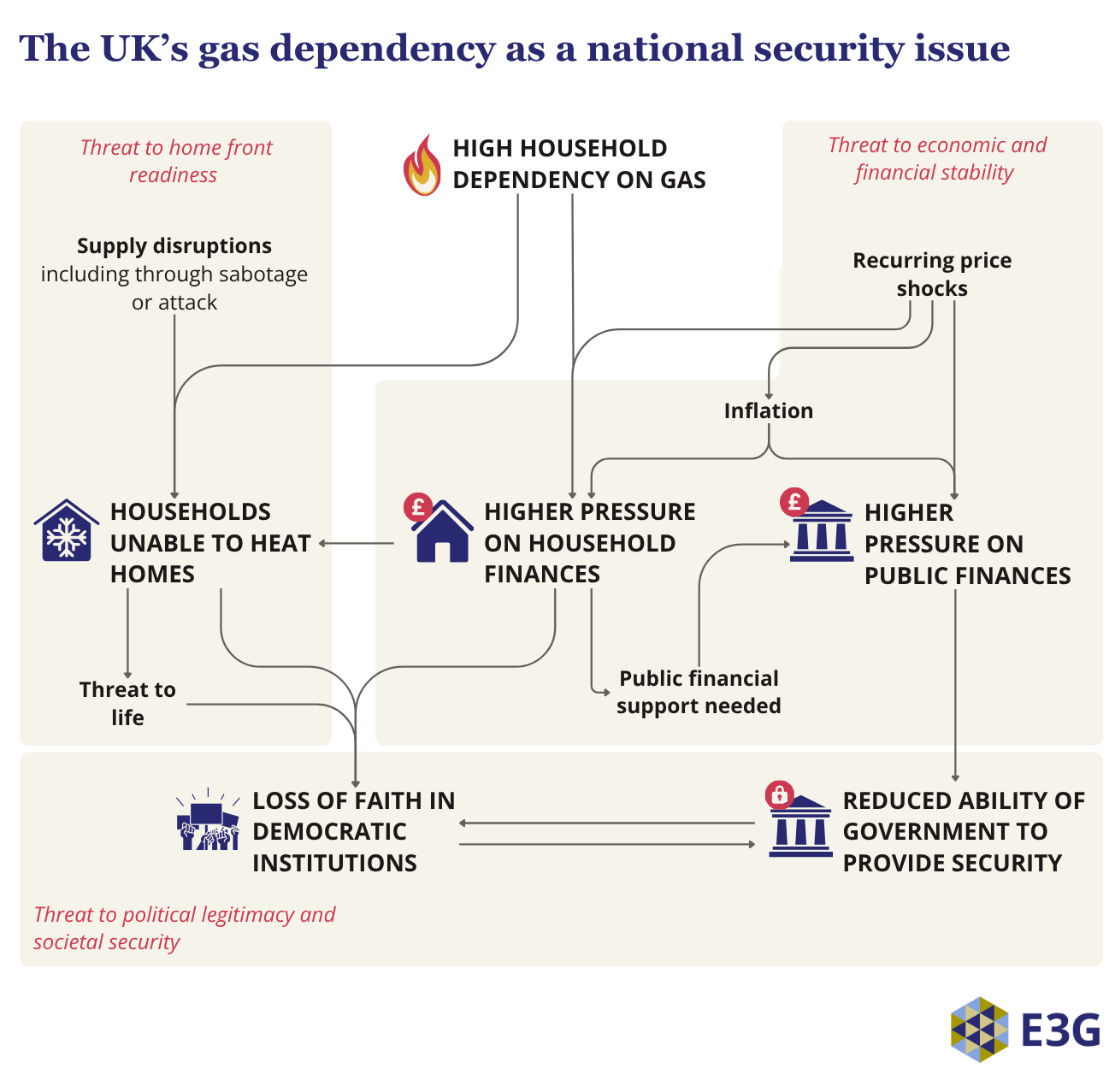
This conclusion is based on assessment of three compounding risks:
- Threat to home front readiness: Almost half of the UK’s gas must be imported through just four infrastructure clusters. The ability of aggressor states to target this infrastructure is a structural and crucial vulnerability, as is the risk of supply chain weaponisation and disruption, as has been exposed in the Strait of Hormuz this year.
- Threat to economic and financial stability: The UK’s reliance on gas and exposure to recurring energy crises damages the UK economy and weakens public and household finances.
- Threat to political legitimacy and social security: Pressure on public finances makes it harder for the state to take the action required to mitigate the impacts arising from the UK’s gas dependence, leading to a broader feeling that society cannot be protected. This risks democratic and political legitimacy itself, which is amplified by disinformation over clean energy.
Decisive action on the electrification of British housing is an investment in long-term durability and security of the state and its people, while delaying such action puts the UK at great risk. It is not geologically possible for the UK to secure short- or long-term energy security though its 85–93% depleted North Sea oil or gas reserves, while compounding climate effects risk further deterioration of security.
Strengthening the resilience of British homes improves deterrence, restores public confidence and reduces the UK’s exposure to attack. The government can either act to urgently shore up the home front or keep courting catastrophe.
Top recommendations for the UK government to consider
- Launch a national “Home Front Mission” to accelerate electrification of UK homes and establish a plan to phase out oil and gas for home heating.
- Prioritise a more strategically decentralised, more secure energy system at pace.
- Prioritise diversification of supply chains for clean energy technologies and develop incentives to maximise UK manufacturing.
- Identify gas dependence as a security threat and classify it as a “chronic risk” in the National Risk Register.
- Government and Joint Intelligence Committee to launch a joint inquiry into action by hostile states and malign actors to spread disinformation regarding clean energy.
Download the full list of recommendations.
Download the executive summary.
Dr Pauline Heinrichs is a lecturer in War Studies (Climate and Energy) at the Department of War Studies, King’s College London. Dr Heinrichs contributed the analysis on threats to political legitimacy and social security covered in Chapter 3 of the report. The remainder of the report was led by E3G and reflects its views alone.