
Against a backdrop of volatile geopolitics and rising trade protectionism, bilateral trade partnerships are gaining traction as a model for sustaining cooperation between countries with shared interests – including accelerating the global transition. Partnerships can provide targeted support for clean technology sectors, diversify trade relations to boost resilience, and deliver win-win economic outcomes for both sides. However, recent agreements, such as the first Clean Trade and Investment Partnership (CTIP) between the EU and South Africa, have failed to secure new financial commitments, limiting their ability to deliver tangible additional benefits to developing countries. In the context of shrinking aid budgets and increasingly transactional EU–partner relations, this article examines how the EU’s trade partnerships can be more strategically financed to support the priorities of partner countries, while also generating decarbonisation, economic security and competitiveness benefits for the EU.
Gaps in the current landscape
Bilateral partnerships offer significant opportunities to advance the clean transition. They can help to structure clean investments, create demand signals for clean products, facilitate capacity building and knowledge exchange, and improve alignment on industrial policies and regulation for clean sectors.
However, these partnerships have the potential to deliver greater impact to both sides if they are backed by additional financial commitments, which constitute complementary sources of funding rather than repackaging existing support. Utilising the EU’s international finance capabilities to deliver on negotiated trade outcomes offers a win-win mechanism to deliver shared priorities: the developing country benefits from increased investment, and the EU receives its own benefits from a deeper partnership – secure access to critical materials, diversified supply chains, and cheaper inputs to boost competitiveness.
Reevaluating trade partnership financing is particularly crucial as the development finance landscape faces significant strain. The historic drop in development aid and shift to more transactional climate diplomacy – where the EU is increasingly seeking benefits in return for its support – marks a systemic shift in the dynamics of the global transition. This trend is exacerbated by rising competition from China, which reinforces the need for the EU to present a more compelling and coordinated partnership offer.
At the multilateral level, trade partnerships can also play a role in scaling the global climate finance needed to achieve the Baku to Belém Declaration to mobilise USD1.3 trillion for developing countries by 2035. As the vast majority of climate finance must come from the private sector, public capital is essential to de-risk investment: investors will not take advantage of market access and favourable trade terms facilitated by new partnerships without a pipeline of bankable projects to invest in.
Public finance commitments in trade partnerships will not be a silver bullet to accelerate the transition, but if approached strategically they can play an important role in catalysing private investment and create the enabling conditions to accelerate clean growth in developing countries.
Mapping EU financing instruments
There are a wide range of financial instruments that can support mutually beneficial clean trade partnerships, but many are currently underutilised by the EU in its trade policy. To generate greater impact through clean trade partnerships, the EU’s financing instruments must be strategically coordinated during trade negotiations, and in turn, trade partnership opportunities should be factored into the decision-making framework of EU finance institutions. This will deliver a more coherent trade and finance toolkit to maximise the benefit of global partnerships.
Building an effective financing package should always be a two-way process with the partner country. The EU must be flexible to ensure the partnership delivers on locally defined priorities for third countries, whilst also supporting the EU’s domestic and international objectives.
Table 1: Overview of EU financing tools and how they could be utilised in trade partnerships
Considerations for aligning partnership finance with sustainable development pathways
The EU should move from generalized and repurposed financial commitments in its trade partnerships to strategic trade finance packages that are coordinated across various financial and trade instruments and institutions. This will maximise impact and allow for long-term strategic planning.
While each trade partnership the EU negotiates will require a bespoke financing offer depending on the unique country context, the EU could adopt an overarching framework that considers at which stage of the clean value chain the partner country needs financial support. This could help to improve on recent agreements such as the EU-South Africa CTIP, which was paired with a repackaging of existing Global Gateway commitments announced earlier in 2025, rather than securing targeted new funding.
Targeting trade partnerships towards specific components of clean technology supply chains could help to provide a more structured approach to tailoring a finance package to meet local needs. For example, upstream sectors are typically higher risk, requiring concessional finance support. Whereas investment in downstream value chains may be better supported through export finance. Middle-income countries manufacturing renewable energy products are likely to require different types of financial support than least developed economies establishing new primary industries such as critical minerals mining. Providing financing that ensures local value addition, long-term social benefit, and political reliability will be key to positioning the EU’s offer relative to investment from other actors such as China.
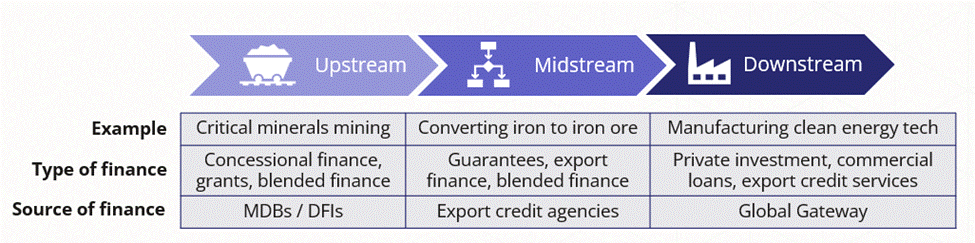
Figure 1: Illustrative overview of mapping financial instruments against supply chain components
Conclusion
Bilateral trade partnerships can and should be better utilised to align finance, development, and climate objectives. Driving regulatory alignment, tackling trade barriers and facilitating business engagement remain important enabling conditions to accelerate clean trade cooperation, but the ability of trade partnerships to deliver tangible economic benefits would be significantly multiplied by additional financial commitments.
In a constrained fiscal environment, this is not about generating new funds, but about using the EU’s existing financial toolkit more strategically to deliver more impactful – and therefore more credible – bilateral trade partnerships. This should include the coordination of a broad set of finance tools, targeting specific value chain components, and aligning with local development pathways.
The increasingly turbulent and competitive global landscape, where deeper cooperation with a diverse set of countries is both an economic and geopolitical objective, makes this the right moment for the EU to recalibrate its approach to financing the next generation of clean trade partnerships.
This article was originally published in TESS Forum.