
Strengthening trade cooperation with Egypt in support of its ambitious renewable energy targets offers unique benefits for the EU’s regional influence, supply chain resilience, and industrial competitiveness. To retain a strong position alongside investment from China and the Gulf countries in this sector, the EU will need to be assertive, focused and joined up. By creating local value, supporting industrial decarbonisation and deploying its unique development-based investment approach, the EU can set itself apart as a reliable and collaborative partner to help drive long-term clean growth in Egypt.
The EU’s clean partnerships with other countries – on trade, energy and industry transitions – have the potential to be one of its most powerful geopolitical assets.
Through strategic partnership with Egypt, a cornerstone of geopolitical security in the EU’s neighbourhood, the EU can reinforce its physical security by maintaining influence in North Africa. There are opportunities to increase European and Egyptian energy security as well, through bidirectional energy connectors. There would moreover be major economic benefits to Egypt from meeting its growing energy needs through renewables.
But with other countries stepping up their engagement in Egypt’s accelerating clean transition, the EU needs to harness the unique value of its approach.
Egypt’s energy transition is a cooperation opportunity for international partners
Egypt has set an ambitious target of 42% renewable electricity by 2030, in a bid to tackle the economic and trade drawbacks of its dependence on gas. The country’s transition is well underway, but it is seeking international cooperation to provide the sizeable financing, technology and expertise needed to meet its target.
This is proving an attractive offer. Aside from the geopolitical benefits of clean energy cooperation with Egypt, there are significant economic opportunities for partner countries. The increased engagement from China and Gulf countries is in part a response to opportunities to export surplus manufactured products and for economic diversification, respectively.
In an increasingly crowded space, the EU will need to find its niche
The EU will need to act strategically to secure its long-term role in Egypt’s clean transition given the speed and scale of finance from China and Gulf countries. Rather than trying to compete head-to-head in areas where those other actors are now established, the EU can build on its unique offer in more complex areas of Egypt’s transition, such as grid modernisation.
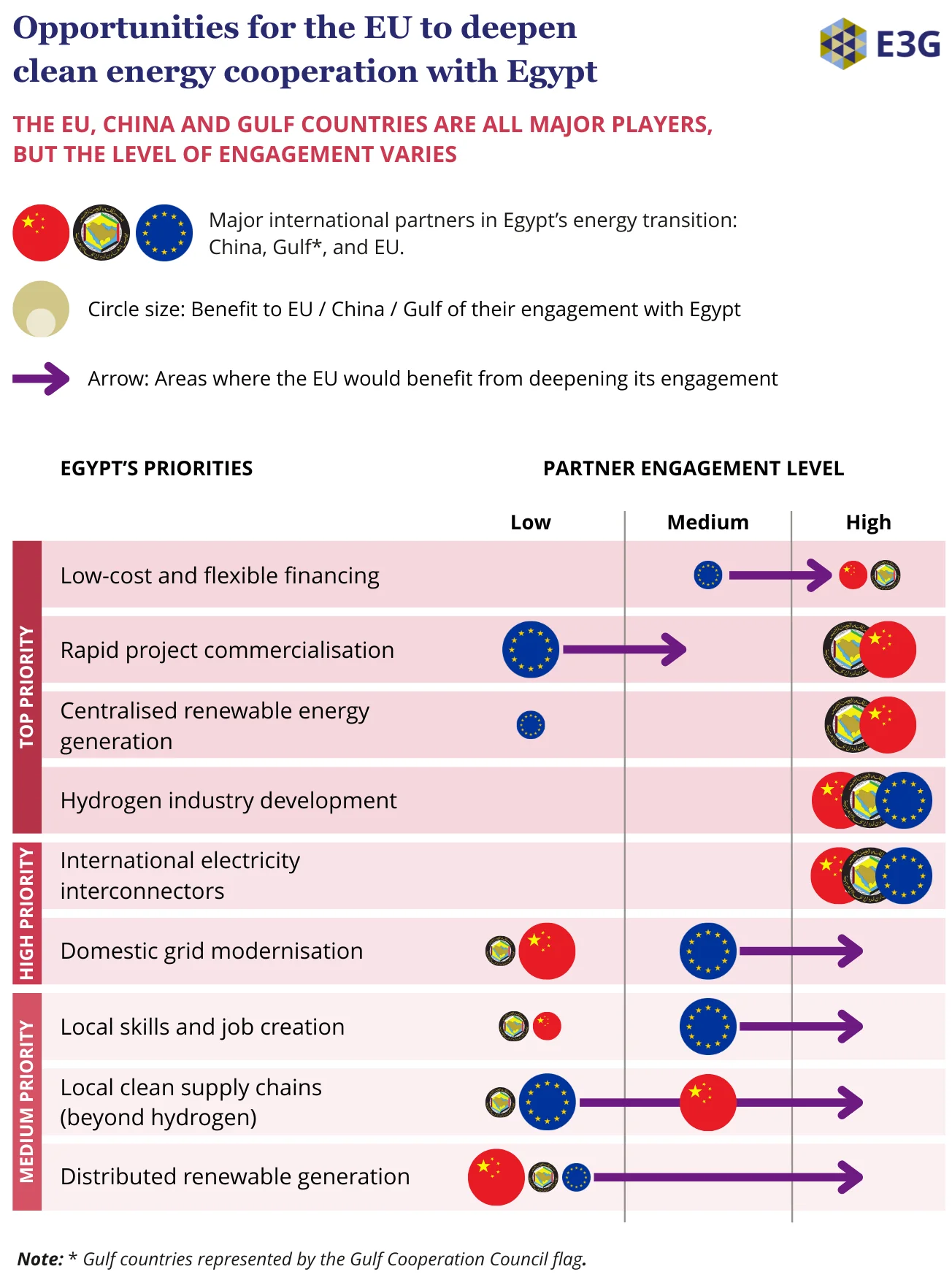
With the right approach, the EU can continue to benefit from its cooperation with Egypt while also advancing Egyptian priorities. For example, making more of the EU’s added value in local value creation and its geographical proximity provides opportunities for EU suppliers, and can boost the EU’s resilience through the development of pan-Mediterranean supply chains. However, the EU needs to reduce trade and political frictions, including by supporting Egypt to reduce its exposure to the Carbon Border Adjustment Mechanism (CBAM).
These insights emerge from our analysis of the roles and priorities of these three major geopolitical actors in Egypt’s clean transition. Our analysis was supported by two commissioned case studies on China–Egypt and Gulf–Egypt clean cooperation respectively, which are also available to download here:
- Powering the Green Transition: China’s growing role in Egypt’s renewable energy sector – Tin Hinane El Kadi, University of Oxford
- Gulf–Egypt Cooperation on Egypt’s Energy and Industry Transition – Jessica Obeid, New Energy Consult
Recommendations for the EU to strengthen its clean cooperation with Egypt
- Anchor EU–Egypt clean cooperation in EU industrial and security priorities. Demonstrate how partnership can benefit European industries and EU security, to secure public and private investment.
- Prioritise cooperation on clean sectors where the EU remains competitive, including a core focus on enabling infrastructure.
- Support Egypt’s industry to decarbonise and reduce CBAM exposure, and anchor clean value chains near Europe.
- Streamline the EU’s clean engagement toolbox to compete on speed and scale more effectively in Egypt.
- Engage and collaborate strategically with Gulf, Chinese and multilateral partners, to avoid duplication, accelerate delivery and maximise impact.