
Last month the European Commission published its proposal for the revision of Europe’s public procurement rulebook, the Public Procurement Act. This proposal follows the Industrial Accelerator Act, published in March, and forms a key part of the Commission’s attempt to secure Europe’s industrial capacity by creating demand for low-carbon materials and products. With the two instruments now on the table, the architecture for European lead markets is taking shape. Yet the measures still fall short of providing the scale and certainty of demand needed to turn planned investments into European industrial capacity.
In its Clean Industrial Deal, the European Commission set out lead markets as a key pillar of its plan to strengthen the resilience of Europe’s industrial base through decarbonisation. By creating certainty of future demand, lead markets are intended to give producers the confidence to make capital-intensive investments into low-carbon production.
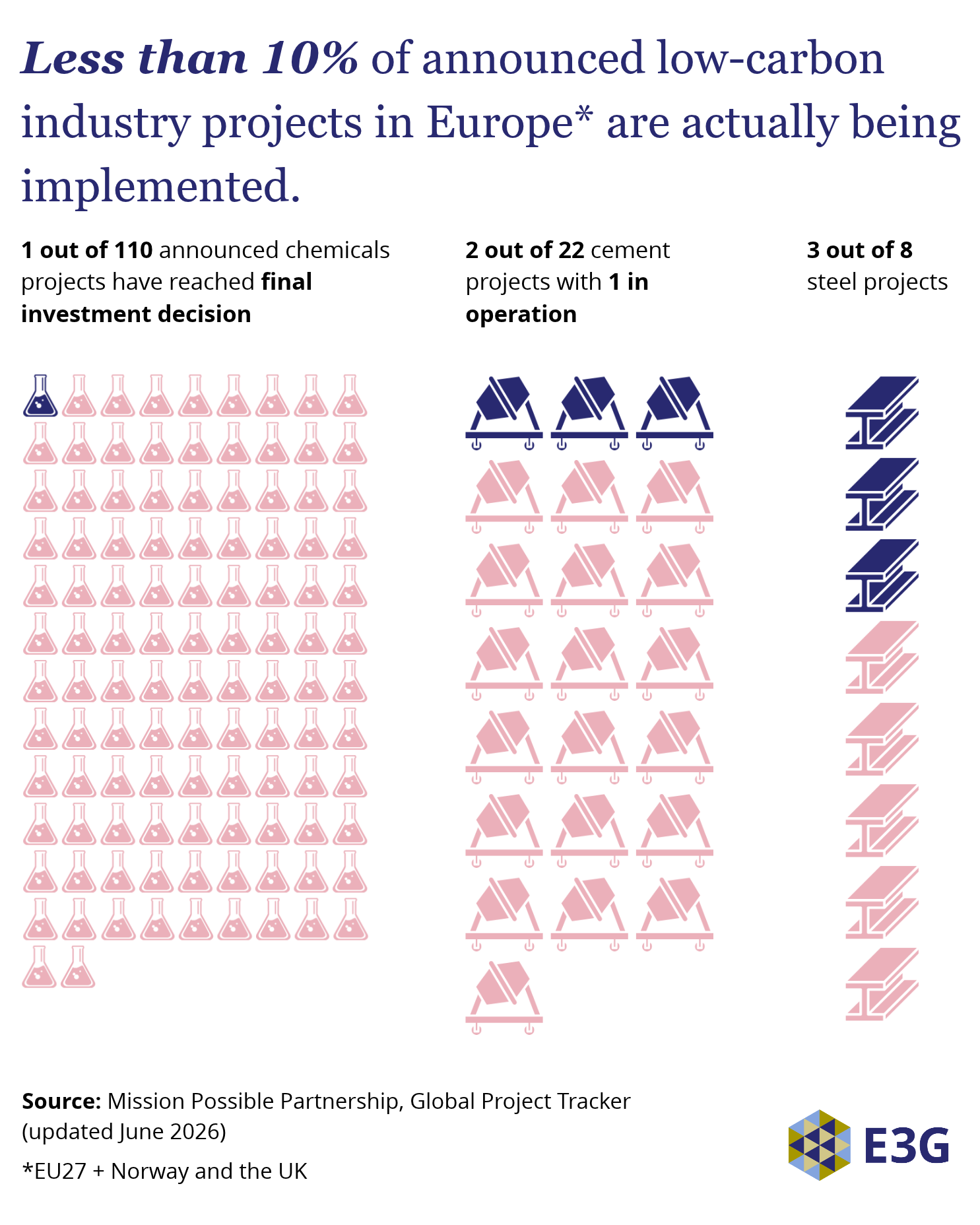
Europe has a promising pipeline of low-carbon investments. Together, announced investments represent a €85 bn investment opportunity. But most of these projects are not moving forward as companies do not yet trust that there will be sufficient demand for the low-carbon materials they produce. To create a credible business case for new investment, lead market initiatives must cover a significant share of the market, going beyond the existing pipeline of clean projects.
The PPA is a step forward, but voluntary measures will not create the necessary business case
The proposed Public Procurement Act contains several positive elements. It establishes a more developed framework for green public procurement, moves away from the use of price as the sole basis for awarding contracts and provides legal certainty to procurers looking to buy climate-friendly products.
However, the Commission’s proposal gives procurers the freedom to choose which types of quality criteria to use, essentially making environmental and climate criteria voluntary. The existing procurement rules already allow public authorities to take sustainability into account. Yet 53.4% of public contracts are still awarded based solely on the lowest price, while only around one fifth of contracts include environmental criteria. Without mandatory use of sustainability criteria, the rules are likely to lead to market fragmentation, whilst failing to generate the scale of demand that low-carbon producers need.
Credible lead markets need to go beyond public demand
As the Industrial Accelerator Act and the Public Procurement Act move through the European Parliament and Council, policymakers can still strengthen the public demand pillar of the EU’s lead-markets framework. Mandatory low-carbon procurement requirements need to cover a sufficient share of relevant markets to give producers meaningful demand certainty.
But public procurement alone will not be enough. Public buyers account for only a part of overall demand, and in some industrial sectors they are only a marginal lever. As a cross-sector coalition warned earlier this year, a lead-markets strategy focused narrowly on public incentives and a handful of sectors would not create credible markets on its own.
A comprehensive strategy must therefore also reach private buyers, through measures such as demand-side obligations, green market makers and tax incentives. Product rules under the Ecodesign for Sustainable Products Regulation and the Construction Products Regulation can further strengthen demand across the European market, if sufficiently ambitious.
The Circular Economy Act must not repeat the same mistake
The upcoming Circular Economy Act will be another important test of the Commission’s lead-markets agenda. Its expected focus on strengthening the single market for circular materials is welcome, but improving the supply and circulation of circular materials alone will not create the demand needed to scale them up. The CEA should therefore combine measures to strengthen circular markets with clear demand-side measures that create demand for circular materials and products through resource use targets, mandatory procurement requirements, and introduce economic levers such as EPR schemes and taxation.
The IAA and PPA are important building blocks, but policymakers must strengthen them if public incentives are to provide meaningful demand signals for low-carbon production. But public demand cannot do the job alone: Europe needs a broader regulatory framework that creates credible demand for low-carbon and circular products across both public and private markets.