
In 2026, Europe endured one of its hottest ever summers putting the EU’s resilience and energy security to the test. Now, this autumn’s legislative agenda presents two opportunities to embed lessons from this summer’s heatwaves and plan for a secure and resilient future.
The forthcoming Climate Resilience and Risk Management Integrated Framework is a first step to ensuring climate impacts are built into the decisions that shape Europe’s economy. The revision of the Energy Security Framework can be an early test of what this looks like in practice – and whether Europe is ready to plan its energy system for the future climate.
This summer exposed a ‘double pressure’ on Europe’s power system
The heatwaves drove up demand for cooling, especially during evening peak hours, while simultaneously constraining traditional electricity generation.
Across Europe, hydro and thermal power generation, including coal, gas and nuclear, were forced to shut down or restrict their output due to climate and heat-related causes (see Figure 1). Thermal plants become less efficient at higher temperatures, while low river levels and high-water temperatures can limit the availability of water needed for cooling. Nuclear plants experienced complete or partial shutdowns in France, Romania, Hungary, Slovenia and Switzerland, while gas plants in Italy, the UK and France, as well as coal plants in Poland faced constraints due to heat stress. Low river flows reduced hydropower generation in parts of Slovenia, Austria and Italy’s Po River valley.
Interactive map
Heat impacts across Europe: solar key to meet rising demand
1 May – 16 August 2026 heatwave days
Change in mean daily electricity demand on heatwave days against matched normal days (%). Select a country for what rose and what fell.
Source: E3G analysis based on ENTSO-E Transparency Platform, 1 May – 16 August 2026 (total load, generation per production type, cross-border physical flows) and ERA5 via Open-Meteo.
20 countries had enough heatwave days to compare. A heatwave day is 3+ consecutive days above the local day-of-year 90th percentile of daily maximum temperature, or at or above 30 °C; each country is measured against its own non-heatwave days in the same season, weekdays matched to weekdays. Temperature is population-weighted across each country’s largest metropolitan areas.
Figure 1: Interactive map showing changes in mean daily electricity demand on heatwave days compared with matched normal days.
At the same time, the need for cooling pushed electricity demand upwards. Between May and mid-August, peak demand was on average 9% higher on heatwave days than during non-heatwave days. The impact of these peaks on the power system was particularly pronounced in the evening, when solar generation declined, but households and businesses continued to need cooling.
This combination of constrained supply and higher demand increased reliance on fossil gas to meet evening peaks, contributing to some of the highest wholesale electricity prices since the 2022–23 energy crisis. Higher summer gas demand also has winter energy security and affordability consequences: increased gas consumption and high prices have made gas storage refilling more difficult ahead of the winter heating season.
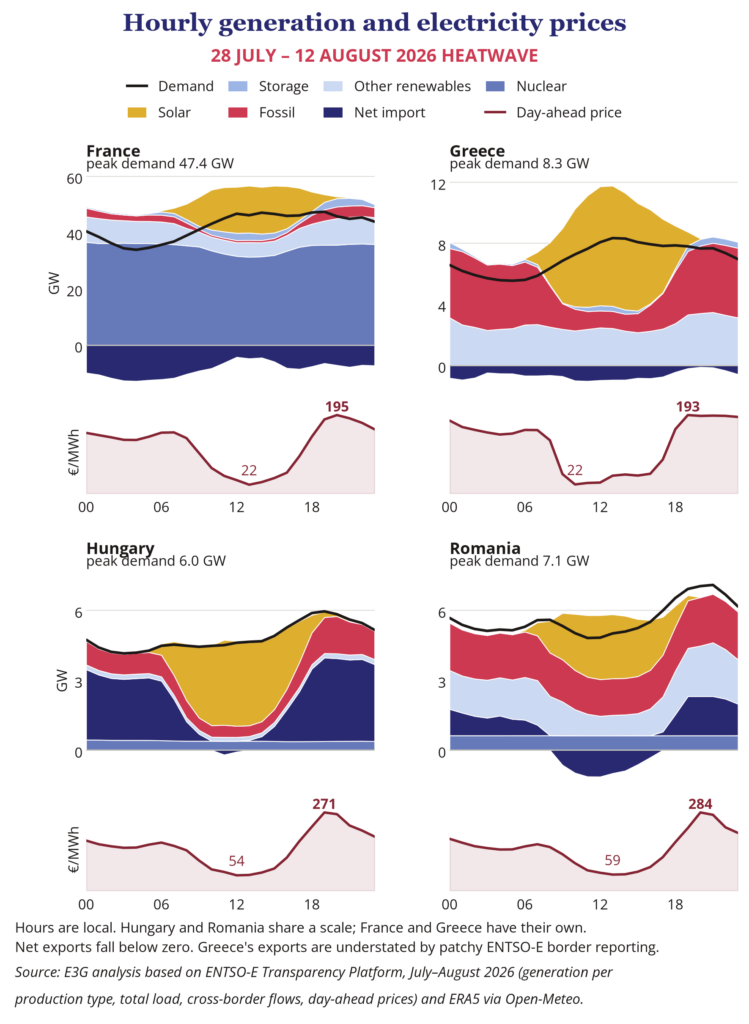
Figure 2: The energy mix of France, Greece, Hungary and Romania during the 28 July – 12 August heatwave.
But, this summer also demonstrated what a more resilient system can look like
The story of this summer is not only one of vulnerability. It also demonstrated the value of a more flexible, interconnected and renewable energy system. Solar generation was particularly well-suited for cooling during the heat of the day. During June and July, solar power met 25% of EU electricity demand for the first time. Interconnections and flexibility also proved critical to address supply constraints: the near-total shutdown of Hungary’s only nuclear plant was primarily compensated by imports, while Greece’s strong solar generation enabled exports to neighbouring countries to help meet higher demand. Storage and demand-side response were deployed, for instance in France and Greece, but were underutilised levers for curbing evening fossil gas needs. Crisis response thus demonstrated that flexibility, demand-side response and batteries are actionable resources to make the most of periods of strong renewable generation and, crucially, smooth electricity prices during evening peak demand.
From crisis response to resilience by design
To date, the EU has not sufficiently considered climate impacts and associated energy system preparedness as part of its energy security agenda. Europe should now turn this summer’s lessons into a strategic and coordinated approach to resilience across sectors.
The EU’s forthcoming Climate Resilience Framework should establish the principle that climate risks are considered when policies, infrastructure and investments are designed – not after disruption occurs.
The forthcoming EU Energy Security Framework is an important opportunity to put this approach into practice. This means using forward-looking climate scenarios in system adequacy assessments and infrastructure planning. It means stress testing grids, generation and operational systems against more severe heat, drought and other weather extremes. It means identifying the requirements, regional cooperation frameworks, investments and capabilities needed to securely operate – and, where necessary, rapidly restore – the energy system under future climate conditions. It also means prioritising “no regret” solutions that improve weather preparedness, including interconnections, flexibility, batteries and demand side response, at both centralised and decentralised levels.
This summer demonstrated both the vulnerabilities of Europe’s energy system and the solutions available for managing them. Now the EU must take the next step and move from ‘responding’ to ‘planning’ for climate impacts. Embedding this approach into the energy security framework revision is the first step towards making resilience the foundation of Europe’s economic security.