
The review of the EU Emissions Trading System (ETS) is no longer just about the carbon market; it has become a defining political debate about the EU’s industrial future. It will test whether the EU can reconcile competitiveness, decarbonisation and fiscal pressures in a more contested geopolitical environment – all while securing lasting political support. The risk is that policymakers weaken the ETS as a quick fix to Europe’s deep economic challenges, undermining one of the EU’s main tools for delivering on its industrial transformation ambitions.
Key takeaways:
- The ETS review will not simply shape the feasibility of Europe’s climate transition; it is a broader test of the EU’s capacity to strengthen its industrial competitiveness, security and strategic autonomy in an increasingly contested global economy.
- The crucial question in the review is whether the ETS can create the incentives and mobilise the investment needed for decarbonisation to underpin a broader EU industrial strategy – which is in turn crucial for the carbon market to succeed.
- Different views on how to balance today’s competitiveness challenges with effective industrial transformation are reflected in the most contentious elements: the pace of decarbonisation, industrial protection and the use of ETS revenues. The outcomes from the review need to set the EU up for the more demanding phase of decarbonisation ahead in a way that is politically durable.
- Political divisions are no longer between industry and climate advocates, but increasingly within sectors, between industries and across member states as the debate reflects different industrial realities, transition pathways and investment conditions.
A highly political EU ETS review amid competing pressures
Recent energy shocks and intensifying global competition have brought Europe’s climate, industrial and security agendas closer together, requiring the EU to accelerate decarbonisation while preserving its industrial base.
How to reconcile these objectives has become highly contested, as the same economic pressures are used both to justify accelerating the clean transition and to argue for slowing or weakening parts of it.
The need for industrial decarbonisation is now widely accepted across the EU; the question is whether investment conditions can support the transition at the required pace and scale. While frontrunners are moving ahead with cleaner production, many projects are being delayed or cancelled by deteriorating investment conditions.
In this context, the ETS review has become a focal point of wider debates about Europe’s industrial future. Its interlinkage with EU strategic priorities, combined with the difficult trade-offs between its role as a long-term investment signal and a short-term cost factor, has made it one of the most politically contested files of this mandate. The review is also becoming a proxy for wider competitiveness debates, with pressures to weaken the ETS often reflecting industrial challenges whose main drivers lie elsewhere.
What is at stake for the EU and the clean transition?
- Europe’s industrial renewal and competitiveness. The clean transition is central to Europe’s long-term industrial competitiveness. The ETS is a cornerstone of this transformation, but it can only deliver it as part of the EU’s broader clean industrial strategy. The review will determine how and whether the two reinforce one another.
- The feasibility of Europe’s long-term climate transition. As the first major revision following the agreement of the EU’s 2040 climate target, the ETS review will shape the EU’s long-term climate framework and test whether the carbon market can remain politically and economically durable as emissions become harder to reduce.
- Europe’s capacity to mobilise investment at scale for its clean transition. The ETS plays a unique role in mobilising investment by creating incentives for decarbonisation, providing long-term investment signals and generating public revenues. The review will determine how these three functions work alongside the EU’s wider investment architecture to mobilise capital at the scale needed for the clean transition.
- The EU’s independence, strategic autonomy and global influence. The review will determine whether the ETS remains a credible foundation for the EU’s strategic autonomy and ability to shape the global transition. By reducing fossil fuel dependence, strengthening domestic clean industries and underpinning the Carbon Border Adjustment Mechanism (CBAM), it supports Europe’s resilience while promoting fairer international competition as more countries price carbon.
The most contentious elements in the ETS revision
Beneath the technical complexity of the ETS lies a set of highly political choices about how quickly emissions should fall, how industry should be protected during the transition, and how the revenues generated by the system should be used.
A key question is how much of the EU’s 2040 target should be achieved through domestic emissions reductions covered by the ETS. Central to this is how quickly ETS emissions should decline, but also how much space the ETS makes for international carbon credits, carbon removals and other flexibility mechanisms such us a longer shelf life for unused allowances through a weaker Market Stability Reserve. The more the ETS relies on these mechanisms, the fewer emissions will be reduced directly by the sectors covered by the system.
Why is it contentious? Different views reflect competing assessments of how quickly industry can realistically decarbonise as the ETS cap approaches zero and emissions become harder to reduce. International carbon credits and carbon removals have become the main vehicles through which proposals for a less stringent domestic trajectory are advanced.
The review will determine how carbon-leakage protection evolves, including the pace of free allocation phase-out, the level of continued protection for different sectors after the introduction of the Carbon Border Adjustment Mechanism (CBAM), and whether support should become more conditional on decarbonisation efforts.
Why is it contentious? Different views reflect competing assessments of how much protection European industry still needs during the transition, confidence in CBAM’s ability to address carbon-leakage risks, and how to balance industrial competitiveness with incentives to decarbonise.
ETS auction revenues have become a major source of public funding for the clean transition, but there are growing questions about whether they are being used as strategically as intended. The review will determine how these revenues should be used and monitored to maximise their impact.
Why is it contentious? The debate reflects competing views on whether ETS revenues should primarily support the most strategic transition investments for the EU or remain a flexible source of funding under Member State control. Additionally, it is increasingly intertwined with wider EU budget debates, as pressures grow to use ETS revenues for competing spending priorities beyond the clean transition.
Political dynamics shaping the process
The political dynamics of the ETS review reflect competing views on how Europe should reconcile competitiveness and decarbonisation. For some, the ETS is primarily an additional cost to industry; for others, it is a cornerstone of industrial transformation, clean investment and energy security.
- The focus of the ETS is shifting from power generation to industrial decarbonisation, fragmenting the political landscape and reflecting the greater costs, constraints and international exposure of the sectors now at the centre of the system.
- The current pushback reflects both long-standing opposition to stronger carbon pricing and genuine concerns about whether the wider conditions for industrial decarbonisation are in place. Now, a more difficult investment environment has amplified these concerns.
- But the ETS is also being used as a proxy for wider competitiveness pressures that often have little to do with carbon pricing. Industrial actors seeking to slow the tightening of the ETS rules are highly organised and have been particularly effective at shaping the political debate, giving greater visibility to calls for slowing carbon price increases, extending free allocations or linking future ETS tightening to the successful implementation of CBAM.
- Yet, industrial divisions run within sectors and countries, while industry associations are finding it harder to maintain common positions as companies pursue different transition strategies.
- Public opinion continues to back its core principles, while many companies, investors, utilities, scientific bodies, and member states see it as a cornerstone of industrial transformation, investment certainty and energy security.
- Traditional centre-right support for the ETS as a market-based, technology-neutral climate instrument has weakened under sustained pressure from parts of industry since the last reform and parallel polarisation over the upcoming ETS2 for buildings and transport – emboldening some member states to seek fundamental changes.
- Paradoxically, the political salience of the ETS depends on countries’ exposure to fossil fuel prices, despite the ETS being part of the solution to reducing that dependence.
- Policymakers remain divided and the outcome of the review is still highly open. While the Commission is seeking to balance preserving the core architecture of the ETS with targeted adjustments, divisions among member states and the potential for different parliamentary majorities leave significant room for the final outcome to shift.
What to watch next?
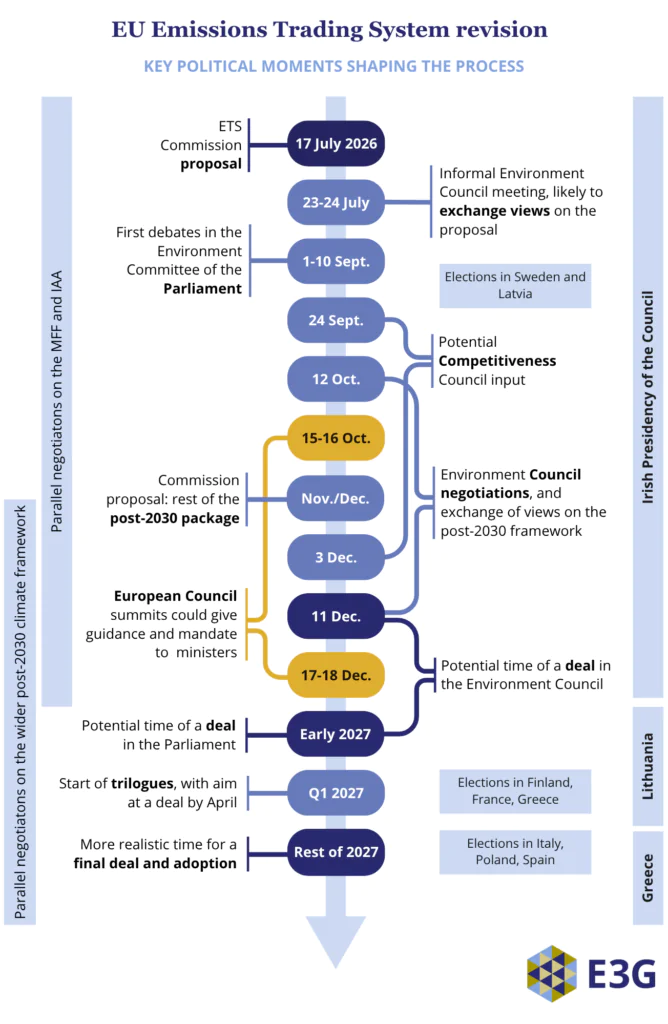
The ETS review will begin with the Commission proposal on 17 July 2026, followed by negotiations in the Council and European Parliament throughout the second half of the year, and between them in the first half of 2027.
The ETS discussions will interact closely with negotiations on the EU budget and other major industrial and climate initiatives. Specifically, the presentation of the review of the rest of the post-2030 climate and energy framework by the end of 2026 could influence the ETS negotiating positions and final compromise.