
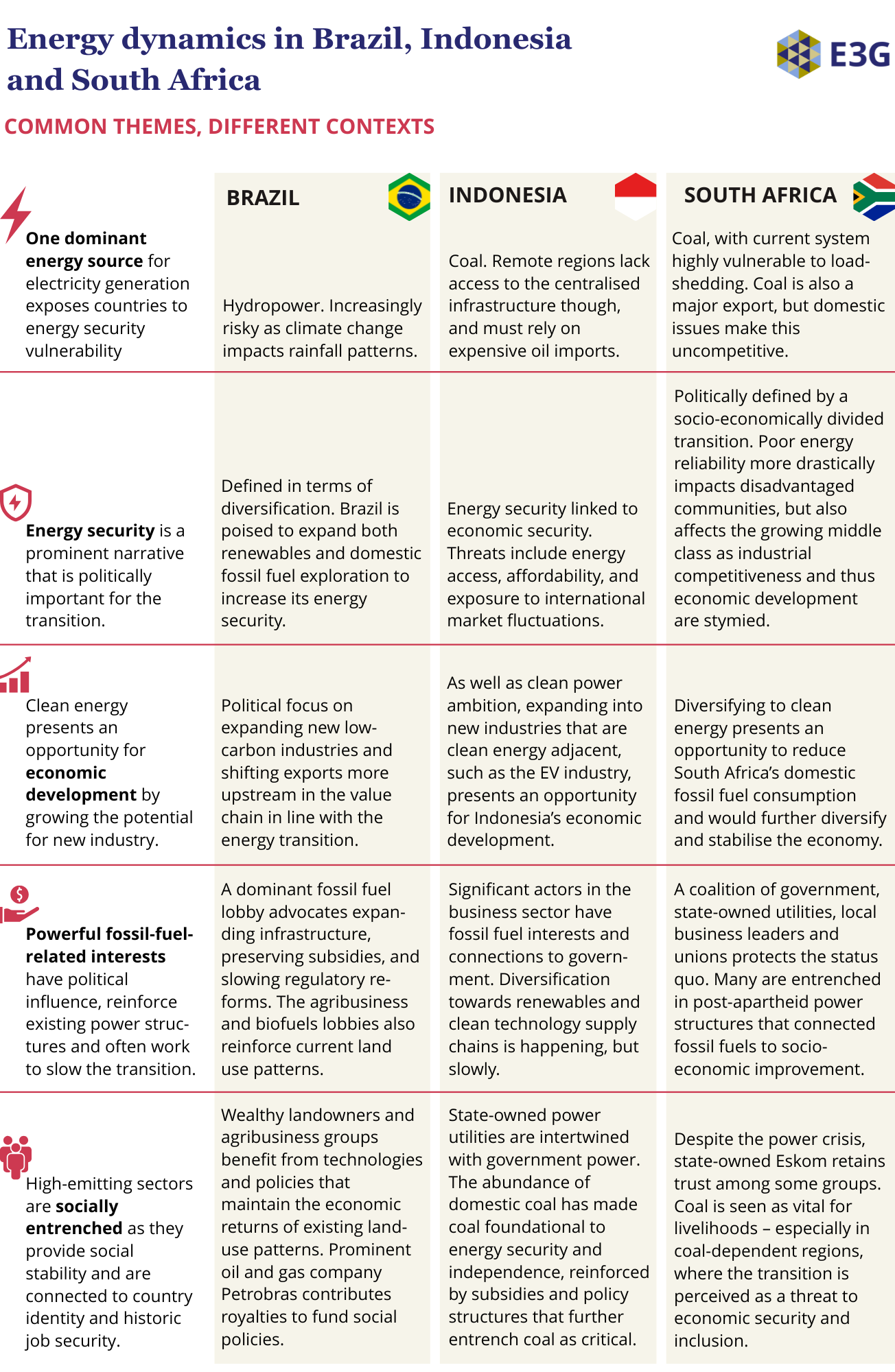
Brazil, Indonesia and South Africa – three pivotal emerging economies – are increasingly focusing on clean energy to enhance national and local security alongside historic reliance on fossil fuels. National conditions mean that for each of them a different aspect of energy security prevails when evaluating clean energy options: diversification for Brazil, economic development for Indonesia and distributional aspects for South Africa. Still, this is balanced with other complex structural and political economy constraints around energy security. Understanding this balance can unlock pathways for a faster energy transition that delivers upon national energy security priorities.
Understanding country dynamics is important in identifying opportunities and barriers for climate action. Our analysis uses E3G’s unique approach to political economy mapping, through which we are able to uncover how the social and political context in each country shapes how the energy transition is framed, and how it could be accelerated.
Each of these three high-emitting, growing economies has a complex relationship with the energy transition, at a crossroads of fossil fuel expansion and exploring clean energy for economic growth and future competitiveness. In our briefing, we show how common themes emerge. The transition is linked to energy security and economic development narratives in each case, while existing social and political structures act to slow the transition despite stated ambitions.
The difference is in the detail. To be effective, climate action needs to be tailored to and embedded in local political, economic and social contexts. However the similarities in themes suggest there is potential for applying recommendations across other similar emerging economies.
A faster transition and better policy design through understanding the political economy of transition dynamics
- A low-carbon transition can be accelerated through tailored narratives of economic development that align with key economic growth priorities. Policymaking should also align with a country’s specific short and long-term energy security priorities to make the economy more resilient to future climate and economic risks.
- A just transition approach for the whole economy is necessary to drive greater public support. This needs to be carefully framed around local understandings of “just” and to address existing social inequalities as well as those that the transition may exacerbate.
- Building domestic clean technology industry (supported by institutional reform), that positions key sectors to remain competitive in a decarbonising global economy, is critical to unpicking the embeddedness of fossil fuels across a country’s political economy. Policies that build resilience and incentivise the transition can also align with broader economic development ambitions.
- Capitalising on Asian investment (mostly China and Japan) and trade opportunities will be critical to financing the transition and realising clean technology potential in emerging economies. However, vested fossil fuel interests in external partners could also slow the transition.
- Adopting renewable energy will need to be coupled with addressing structural issues in the power sector (e.g. infrastructure and market model). Renewables will also need to align with government preferences for transmission and distribution, as exemplified in the inherent tension between Indonesia’s centralised model and ideal renewables infrastructure.
Political economy analysis at E3G
E3G uses its unique Political Economy Mapping Methodology (PEMM) to conduct multidimensional political economy analysis within country contexts. Our analyses allow the climate community to identify locally specific insights, critical barriers and entry points for advancing climate action, grounded in local realities. It also allows comparative country analysis across key transition dynamics.
This briefing draws on PEMM analyses of Brazil, Indonesia and South Africa conducted over 2024–2025. The full analyses, and those for other selected countries, are available through E3G’s Climate Transformation Hub.