
Indonesia has shown ambition on clean energy: from President Prabowo’s pledge to reach net-zero by 2050 made at the G20 last year, to its recent announcement of a 100 GW solar target and a goal of achieving 100% renewable electricity by 2035.
However, Indonesia’s messaging at COP30 was mixed. Indonesia signed the Belém Declaration on Global Green Industrialization, showing an intentional stance to be at the forefront of balancing emissions reduction with economic development.
At the same time, it also showcased a restrained and contradictory diplomatic stance, notably by not joining the coalition of more than 80 countries calling for a roadmap and a global dialogue on transitioning away from fossil fuels (TAFF). Such a roadmap, rather than being prescriptive, would be a way for countries to discuss country-driven pathways to TAFF based on national circumstances, highlight gaps in technology, finance, and capacity, and develop common solutions needed to accelerate action.
Indonesia’s equivocal diplomatic attitude is now being tested through implementation of the country’s NDC 3.0, the credibility of which hinges overwhelmingly on the energy sector. Policy choices that allow the prolonged operation of fossil-fuel power risk turning the NDC’s ambition into a missed opportunity for accelerating green economy development.
Strengthening the implementation of NDC 3.0 could serve as a critical platform to reassert leadership by aligning domestic policies with the President’s commitment on renewables and accelerating Indonesia’s coal phase down agenda. In turn, this so would help Indonesia move beyond its currently selective leadership posture – ambitious on green industrialization yet cautious on fossil fuel transition – signalling stronger confidence to the international community that Indonesia is prepared to advance a credible, development-aligned transition pathway.
Key changes and risks in Indonesia’s NDC 3.0
A notable change in Indonesia’s NDC 3.0 is the adoption of 2019 as the reference year for emission targets, replacing the previous BAU approach in Enhanced NDC (E-NDC), 2022 which relied on assumptions and made international comparison difficult. The new method aligns with the Global Stocktake (Decision 1/CMA.5) guidance calling for more transparent, economy-wide target setting allowing for better tracking and enhancing credibility.
Indonesia NDC 3.0 presents the Low Carbon Compatible Pathway (LCCP) scenario, designed to align Indonesia’s emission trajectory with the 1.5°C pathway through additional measures for Net-Zero Emission by 2060 or sooner. President Prabowo’s aspirational target of 8% annual economic growth is reflected in the high growth modelling scenario (LCCP-H). The results indicate a close link between economic growth and emission trajectories: if growth underperforms, emissions will also decline, and vice versa. The two main scenarios are presented below.
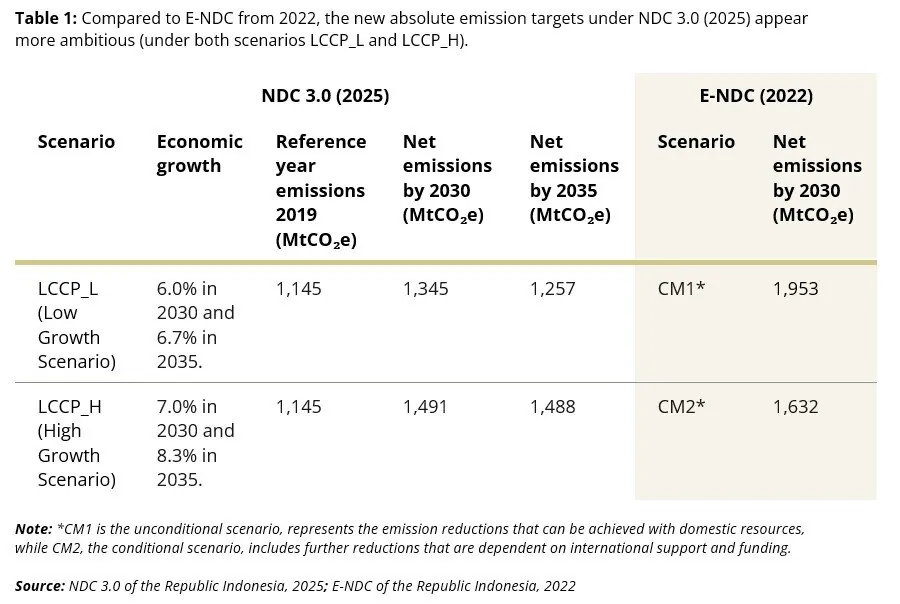
Despite this upward shift in ambition and Indonesia’s stated 1.5oC Paris-compatibility, a closer examination finds three potential risks:
- A clear articulation of emissions reduction target, backed by a fixed range of percentage reduction is currently missing. Such an articulation can help provide more transparency for policy and business stakeholders. This can also help examine avenues for bringing forward peak emission targets for both energy and overall economy.
- A risk of misalignment in implementation between the E-NDC (2022) and NDC 3.0 (2025), if current domestic policies, geared towards achieving E-NDCs, are not updated.
- Delayed emissions peak in the energy sector. Under current modelling, emissions from the energy sector are projected to peak only in 2035, implying continued emissions growth over the next decade. This trajectory risks delaying an economy-wide emissions peak beyond the 2030 commitment and would be misaligned with a 1.5°C-compatible pathway.
Indonesia’s energy sector steers the achievement of S-NDC, yet ambition remains insufficient
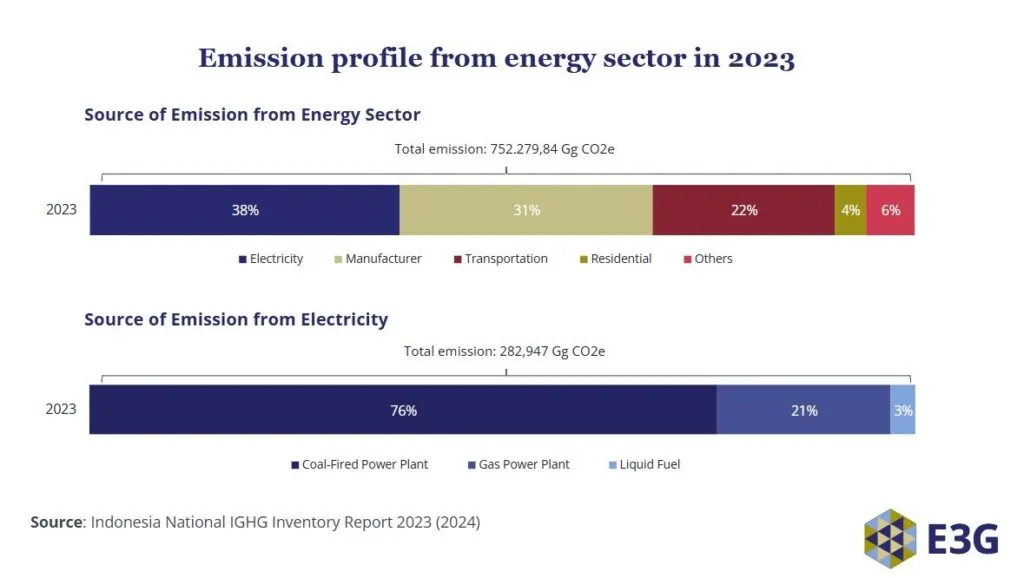
The electricity sector accounted for 38% of energy-sector emissions in 2023, and coal plants made up 76% of those emissions (Picture 1). Coal therefore sits at the centre of Indonesia’s decarbonisation challenge. Achieving a clean, resilient power system will require two clear signals from the implementation of NDC 3.0: reaffirming no-new-coal commitments and accelerating renewable energy deployment.
Indonesia formally adopted a no-new-coal policy in 2022. However, the surge in mineral processing (especially nickel) has triggered the government to dial down its commitment and allowing inclusion of new coal power. State utility PLN’s new electricity plan (“RUPTL”) and the country’s Just Energy Transition Partnership (JETP) Secretariat project additions of 14.9 GW of new coal – 6.3 GW of on-grid and 8.6 GW of captive capacity.
Evidence suggests that Indonesia may be overestimating the need for new coal power. EMBER’s analysis finds that new coal plants carry a high risk of becoming stranded. In addition, JETP Secretariat’s findings indicate that replacing captive coal at major industrial sites with a power mix dominated by renewables (hydropower, solar, and batteries) can cut emissions by around 90% and reduce costs by about 18%. This suggests that reducing inefficiencies and accelerating clean energy can not only help Indonesia to maintain its no-new-coal commitment, but also enhance industrial competitiveness.
Indonesia has only 1.07GW of installed solar and wind power capacity in 2024. This low base makes scaling RE to meet 2035 ambitions exceptionally challenging. PLN’s ambitious plan (RUPTL) aims to reach 42.1 GW of RE by 2034.
Yet the route to implementation is unclear because of mixed messages on the future of coal in Indonesia and slower progress on policy reforms around inefficient procurement processes. The implementation gap is further entrenched due to aging electricity infrastructure– a crucial barrier preventing higher RE penetration.
Accelerating Renewables as an Economic Strategy
Accelerating renewable energy will be central to ensuring Indonesia’s economic competitiveness, respond to evolving geo-economic and political realities, and help achieve climate goals.
Indonesia’s long-standing reliance on fossil fuels makes the economy vulnerable to commodity price volatility and geopolitical risks. In the coal sector, Domestic Market Obligation (DMO) requires Indonesian coal producers to sell a portion of their coal output to the domestic power sector at a regulated price. While these measures have helped keep electricity prices low, they have also created long-term fiscal risks and distort the market, undermining renewables’ competitiveness.
A strong policy push that prioritises renewables over coal and a shift from procurement to competitive tariffs can help reduce long-term system costs and attract domestic and foreign investments for fast-tracking deployment. In addition, a government focus on mobilising public and private investments in grid infrastructure and flexibility measures is critical. International support can also play an important role in deploying and attracting low-cost capital for these desired infrastructures.
Global markets increasingly demand low-carbon products. Positioning Indonesia as a driver of green industrialisation will be key to achieving Indonesia aims to create 19 million green jobs. Business leaders are already recognising this shift. A recent global business poll found that nearly nine in ten (88%) Indonesian business leaders polled support a transition from coal and other fossil fuels to renewables within ten years.
The Way Forward: Indonesia’s power sector decarbonization post COP30
Indonesia’s NDC implementation should function as a strategic signal of Indonesia’s clean energy direction, positioning the country to capture emerging growth opportunities from rising global demand for low-carbon products.
Failing to reaffirm the country’s NNC commitment in its NDC risks missing the 2030 peak emissions target under NDC 3.0. Relying on legacy approaches, such as support for expensive and unproven “clean coal” technologies and attempts to dilute the ‘no-new-coal’ provision locks in high emission pathways for vital resources. Reinforcing NNC would align the NDC with the President’s 2035 renewable and net-zero vision.
The energy sector’s 2035 emissions peak raises concerns about whether this trajectory is ambitious. By backing its no-new-coal commitment in the NDC 3.0 with consistent renewable procurements and supporting TAFF, both a roadmap led by the COP30 presidency and a global dialogue, Indonesia has the opportunity to enhance the country’s industrial competitiveness and position itself as a regional leadership.
Significant investment—enabled by stable policy signals, modernised grid planning, and international support—is essential for integrating large volumes of renewable energy. Global investment trends now favour clean, reliable electricity; Indonesia can seize this momentum.