The once-again rising gas price is set to further fuel inflation and the cost-of-living crisis in the UK, with electricity bills not projected to fall again until the 2030s. However, with the right package of interventions, targeting each component of a bill, government could lower household and business electricity bills by approximately 20% by 2030.
Only two actions can immediately lower bills: removing levies from bills and improving targeted support for households in fuel poverty and trade-exposed businesses.
This report was produced with major contributions from members of the Electricity Bills Taskforce.
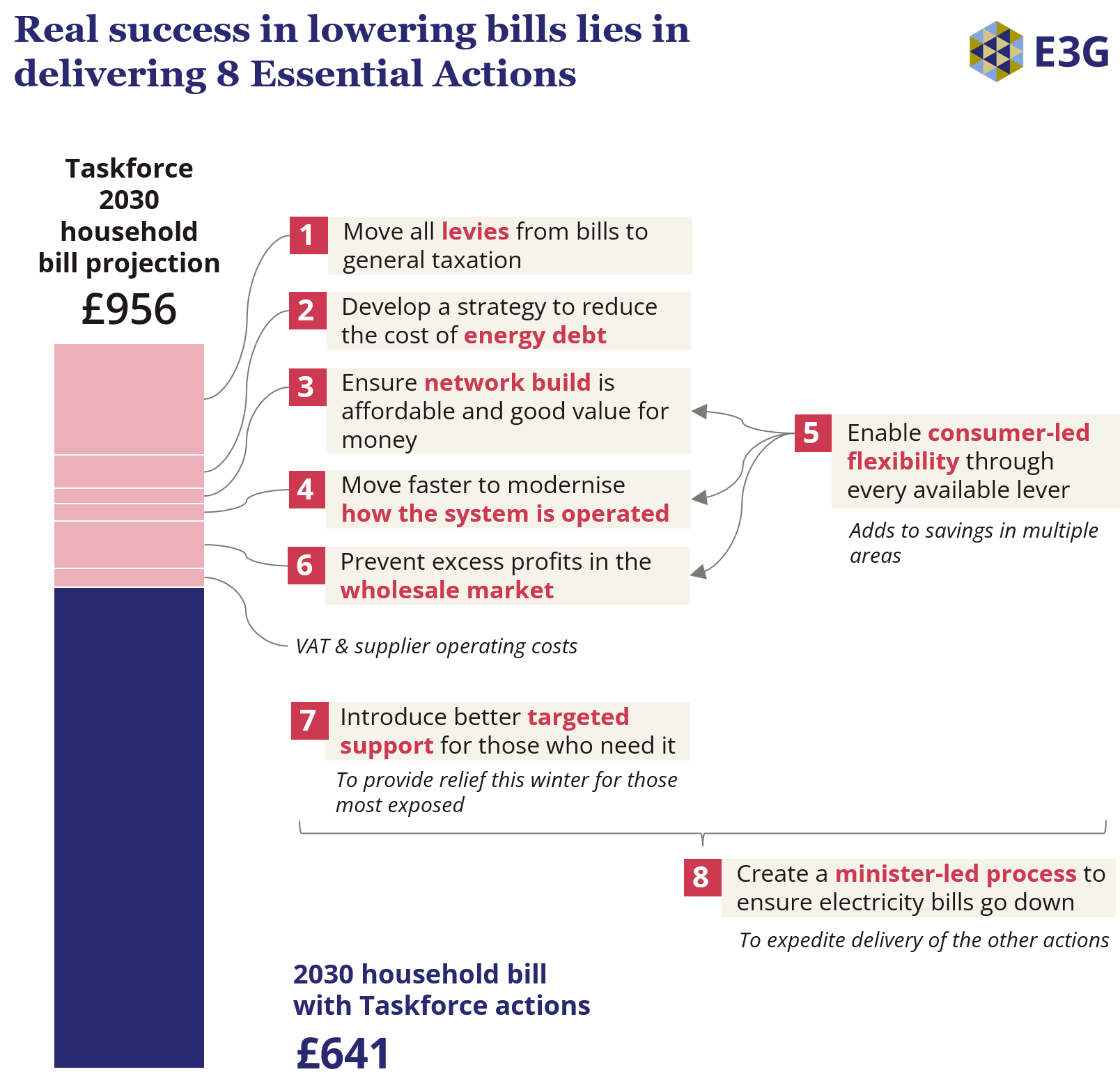
Successive energy crises, driven by the increase in the price of fossil fuels, have dramatically increased bills for households and businesses in Great Britain. Another 16% rise in Ofgem’s energy price cap is anticipated in January 2027 and bills aren’t set to fall until the 2030s. But that doesn’t have to be the case. The government can build an affordable, low-carbon system by 2030 by delivering 8 “Essential Actions”.
The call for the government to deliver these 8 Essential Actions is backed by 20 organisations, including major energy suppliers, business representatives, consumer advocates, academia and charities. As the Electricity Bills Taskforce, these organisations together with other experts pooled their expertise in a year-long effort to identify ways of lowering each component that makes up an electricity bill.
The real success will lie in government undertaking a comprehensive and concerted programme to deliver all 8 actions. While some proposals have a bigger impact on bills than others, it is the combined effect that really delivers for consumers.
Download the report for more detail about the Essential Actions and proposed solutions.
The first step: lowering bills this year
Ahead of delivering this full package by 2030, it is essential the government lowers bills this year to mitigate the increased pressure on households and businesses arising from the conflict in Iran and the rise in gas prices. Only two of the Essential Actions can lower bills in the short term: removing levies and increasing targeted support for those who need it.
These measures would cost roughly £10–11bn per year to 2030, then tailing off each year. However, there is evidence that the economic boost from removing levies would outweigh the cost, while targeted support would help millions of households in fuel poverty and trade-exposed businesses through a difficult winter.
We urge the government to fund these proposals and then go on to deliver all of the Essential Actions. Many actions to lower bills require several years to have an impact, so it is essential that the government acts now across each bill component for bills to be lower by 2030.
The 8 Essential Actions to lower electricity bills
1. Move all levies from electricity bills to general taxation
Lowers bills by £150 per household and 16% for businesses in 2030. It will cost roughly £8–10bn/yr from now to 2030 but would overall deliver a £130bn boost of additional economic growth from now to 2050.
2. Develop a strategy to reduce the cost of energy debt
Lowers bill by £45 per household for everyone and helps the millions of people currently in energy debt. Government could resolve this energy debt crisis by paying for targeted wiping of some debt, improving support for struggling households, giving suppliers more tools to manage debt and/or ensuring all supplier debt support practices meet a minimum standard.
3. Ensure network build is affordable and good value for money
Lowers bills by £20 per household and 2% for businesses in 2030. The strategy could investigate returning the £6–7bn network windfall to consumers, ensuring the next 5 years of distribution network spend is efficient and at a fair financing cost, modernising the voltage on the distribution network and/or boosting transparency around new transmission network build.
4. Move faster to modernise how the system is operated
Lowers bills by £20 per household and 3% for businesses in 2030. The government should look to deliver reforms which are underway quicker where possible. If these cannot be delivered by 2030, then a Plan B should be drawn up to minimise costs in these years.
5. Enable consumer-led flexibility through every available lever
Lowers bills by £33 per household and 4% for businesses in 2030 (note this saving is spread across the other areas mentioned). Consumer-led flexibility enables consumers to make the most of electricity when it is cheap and plentiful. This lowers costs for everyone. Government must fill in the policy gaps to make this technology accessible and appealing.
6. Prevent excess profits in the wholesale market
Lowers bills by £60 per household and 7% for businesses in 2030. The government has a 55% windfall tax in place but there are several available options to lower wholesale prices and profits further. Achieving substantial savings will, though, require major changes to how the market operates.
7. Introduce better targeted support for those who need it
We recommend paying an additional £2bn to support households in fuel poverty. This would support an extra 3 million households – up from 6 million today – with support increased by £250/household. Removing levies for all businesses (Essential Action 1) would support an additional 120,000 manufacturing businesses relative to current plans to remove levies for only about 10% of this.
8. Create a minister-led process to ensure electricity bills go down
The government should create a strategy to lower bills and then expedite and ensure delivery of all of the actions.
In our report, we outline options for how the government can deliver each of these Essential Actions. We demonstrate how measures across the 8 actions can collectively lead to bills in 2030 being 20% lower than today, though the potential for savings will depend on the exact package government puts together from the suggestions provided.
Download the report for more detail about the Essential Actions and proposed solutions.