
Climate impacts are accelerating, and the need for investment in adaptation and resilience is growing rapidly. While international public finance for adaptation in developing countries has expanded in recent years – tripling between 2016 and 2022 – current levels remain far below what is required. UNEP estimates that developing countries face adaptation needs of $310–$365 billion per year. Without a significant increase in finance, climate impacts will continue to erode development gains, strain public budgets, and undermine economic and financial stability.
The recently published Baku to Belem Roadmap recognises that multilateral development banks (MDBs) have a central role to play in responding to this challenge. As major providers of concessional finance, technical assistance, risk-sharing instruments, and policy support, MDBs are uniquely positioned to help countries plan for and manage climate risks, scale investment in resilient infrastructure and services, and support the most vulnerable communities. Their collective announcement at COP29 – and recent reaffirmation – that they expect to reach $42 billion annually in adaptation finance by 2030 is a positive signal, but further ambition and delivery will be essential.
This briefing highlights a set of practical and politically grounded actions MDBs can take to significantly strengthen their contribution to global adaptation efforts, building on suggestions in the Roadmap and the Circle of Finance Ministers report. These include increasing the scale and quality of adaptation finance; collaborating more effectively across institutions to support shared missions and systemic solutions; improving the design and delivery of country platforms to drive resilient investment; addressing persistent access and disbursement constraints faced by vulnerable countries; and expanding efforts to mobilise private finance where commercially viable.
It also underscores the need for clearer responses to the longstanding concerns of Least Developed Countries (LDCs) and Small Island Developing States (SIDS), whose high vulnerability to climate risks does not always translate into accessible financing.
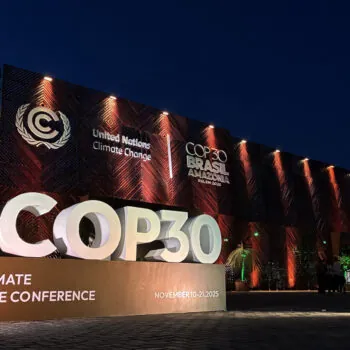
As COP30 opens, the decisions made on adaptation finance will serve as a key test of global credibility. Strengthening MDB leadership – supported by shareholders and aligned with wider reform of the international finance system – offers a concrete pathway to closing the adaptation gap and safeguarding development in a warming world.
Read the full briefing.