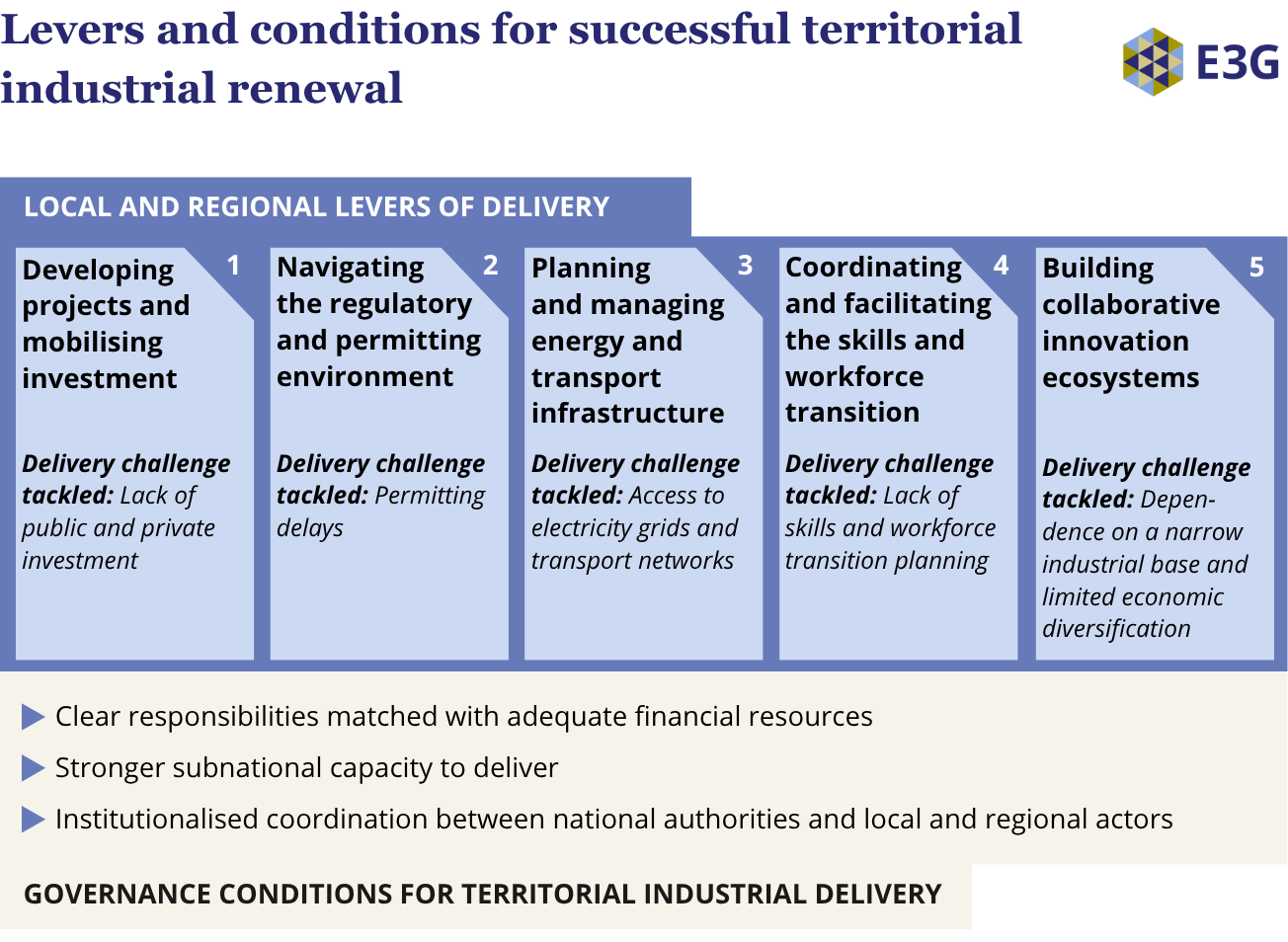

Europe’s industrial renewal will ultimately be delivered, and won, in places. Yet as a new EU industrial policy emerges, there is a risk that Europe overlooks one of its greatest assets: the local and regional authorities already managing the ports and schools, facilitating the innovation ecosystems and planning procedures, and mobilising the economic actors that will determine Europe’s competitiveness. The choice is not between European industrial policy and local action. Europe needs both – a stronger European industrial strategy, built on the local and regional foundations that make delivery possible.
Local and regional authorities’ power to advance industrial renewal should not be sidelined at the EU level
- The EU is heading towards the development of a European-scale industrial strategy to strengthen competitiveness, economic security, strategic autonomy and decarbonisation; but in doing so it is sidelining actors that have been contributing to advancing a clean economy and fostering innovation throughout the past two decades – local and regional authorities (LRAs).
- LRAs hold capabilities that are critical to this delivery and cannot be replaced from the centre: their awareness of territorial economic structures, skill availability and needs, existing industrial innovation ecosystems key to contribute to the renewal of Europe’s industrial base. Most of all, subnational governments hold the key to adapting industrial development to societal needs, advancing a fair and broad-based industrial transition.
- LRAs can action five levers of delivery to overcome the challenges for industrial renewal: (1) developing projects and mobilising investment; (2) navigating regulatory and permitting environment; (3) planning and managing energy and transport infrastructure; (4) coordinating and facilitating the skills and workforce transition; (5) building collaborative innovation ecosystems.
Efforts to strengthen LRAs’ capacity to deliver should focus on three policy files:
- The 2028–2034 Multiannual Financial Framework should strengthen the foundations by involving LRAs in shaping the allocation of EU funds.
- The Regulation on the Governance of the Energy Union and Climate Action should steer member states towards co-constructing implementable National Energy and Climate Plans and equip them to do so.
- The Industrial Accelerator Act should be an opportunity to design industrial policy with the places that will deliver it.
Including subnational levels of government in the design and implementation of deep transformation processes such as the industrial renewal is key to ensure a stronger support for the transition, and higher rates of acceptance. Doing so, will strengthen the democratic resilience of the EU.