

Making national transition strategies like National Energy and Climate Plans (NECPs) more practical for the private sector is essential to ensure public and private capital flow more effectively. Well-designed NECPs should provide clear, comparable data on national transition policies, investment needs and key sectoral information – helping the private sector to identify opportunities and allocate capital.
A new E3G survey of investors, businesses and industry associations highlights the key performance indicators (KPIs) needed to improve the investability of NECPs.
The findings show that the private sector needs more sector-specific information, complemented by cross-cutting data on governance, finance and adaptation policies.
Establishing this diverse set of KPIs as a core component of NECPs in the upcoming review of the Governance of the Energy Union and Climate Action Regulation will enhance their investability, visibility and usability, while enabling their reuse across wider EU policy processes.
The main insights from the survey
National transition strategies can drive investment in the transition by providing the right data to the private sector
- 93% of the surveyed KPIs (54 out of 58) were considered relevant by at least half of the respondents.
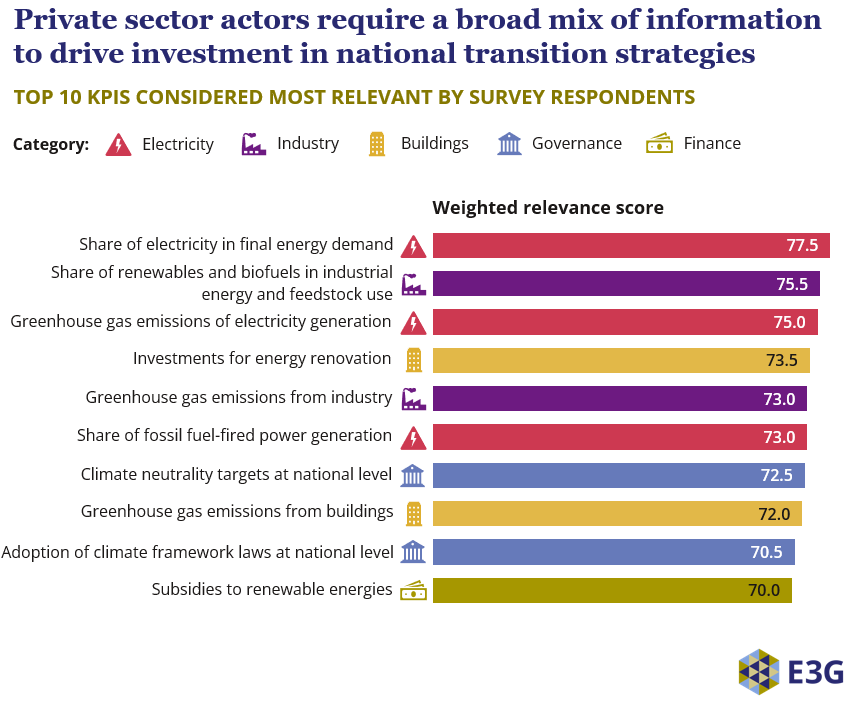
Data should take the form of a multidimensional mix of KPIs
- Information relating to the electricity, industry and buildings sectors should be complemented by cross-cutting data on governance, finance and adaptation policies.
The visibility and usability of data must be improved
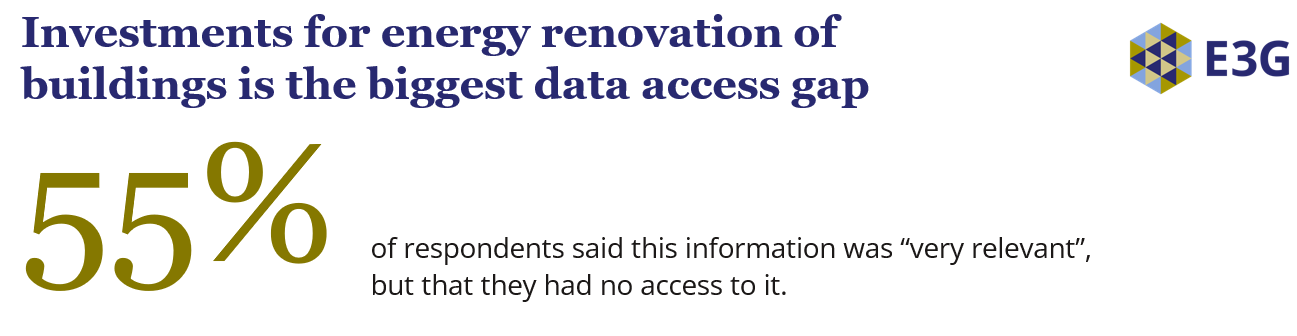
- The private sector can currently only access a limited set of the key metrics surveyed. Data access gaps exist across all categories.
- Information must be provided through a user-friendly online platform that also draws data from other relevant national plans.
Methodology
- The European Climate Neutrality Observatory (ECNO) uses an indicator-based framework to track real-world progress towards a decarbonised economy. Our survey included 58 ECNO indicators from three sectors – industry, electricity and buildings – and three cross-cutting areas – finance, governance and adaptation.
- For each indicator, respondents were asked whether they had access to this indicator, and how relevant it is or would be for their activities.
- Respondents: 14 investors and investor associations; 8 real economy representatives including energy and manufacturing associations and 1 energy company.