
Climate finance access is a critical issue for Small Island Developing States (SIDS) and Least Developed Countries (LDCs), but a common conception of the problem is lacking. Without a clear shared understanding, efforts to reform access risk addressing symptoms rather than root causes. This briefing makes the case that access challenges stem from intersecting structural, supply, and demand problems, and that 2026 presents a critical opening to tackle intersectional barriers to access.
SIDS and LDCs confront clear obstacles in accessing finance to build resilience against climate change. High perceived risk, small economic scale, currency volatility, and limited institutional capacity block their access to capital markets. Their acute need for investment in projects that build local resilience but lack of revenue streams severely limits opportunities for obtaining private capital. The resulting dependence on international public finance intensifies fiscal stress during climate shocks and perpetuates a reinforcing cycle: barriers to access heighten vulnerability, and greater vulnerability increases the hurdles to securing finance, as shown below.
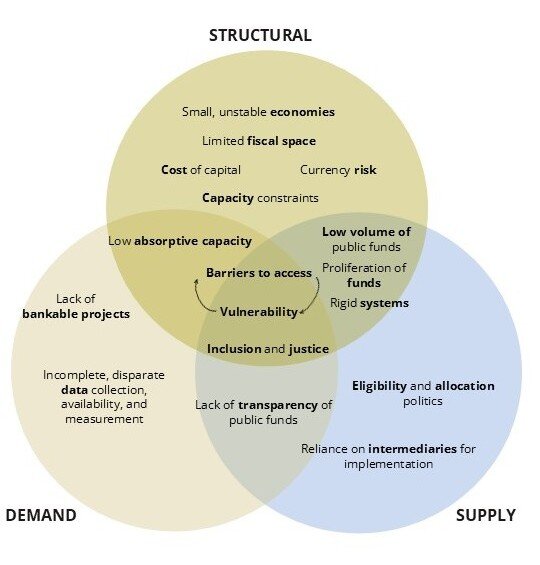
Intersecting barriers: Structural, supply and demand
The contributing barriers to this feedback loop are structural, supply-side, and demand-oriented. Structural barriers are built into the economic realities of SIDS and LDCs: their economies are small and unstable, with financial systems still emerging and institutions and fiduciary standards continuing to develop.
Supply-side constraints arise from fragmented climate funds, with overlapping mandates and rigid, inconsistent access procedures. Allocation is often shaped by income classifications and donor priorities, rather than by vulnerability, and eligibility rules often overlook climate risk.
Demand limitations develop from limited institutional bandwidth, fiscal room, and administrative capacity, reducing what countries can credibly propose and absorb.
These barriers intersect at two key central issues: inclusion and justice in a system where marginalised groups are routinely excluded from decisions about and benefits from finance due to system design, and the vulnerability trap.
Opportunities to build on progress
Some progress has been made. Major funds have issued a joint action plan to streamline procedures, and the World Bank launched a crisis-preparedness toolkit. Climate finance rose to $23.7 billion for LDCs and $3.8 billion for SIDS in 2024. Furthermore, there are clear opportunities on the horizon.
As COP31 President of Negotiations, Australia – working with the Pacific – can mobilise progress on access for SIDS and LDCs and help launch implementation of the New Collective Quantified Goal (NCQG). There are opportunities for intervention and they should not be overlooked; this briefing outlines pathways for progress to dismantle structural, supply, demand, and intersectional barriers in 2026.
Read the briefing in full