
The economics of UK North Sea oil and gas are changing fast. Tax revenues are forecast to drop 98% in just five years, while the clean-up bill is growing. Rosebank and Jackdaw cannot reverse this decline and will not provide meaningful funding for the transition. The UK government should reject exploiting these fields as too big a financial risk to the UK taxpayer. Instead, the government should focus on securing the public’s return from remaining production, making companies pay for the clean-up, and helping North Sea workers secure work in the industries of the future.
What you need to know
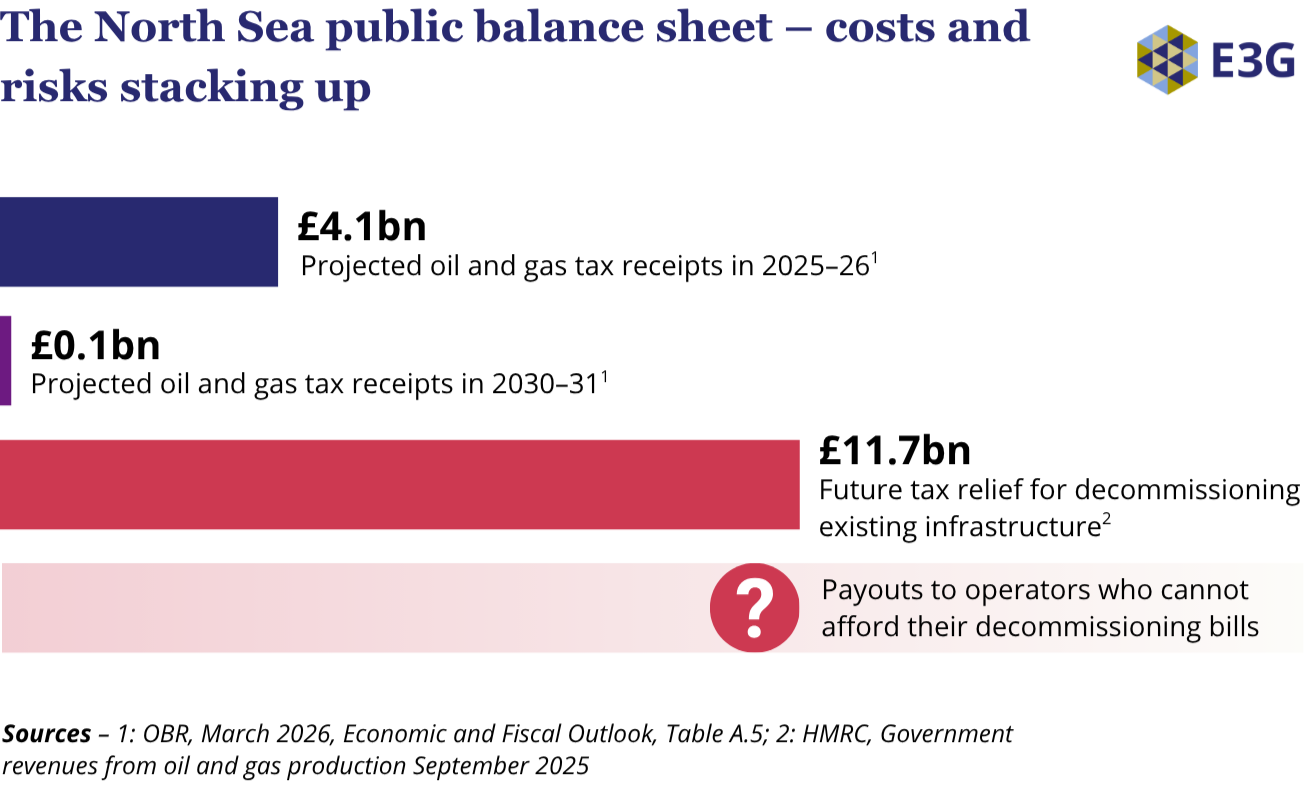
- The North Sea is about 90% drilled out. Tax revenues from drilling are projected to fall to just £100 million by 2030 from £4.1 billion in 2025–26, a 98% collapse within 5 years.
- Even today’s headline receipts are thinner than they seem. The government estimates £3.26 billion of upstream tax relief and support measures in 2025–26, almost negating the projected £4.1 billion tax revenue in that year.
- The Exchequer will need to fund at least £11.7 billion towards decommissioning North Sea oil and gas infrastructure.
- The government has already paid out £355 million in Decommissioning Relief Deeds to a single operator after it defaulted in 2015. The government estimates the Treasury’s exposure could rise to over £23 billion if all operators default.
- Over 500 wells are already overdue for clean-up. 1,000 more are due within six years. Every year of delay adds further cost as ageing equipment degrades and skilled engineers leave the industry.
- New fields risk weakening the economy and slowing down the transition. The Jackdaw gas field will barely dent the UK’s dependence on imports and will not reduce bills. The Rosebank oil field is projected to make a financial loss for the Exchequer.
North Sea revenues are declining dramatically
Some argue that new oil and gas fields will help pay for Britain’s transition to clean energy, but the numbers don’t add up.
The UK North Sea is a declining basin. Oil and gas production has fallen steeply since its peak in the late 1990s, and around 90% of the North Sea is drilled out. New licences may slow that decline at the margins, but they cannot restore the North Sea as a lasting source of public revenue.
OBR’s March 2026 forecasts show the UK’s oil and gas tax revenues falling from £4.1 billion in 2025–26 to £100 million by 2030–31 – a 98% collapse within five years, as production declines and the Energy Profits Levy expires. This levy is due to be replaced by a permanent price-based mechanism, but this does not change the underlying picture that shrinking profits will mean lower tax revenues.
Even today’s headline receipts are thinner than they seem. The government estimates £3.26 billion of upstream tax-relief and support measures in 2025-6, almost negating the projected £4.1 billion tax revenue in that year.
A vast clean-up bill remains – with the taxpayer exposed
North Sea oil and gas infrastructure does not disappear when production ends. Wells have to be sealed to prevent leaks, platforms removed and pipelines made safe, in alignment with the UK’s international commitments to maintain a “clean sea-bed”.
The industry regulator estimates decommissioning existing North Sea infrastructure will cost around £43.4 billion. Companies can reclaim tax they previously paid and reduce their future tax bills when they spend money on the clean-up, which HMRC estimates will cost at least £11.7 billion.
While production is declining, decommissioning costs are likely to rise, pushed up by inflation, higher rig costs, competition for scarce specialist vessels and delays. Over 500 wells are already overdue for clean-up, with 1,000 more due within six years. Every year of delay adds further cost as ageing equipment degrades and skilled engineers leave the industry.
These payments therefore further erode the basin’s contribution to public finances. This is not hypothetical: in 2016-17, government paid out more in decommissioning tax relief than it collected in oil and gas revenue that year. Any new drilling licenses would add to the decommissioning burden in the long term.
Moreover, if an operator can’t cover the bill, the shortfall risks falling on the taxpayer, with the government stepping in as funder of last resort. Previous owners and other liable companies may have to cover the costs first, but any unresolved shortfall could ultimately fall on taxpayers. This risk increases as mature assets are sold from major companies to smaller operators.
The government has already paid out £355 million in Decommissioning Relief Deeds to a single operator after it defaulted in 2015 and estimates the Treasury’s exposure could rise to over £23 billion if all operators default. BP has confirmed it will exit the North Sea and sell its full UK portfolio after 60 years of production, with its decommissioning liability estimated at £2.6 billion. The UK needs to ensure a buyer has enough capital to pick up the decommissioning bill.
The government should secure adequate funding and financial guarantees while companies can still provide them, rather than allow risks to accumulate as fields approach closure.
Moreover, as long as risks are reduced for UK taxpayers by ending new oil and gas fields, the government should act to secure more of the decommissioning market for UK-based companies. This is a significant opportunity for UK workers and businesses to build on existing expertise and export these into a global market estimated to be least $200bn. However, while UK-based companies secured about two-thirds of the value of decommissioning contracts in 2025, that proportion has begun to fall.
Rosebank and Jackdaw will add to the economic burden
Rosebank and Jackdaw are two of the largest undeveloped oil and gas fields in the North Sea. Their previous approvals were quashed after legal challenges over how the projects’ climate impacts were assessed. The government should now reconsider the economic case as well.
These new fields cannot reverse the basin’s decline or restore public revenue flows. A key test for Rosebank and Jackdaw is therefore whether further drilling improves the public balance sheet or adds to its risks. A project can make money for its owners without being a good deal for taxpayers.
Rosebank is the UK’s largest undeveloped oil field, lying around 80 miles north-west of the Shetland Islands. Analysis by WWF Norway, published by Uplift, estimates that, at an oil price of $70-a-barrel, operators could make £1.5 billion in profit while the Exchequer records a net loss of £258 million. At $40 a barrel the developers would still make about £445 million, while the Treasury’s loss could reach £1.3 billion. While not official figures, they challenge the assumption that a large oil field will generate money for the transition.
Jackdaw is a proposed gas field that has been presented as important for energy security. But it would only reduce the UK’s import dependency by 2% and the government itself has said it will not materially reduce household energy bills.
Adura, the field’s operator, projects that Jackdaw and Rosebank together will generate £1.4 billion in tax revenue by the end of this parliament – but that does not establish a net public return. Adura has not published the assumptions, including whether the figures are net of allowances, decommissioning relief and existing tax losses. The return to the Exchequer could therefore be significantly lower than this figure suggests, once losses and reliefs are accounted for – and the field may even become a liability.
Jackdaw cannot be justified in terms of job creation either, since it will sustain only 27 new jobs, according to the operator’s own assessment.
The wider economic cost of climate change
Climate damage is a growing cost for the UK economy and public finances, and should be factored into any approval process for these projects.
The OBR estimates that, under current policies, climate damage could leave the UK economy almost 8% smaller by the 2070s and increase annual government borrowing by over 4% of GDP by the early 2070s – roughly six times the cost of the net zero transition itself. These economy-wide costs cannot be assigned to Rosebank or Jackdaw alone, but they explain why an assessment of public benefit must include climate impacts.
What the UK government should do now
- Reject Rosebank and Jackdaw. These developments are not consistent with climate safety, could encourage other countries to develop new fields, and are too big a financial risk for UK taxpayers.
- Publish the full public lifetime cost of Rosebank and Jackdaw, as part of a decision, to raise public visibility of the financial risks to taxpayers of further drilling. This should include assumptions and show tax receipts, public support measures, tax relief and decommissioning costs, testing lower prices and repeated price shocks.
- Require oil and gas companies to set aside money for decommissioning upfront, so taxpayers are not left with the bill. This could be achieved by mandating a ring-fenced, discount-accumulating fund and ensuring companies buying mature North Sea assets can afford to meet their clean-up obligations. At a minimum, Decommissioning Relief Deeds should not be signed for Rosebank and Jackdaw.
- Strengthen the successor to the Energy Profits Levy to ensure the tax system secures a fair public return from remaining production and supports workers through the transition.
- Back North Sea workers, supply-chain companies and engineering, design and services companies to move into decommissioning, offshore wind, carbon capture and other industries with a long-term future.
- Legislate to make the ban on new licences permanent (i.e. via the forthcoming energy independence bill), to provide certainty to investors and make it harder for a new government to change course.