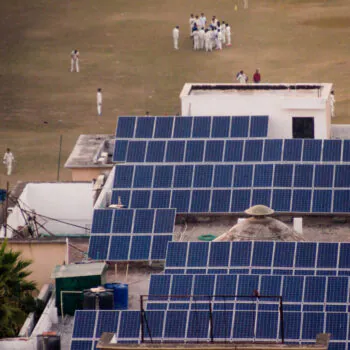

- At next week’s 16th EU-India Summit in New Delhi, long-running free trade agreement (FTA) talks are expected to conclude with a deal. This creates a timely opportunity to make clean technology manufacturing a central part of the relationship.
- Clean tech manufacturing and deployment now sit at the heart of industrial strategy, trade policy and international partnerships, driving economic resilience, energy security and geopolitical influence.
- The EU and India have complementary strengths across wind, batteries and solar that can underpin a green industrial partnership.
- The EU-India FTA should be seen as a platform for deepening clean economy co-operation – not as an end point.
Story
As India’s Prime Minister Narendra Modi prepares to host European Commission President Ursula von der Leyen and European Council President António Costa at the EU-India Summit in New Delhi, the moment offers a critical opportunity to deepen the strategic partnership beyond the Free Trade Agreement – by making clean tech cooperation a core pillar of the relationship.
The irreversible shift to a clean economy is reshaping energy security, industrial competitiveness and geopolitical alignments around the world. Global clean-energy investment now exceeds fossil-fuel spending, and the ability to manufacture, trade, and deploy clean technologies has become central to national resilience, economic strength, and geopolitical influence.
For both the EU and India, this transition is no longer driven by climate goals alone. Clean-tech manufacturing and deployment now sit at heart of industrial strategy, trade policy, and international partnerships. This was noted by India’s Vice President C. P. Radhakrishnan in his recent address at the Bharat Climate Forum where he said climate action is not a constraint on India’s development but a strategic opportunity to drive inclusive growth, strengthen energy security and build a future-ready economy. Clean-tech manufacturing should be central to this vision.
The shared value of EU-India clean trade
Against this backdrop, the Summit and FTA negotiations signal a desire to strengthen the strategic partnership and widen cooperation to support energy security, resilience, economic growth and stability for both sides. It can also lead to a deeper EU-India partnership in clean manufacturing that delivers growth and jobs, while strengthening supply chain resilience, accelerating clean energy deployment and contributing to a more balanced global clean-tech ecosystem.
At a time of geopolitical fragmentation and growing concentration risks in critical supply chains, cooperation can help both the EU and India reduce strategic vulnerabilities while building domestic industrial capacity.
For the EU, India offers scale, cost-competitive manufacturing and a trusted partner for diversifying clean-technology supply chains as Europe accelerates its energy transition.
Partnership with the EU can support India’s ambition to become a global clean-energy manufacturing hub. It will also help India diversify its export markets, while strengthening domestic value chains across clean tech supply chains.
The economic opportunity is substantial. India’s clean-technology market could reach USD90–135 billion by 2030 across solar, wind, batteries, hydrogen, electric vehicles and grid equipment. Read more on how EU-India cooperation can scale across 3 key areas: solar, wind and batteries.
These benefits can be catalysed by a robust EU-India partnership that allows each side to play to their existing technological and sectoral strengths, creating a stable framework for trade and investment that supports jobs and growth. In this context, the EU–India Free Trade Agreement should be seen as a platform for deepening future cooperation – not as an end point.
Quotes
Manon Dufour, Executive Director of E3G’s Brussels office, said:
“The EU-India summit is an opportunity for Europe to demonstrate that it can act strategically in a more contested world. Securing a comprehensive trade deal would reaffirm the EU as a reliable and collaborative partner, and mark a major achievement for von der Leyen’s Commission after nearly two decades of negotiations. More broadly, Europe is beginning to move beyond a year of reactiveness — accelerating partnerships from Mercosur to India and recognising that, in a world shaped by the US and China, major powers below that scale must cooperate to retain agency. Deepening ties with India is not just about trade, but about shaping a more resilient, competitive clean economy and a stable geopolitical order.”
Matthew Webb, Associate Director of Global Clean Power Diplomacy at E3G, said:
“The EU-India clean-energy partnership is no longer about [just] ambition — it is about resilience. A deeper strategic partnership between the EU and India can be an anchor in turbulent times and can offer mutual benefits by increasing cooperation and trade in clean energy. Europe’s push to diversify clean-tech supply chains and India’s ability to manufacture at scale create a shared opportunity to reduce strategic dependencies through co-investment to accelerate deployment in wind, batteries, and solar. As the EU–India FTA nears agreement, this is a key moment to lock in clean technology as strategic infrastructure for the 2030s.”
Madhura Joshi, Programme Lead – Asia at E3G, said:
“The EU is already India’s largest trading partner. Strengthening EU-India’s strategic partnership has the potential to boost economic growth, build resilience, improve energy security, and build a future-ready, collaborative relationship. An FTA between EU and India has been long in the making. Concluding the discussion can be the building block for something more ambitious: a partnership on clean energy that goes beyond trade. Both sides face a common challenge: building clean energy industries without concentrated dependency. The complementarity is real, the opportunity is significant, and the timing is right. A deeper partnership with clean tech as a foundation would build resilience, not just for both regions, but for global clean energy supply chains.”
Ellie Belton, Senior Policy Advisor – Trade at E3G, said:
“Completion of the EU-India FTA will be a landmark moment, marking a significant step towards strengthening the strategic partnership between two of the world’s largest economies. Building on this agreement to deepen cooperation in clean technology sectors and value chains will not only help to deliver shared decarbonisation goals, but is also in the interests of both sides’ geopolitical resilience, economic security and long-term prosperity.”
Available for comment
Madhura Joshi, Programme Lead – Asia
madhura.joshi@e3g.org | +91 9650783893
Nakul Sharma, Senior Policy Advisor – India
Nakul.sharma@e3g.org | +91 9716647408
Ellie Belton, Senior Policy Advisor – Trade; CBAM
ellie.belton@e3g.org | +44 (0) 7712 537878
Notes to editors
- E3G is an independent think tank working to deliver a safe climate for all. We drive systemic action on climate by identifying barriers and constructing coalitions to advance the solutions needed. We create spaces for honest dialogue, and help guide governments, businesses and the public on how to deliver change at the pace the planet demands. About E3G
- For further enquiries, email press@e3g.org or phone +44 (0)7783 787 863
- Register for our journalist WhatsApp briefing service to receive updates and analysis for key geopolitical and climate events over 2026 on the road to COP31: E3G WhatsApp registration for journalists