
Governments and businesses are putting electrification at the top of the international agenda as a practical response to the twin energy and climate crises. Electrification reduces dependencies on volatile, insecure and polluting fossil fuels by supporting the build-out of renewable assets, improving energy system management and delivering efficiency gains – but for the electrification push to be effective in realising these benefits faster, it must be backed by increased international financial support for grids and storage and drive progress in national plans, including roadmaps to transition away from fossil fuels.
Electrification is emerging as a global priority
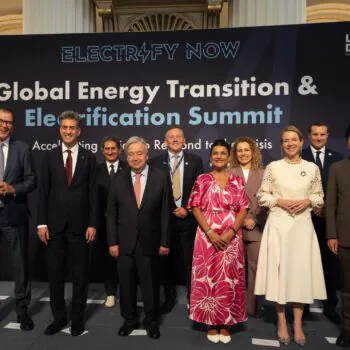
As another major global energy shock lays bare the economic and security risks of reliance on volatile fossil fuels, governments and business leaders gathered at the first Global Energy Transition and Electrification Summit, during London Climate Action Week, which included the launch of the Electrify Now campaign. Scorching temperatures in the city served as a stark reminder for delegates, in a hot, jam-packed room, that climate impacts are accelerating, and delivery of the global energy commitments to triple renewables, double energy efficiency by 2030, and transition away from fossils cannot fail.
Headlined by the UN Secretary General, António Guterres, the Summit saw UK Energy Secretary Ed Miliband joined by the President of Palau, Surangel S. Jr. Whipps and government representatives from Türkiye, Australia, Ethiopia, Colombia, Brazil, and the European Union. Together they set out both how they are going to accelerate the pace of the transition from fossil fuels towards clean electrification, to deliver resilience in the face of crisis and build a sense of shared direction in the lead-up to COP31 in Antalya.
Business leaders reinforced this momentum. A recent poll found that 79% of business leaders say geopolitical instability has made their own business shift to electrification more urgent, while 82% want their country to be powered mainly by renewable electricity to enable a shift away from fossil fuels. Even in coal-intensive markets, two-thirds want coal out of the power mix by 2035.
Electrification can help deliver global energy goals
This show of political will follows Türkiye’s COP31 President Murat Kurum’s announcement that electrification will be included in the COP31 Action Agenda. The proposed 35% by 2035 target – which is in line with IRENA and IEA 1.5 °C- aligned scenarios – would require a major acceleration in the shift from direct fossil fuel use to clean electricity across buildings, transport, and industry.
It is an important signal that the world is committed to increasing its efforts to deliver against global energy commitments agreed under the first global stocktake of the Paris Agreement. By elevating the energy transition and electrification as a global priority, the COP31 Presidency can help align the policy and investment needed to accelerate renewable energy deployment, boost energy efficiency, and transition away from fossil fuels.
Electric technologies like electric vehicles and heat pumps are on average three times more efficient than combustion-based systems (Ember, 2025), meaning electrification can deliver the same services with far less energy. This is significant: it improves energy productivity and provides a fast demand-side route to reducing fossil fuel use, helping countries deliver faster against their NDCs.
Electrification can also drive renewable investment by providing the market pull to accelerate the renewable energy build-out.
Turning energy ambition into delivery
COP31 is the moment to show that global energy goals are being implemented. However, leaders must turn the growing momentum for electrification into a collective, sustained multi-year delivery effort that drives the transformation of existing energy systems and helps emerging and developing countries improve energy access and to grow their economies through green industrialisation.
As the UN Secretary-General stated at the Summit, the question now is whether this push for electrification can be turned into a substantive platform of change that accelerates the deployment of grids and storage infrastructure, mobilise the investment at the speed and scale required. This can answer the call from global business leaders that are frustrated at the pace of delivery– over two-thirds say businesses are electrifying faster than governments are preparing the system, while 80% also support national investment in grid upgrades and storage.
Moreover, the COP Presidencies should ensure electrification is supported by increased international finance commitments and aligned with credible plans to continue the Santa Marta and Brazilian TAFF Roadmap process. This will ensure that the transition is driven across different sectors of the economy and is also secure, just and orderly for producer and consumer countries to successfully transition away from fossil fuels and towards clean and resilient economies.
Leaders must throw their weight behind this renewed momentum to ensure the strongest economic and security gains of the transition are realised as a response to the current energy crisis when they meet in Antalya. This should become the foundation towards a successful second global stocktake outcome in 2028 that steps up existing ambition with a new set of clean energy goals for 2035.