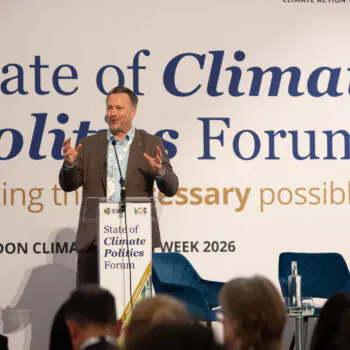

Twenty years after the UK first brought climate to the UN Security Council, the topic is re-emerging as a strategic priority. During London Climate Action Week, at E3G and King’s College’s inaugural Climate Security Forum, the UK announced its first ever Climate Security Taskforce, co-chaired by the Ministries of Climate and Defense. Across the forum, five governments delivered the same message: climate now underpins economic, political and security stability.
The question is no longer whether climate change matters for security, but how governments will adapt their institutions, strategies and partnerships to this new reality. Four reflections stand out.
This is not a niche environmental conversation; recent events continue to reinforce the point. Record heat is affecting Europe, the United States and much of the world, straining power grids, health systems, and harvests. It forced schedule changes and player-safety measures at the World Cup across North America. Wildfires across Canada have burned uncontained, pushing hazardous air across the continent. Conflict in the Middle East has once again threatened hydrocarbon, agricultural and other supply chains while putting the Strait of Hormuz at the center of security planning. Meanwhile, melting Arctic routes are opening a new theater of geopolitical competition, and insurers keep pulling away from exposed assets.
Climate risk and geopolitical risk are becoming increasingly intertwined. As climate converges with competitiveness, energy and hard security, more governments are incorporating climate security in their National Security Strategies and other strategic documents. The challenge now is less about recognizing the risks than building the institutions, policies and international cooperation needed to respond effectively:
- A new phase. The first generation of climate security work, which E3G helped build, focused on demonstrating that climate change creates security and resilience risk. Across much of the political landscape, that argument has largely been won. Climate is no longer simply a threat multiplier. It is becoming a geopolitical force in its own right, reshaping energy systems, trade, industrial strategy, migration and state resilience, and competition over critical minerals and clean-tech supply chains. Climate is not just affecting geopolitics; geopolitics is increasingly shaping what is possible on climate. Analysis, strategy, and institutions must now catch up rather than continue refighting yesterday’s debate.
- The institutional response is growing but needs sharper focus. Governments are acting. Alongside the UK’s Taskforce, Germany’s 2025 national climate risk assessment treats climate as a direct risk to resilience and European security. Japan incorporated climate into its 2022 National Security Strategy, while as far back as 2018 the Pacific Islands Forum’s Boe Declaration identified climate change as the single greatest security threat to the region. Today, more than 60 countries reference climate and security in national or defense strategies. Yet as geopolitical fragmentation deepens and trust in institutions weakens, there is a risk that the language spreads faster than meaningful action. Some of the greatest security risks may stem not from climate impacts alone, but from failures of cooperation and disorderly, militarized or protectionist reactions that generate insecurity of their own. The priority now is to translate growing political attention into practical policy.
- A broader concept that reflects a changing global order is needed. A credible agenda must bring together defense, diplomacy, development, finance and resilience, or we risk securitizing climate without improving security. That means embedding climate across foreign and security policy, including within the offices of policy planners, rather than confining it to environment ministries. It also means that much of the world does not experience security through a military lens first. For Pacific Island states, climate is already an existential threat. For emerging powers such as Indonesia, the entry points are disaster response, maritime security, and the energy transition. For others, the challenge is ensuring critical minerals and supply chains create shared prosperity rather than reinforcing insecurity and instability.
- Climate finance is part of the security response. Defense spending is rising while development and overall foreign assistance budgets are cut, shrinking fiscal space (including addressing climate impacts through increased adaptation and resilience) just as risks accelerate. Yet some new defense financing instruments omit climate altogether. The Canadian-led Defence, Security and Resilience Bank, which just gained eight new supporters, places resilience at its core while defining it in narrowly military terms. Resilience that ignores climate is not resilience. Closing the adaptation gap, reforming the development banks, and budgeting for climate risk are also critical tools that must be incorporated in the security conversation.
Watch the next few months for whether this holds. The UK’s Climate Security Taskforce has the opportunity to deliver more than a risk register; its success will depend on whether its findings move into foreign policy, national security strategy, and the UK-EU reset. In September, climate security will also feature prominently during the UN General Assembly and New York Climate Week. Meanwhile, physical climate risk will continue to intensify. A strong El Niño is forecast to intensify heat, drought, and food stress through the coming months, testing whether these institutions can respond at the pace events now demand. The opportunity to build a credible, well-defined agenda is real. Whether governments fill it with substance, or settle for the language, is the question worth watching.