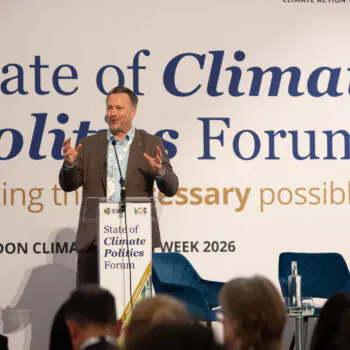

The United Nations General Assembly (UNGA) opens this month in a world pulled in several directions at once. Wars grind on in Ukraine and escalate across the Middle East, geopolitics remains center stage with the world order being reshaped in ways still uncertain, multilateral institutions are being tested and defunded, and this is the last UNGA of UN Secretary-General António Guterres’s tenure, with the choice of his successor underway. It would be easy, in this backdrop, to treat climate as a problem for calmer times. That would be a mistake.
Two shocks this year make the point. Disruption around the Strait of Hormuz has pushed instability straight into energy markets and household bills far beyond the Gulf. At the same time, a strengthening El Niño is amplifying a brutal year of impacts already, including record heatwaves that killed thousands across Europe, wildfires in Canada, droughts threatening harvests, power supply and the coral reefs coastal economies depend on, and melting glaciers leading to tragedies such as in Nepal. These disasters, and UNEP’s latest assessment, are a blunt reminder that the world is still off track on its climate goals. Economies built on volatile fossil fuels and unmanaged risk are exposed, and clean, diversified, resilient systems are the hedge.
The task for leaders arriving in New York is to make the case, plainly, that climate action – at home and in cooperation with others – is how you deliver security, affordability, stability and growth in a dangerous decade, and to carry that argument into the year ahead toward COP31 and beyond. Credibility will rest on what they say and what they bring.
At this year’s UN General Assembly and Climate Week NYC, we hope to see the following.
Leaders should say directly that energy security, lower bills and industrial competitiveness now run through the clean economy, and that the Hormuz shock, intensifying climate impacts and this year’s El Niño are arguments for accelerating action and placing climate at the top of the agenda. Clean, electrified and diversified energy gives countries control over their own supply and shields households from the next price spike and economies from disruptions at critical chokepoints. Energy and economic security, affordability and climate action are one agenda, and leaders should speak about them that way.
The Secretary-General made climate a defining priority. With his term ending in December and his successor about to be chosen, the responsibility now falls to member states to protect that legacy and insist that the next Secretary-General keeps climate at the center of the UN’s work. Countries should back the Secretary-General’s High-Level Meeting on Climate Action and the Just Transition on 23 September and treat it as a handover for others to take the baton, not a farewell. The appointment of a new Secretary-General creates an opportunity to both support and reimagine the role of multilateralism, and the UN in particular, in a more fragmented world, making it more effective, representative and legitimate. At the same time, it is important to defend what still makes the UN unique: a global forum where even adversaries meet, backed by an institutional architecture that remains central to peace and international security, humanitarian action, climate cooperation and development.
The clean economy is now the center of gravity: renewables made up more than 90 percent of new power capacity last year, and global investment in the energy transition has passed 2 trillion dollars a year. Leaders should commit to faster electrification, deployment of renewables and credible timelines to phase out coal and wind down oil and gasto cut exposure to imported fuel. This is where security, affordability, and emissions cuts meet. And as the process for the second Global Stocktake will demonstrate already at COP31, countries that have not yet submitted strengthened national climate plans should do so, with the largest emitters leading by example.
Intensifying climate impacts across developed and developing countries requires urgent focus on adaptation and resilience, with climate finance and adaptation investments being treated as part of the core security-related spending that governments make in times of crisis. This must include greater support for countries facing the gravest climate risks but unable to invest adequately in resilience because debt burdens and the high cost of capital are consuming limited fiscal space. This should include supporting the countries facing the gravest risks but cannot invest in resilience due to debt and the high cost of capital consuming their budgets. Leaders should press for more grants and targeted concessional finance, a reformed and more effective development financial system, debt solutions and mobilization of private finance that free up fiscal space and use the high-level meeting on sea-level rise to put adaptation, insurance and loss and damage where they belong, at the center of the agenda. Every dollar spent preparing for climate shocks returns many times over.
As the IPCC prepares its next assessment, its authority and the observation systems behind it are under growing pressure, and misinformation is corroding public trust and risks delaying climate action. Leaders should make a visible stand for the evidence that guides sound policy and back the widening coalition of countries committing to information integrity.
No country solves this alone. The Paris Agreement showed that coordinated action can bend the curve; a decade on, projections have come down from well above 4 degrees toward 2. That progress is real and unfinished. Geopolitical tensions have even contributed in accelerating implementation as wars and energy import disruptions following Ukraine and the Iran wars are accelerating the clean energy transition. We are also seeing progress on the multilateral cooperation agenda each year, with implementation driven forward by markets, and better incorporated and elevated within the UNFCCC system and throughout the year at Climate Weeks. Climate Week NYC must act as a bridge between the UN system and the real world action powering communities, businesses and economies. In a more divided moment, keeping climate cooperation working, through the UN and through new coalitions willing to move from agreement to delivery, is itself a strategic act.
None of this is abstract. Whether farmers can bring in a harvest, whether families can afford to keep the lights on, whether islands and coastlines stay livable; these are the stakes leaders carry to New York. UNGA81 is the moment to show that climate leadership is not a luxury of quieter years but the engine of security and prosperity in this one, and to build the momentum that carries into COP31 and beyond.
E3G will be participating in UNGA and Climate Week NYC. To connect with us, please contact E3G via press@e3g.org.