
The Asia Zero Emission Community (AZEC), Japan’s flagship initiative for regional decarbonisation cooperation, has seen major changes in its operating environment in 2026. While Japan emphasises measures to improve fuel supply stability, many member countries are looking at accelerating clean energy expansion. One such country is the Philippines, this year’s host of AZEC’s high-level meetings. Our new case study on AZEC in the Philippines highlights significant opportunities for grids and clean energy cooperation.
Southeast Asian countries have been heavily impacted by the effective closure of the Strait of Hormuz and the ensuing energy market crisis. Japan has reacted to the turbulence by announcing updates to its AZEC initiative, emphasising energy resilience as a core principle of “AZEC 2.0”, and launching the $10 billion “POWERR Asia” financial cooperation package to support partner countries’ energy procurement. While providing financial assistance to countries grappling with the impacts of the ongoing crisis is a welcome step, the announcement has also raised concerns that the package may be skewed toward fossil fuel-related approaches both in the short and long-term.
Amid these changes, it is expected that the promotion of tangible projects and investments between Japanese and member countries will retain its role at the core of AZEC. Our first analysis of the AZEC deals, published in 2025, indicated the portfolio of these agreements varies significantly from country to country.
Our new analysis turns spotlight on the Philippines, the host of AZEC’s high-level meetings in 2026.
AZEC in the Philippines – limited progress, large opportunities
The Philippines – the host of high-level AZEC meetings in 2026 – has the fifth largest number of AZEC agreements, with 33 agreements published between 2023 and 2025. The country has frequently emphasised its interest in Japanese technologies, particularly in renewable energy and grid modernisation, and sees these as key to improving its energy security by reducing reliance on imported fossil fuels.
The Philippines’ own energy plans see renewables covering over 80% of new power capacity additions toward 2050, and renewables development has been fast-tracked as a response to the energy crisis. Accelerated clean energy scenarios are also currently being developed. However, our analysis found that AZEC has generated very few agreements in the field of clean energy in the country.
So far, the majority of the 33 Memoranda of Understanding (MOU) signed between Japan and the Philippines under AZEC focus on agriculture and land-use. The agreements include just two MOUs with notable inclusion of renewable energy, and only one of them is centred on a concrete renewable power project. However, the project is significant as one of the larger onshore wind projects in Southeast Asia, currently being planned at a scale of 103.5 MW. One MOU promises to consider financing for renewable projects in the future.
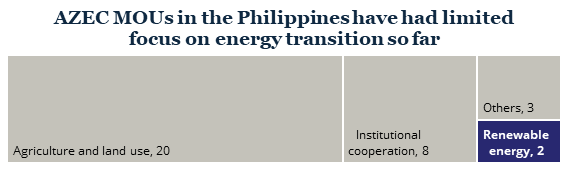
Distribution of cooperation areas in AZEC MOUs in the Philippines. E3G analysis of AZEC MOUs between Japan and the Philippines release in 2023-2025.
Other AZEC partner countries have seen Japanese projects in technologies including solar power, geothermal, hydro power, industrial park decarbonisation, and use of green hydrogen or ammonia in industrial facilities. This range of clean energy technologies would be applicable to the Philippines as well, indicating Japan could support more clean technology-focused MOUs in the country going forward.
No deals that explicitly support fossil fuel projects were identified among those signed in 2023–2025. However, LNG has been mentioned as potential area of cooperation between the two countries. One MOU highlights the intention to explore the use of carbon credits to facilitate the managed phase-out of coal, but no details about potential target facilities have been disclosed.
To date, the published MOUs include no information about the provision of financing by Japanese public or commercial financial institutions, though both have signed MOUs with Philippine counterparts.
Recommendations
The opportunity for accelerating AZEC’s support for power sector decarbonisation in the Philippines is clear. As the country plans to reduce dependency on imported fuels, modernise its grid infrastructure and significantly scale up renewables and storage, Japan should align its offer with these needs.
Going forward, Japan and the Philippines could:
- Prioritise utilising Japan’s capabilities in grid development and modernisation in future deals.
- Consider establishing an energy efficiency programme in the Philippines, similar to the AZEC SAVE initiative in Thailand, to identify solutions deployable in the near to medium term to lower dependency on imports amid ongoing fossil fuel supply and price challenges.
- Diversify the types of renewable energy projects pursued, and expand support for clean power sector development in alignment with the Philippines’ renewable energy growth goals. In particular, explore opportunities in agrivoltaics and geothermal.
- Scope opportunities for additional wind projects and share experiences with other AZEC countries pursuing wind development, building on Japan’s offshore wind technology export vision laid out in the “17 Strategic Fields” Roadmap.
- Ensure that potential energy crisis-response funding through the POWERR Asia initiative is directed to measures that reduce fossil fuel dependencies and do not cause long-term lock-in to new fossil fuel infrastructure.
Read the full briefing and recommendations on AZEC in the Philippines here.