

The increasingly turbulent geopolitical context makes strong trade partnerships an economic, political and security priority. The EU cannot afford to take the risk of global backlash to its Carbon Border Adjustment Mechanism (CBAM) undermining this agenda. In the ongoing review of the CBAM, the European Commission is focusing on improving the measure’s resilience and addressing concerns from EU industry. But persistent criticism of the CBAM from external partners has not yet been adequately addressed. To safeguard the CBAM and strengthen international cooperation, the EU should revamp its approach to carbon pricing diplomacy.
The CBAM is a cornerstone of the EU’s industrial decarbonisation strategy. It preserves a level playing field for EU industry and maintains the pace of decarbonisation. Safeguarding the measure is both an economic and a climate priority.
But in the current context, where competitiveness and resilience are at the top of the EU’s political agenda, there is a growing risk that trade partners interpret the CBAM primarily as a protectionist measure, which could undermine the EU’s global agenda. This is unfolding at a time when the trading system is subject to unprecedented tensions, and volatile geopolitical dynamics are reinforcing the importance of trusted partnerships to deliver economic security and trade diversification benefits.
In our briefing, we argue that it is becoming increasingly important for the EU to reset its approach to CBAM diplomacy to ensure that the CBAM is both domestically resilient and strengthens its international partnerships, rather than obstructing them.
The EU needs a flexible approach to CBAM diplomacy
Key EU trade partners have reacted in a variety of ways to the introduction of the CBAM. These reactions range from countries adopting their own carbon pricing schemes, through technical-level cooperation to circumvention or outright opposition. Not all trade partners fit neatly into one category.
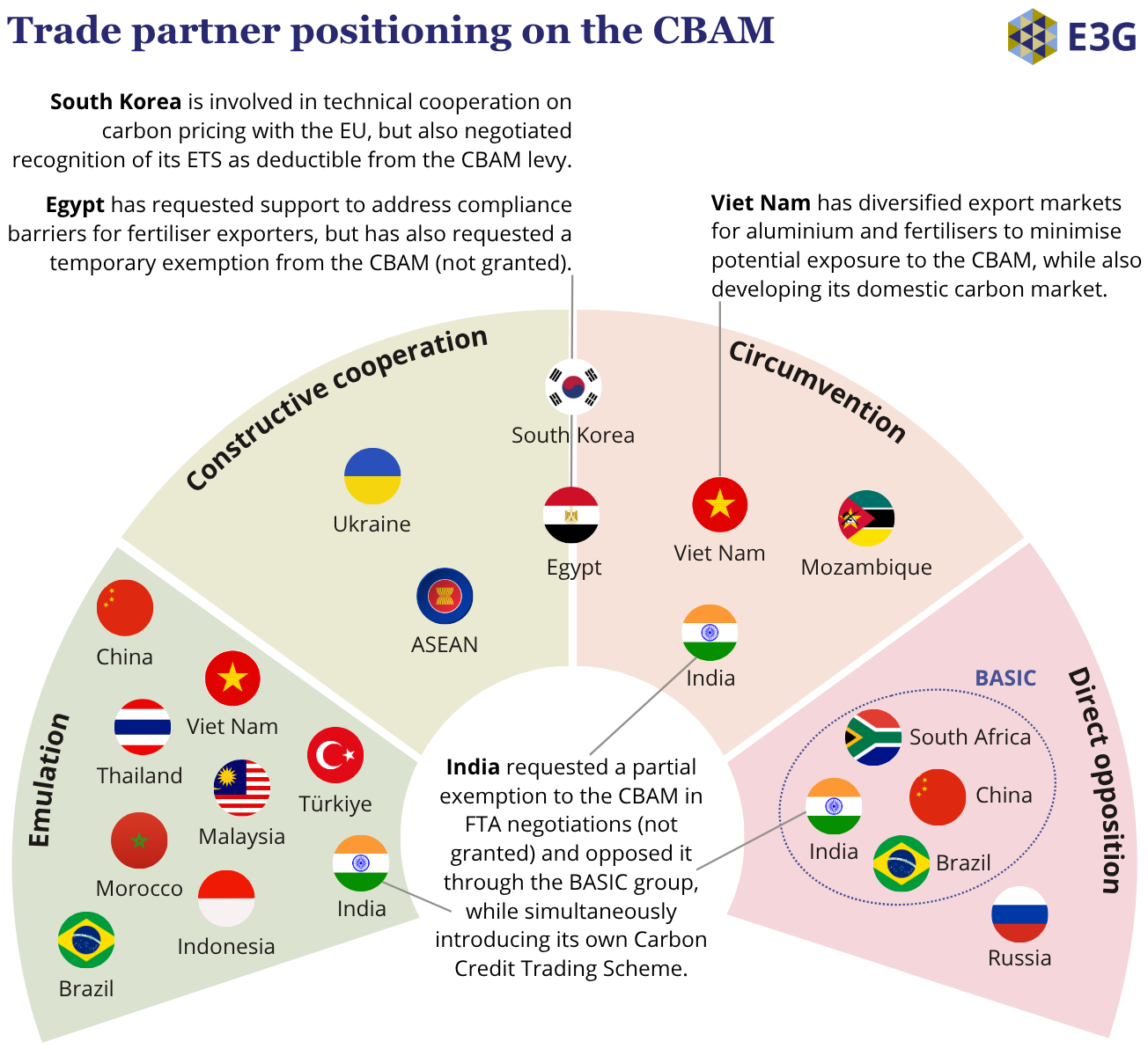
The European Commission and individual member states have already begun taking remedial action to alleviate criticism. The EU has built an impressive toolkit for international cooperation on carbon pricing, and the introduction in 2025 of a “de minimis” mass-based threshold for operators to be within scope of the CBAM should significantly reduce the administrative burden on trade partners.
But despite this, criticism remains. Several proposals in the December 2025 revision package – though in some cases necessary for the effective functioning of the CBAM – could introduce further challenges for trade partners. The anticipated revisions could therefore provoke further global backlash against the CBAM, which risks impeding the EU’s economic and political relations at a critical time.
Opportunities to strengthen CBAM diplomacy – recommendations to the EU
- Improve support for developing countries, by seeking win–win outcomes for the EU and its trade partners. Leverage bilateral partnerships to support decarbonisation in CBAM-affected third countries, and strengthen existing technical assistance and capacity building.
- Advance regulatory coordination. Demonstrate EU commitment to promoting a fair and open clean economy by leading efforts to improve the interoperability of national carbon pricing systems and border adjustment mechanisms.
- Enhance CBAM communications to better demonstrate the support that is available. Engage proactively and constructively with trade partners on the impacts of the CBAM, and participate constructively in international initiatives.
Download the full briefing for more in-depth evaluation of the international implications of the CBAM in the context of the EU’s wider trade and climate agenda, and detailed recommendations.