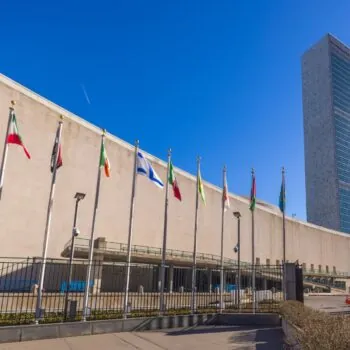

As the United Nations General Assembly (UNGA) opens in New York, the Secretary General will host a Special High-Level Event on Climate Action on 24 September, a chance for countries to present their updated nationally determined contributions (NDCs). The original February deadline was missed almost universally, with some exceptions including Brazil, the UAE, the US under the previous Administration, and the UK’s 1.5°C-aligned plan. The final date for NDCs to be included in the official synthesis report is 30 September.
What countries put forward now will shape COP30 and signal whether the 1.5°C and 2°C targets remain within reach. Ahead of this critical moment, this blog addresses what’s at stake and how to move forward on NDC delivery.
Why NDCs Matter
NDCs, updated every five years, are how governments put the Paris Agreement into practice. Far from a technical formality, they send powerful policy signals that guide domestic reforms, shape regulatory priorities, and galvanise action at the domestic and international levels.
In addition, ambitious NDCs allow countries to seize the momentum of the energy transition, serving as blueprints for jobs, resilience, energy security and economic opportunity. Solar and wind are expanding at record pace – with clean power surpassing 40% of global electricity generation in 2024 – clean tech is getting cheaper and more efficient, and clean industries are becoming engines of growth. Several countries are now completing their coal exits: the UK and Ireland closed their last coal plants in the past year, with Spain and Italy set to follow shortly. Countries that miss the economic opportunity of NDCs risk locking their economies into an obsolete, fossil-dependent model.
Uneven progress towards Global Stocktake energy goals
E3G’s NDC Energy Commitments Tracker provides an early indication of where momentum lies in NDC energy planning – and where it is lacking. Of the 32 countries that had submitted NDCs by early September – covering about one-fifth of global emissions – 94% included a policy commitment supporting one or more of the tracked elements of the energy package agreed at COP28: tripling renewables, doubling efficiency, phasing down unabated coal, transitioning away from fossil fuels, and reducing fossil fuel subsidies.
These commitments show countries are incorporating energy transitions into climate and development planning, yet none have commitments across the full package. Progress is strongest on renewables, with over 70% of submitted NDCs including quantified/timebound targets. Furthermore, almost all (91%) reference efficiency, though less than half set quantified/timebound goals – reflecting the fact that much more needs to be done to meet the 2030 global efficiency goal. By contrast, commitments on transitioning away from fossil fuels, and phasing out inefficient fossil fuel subsidies, remain sparse. Out of 17 fossil-fuel-producing countries, only two, Canada and the UK, reference production declines.
This imbalance shows how governments are capitalising on the clear benefits of renewables, but selective policy commitments, which avoid transitioning away from fossil fuels, risk locking countries into energy addition rather than true energy transition. Stronger coordination is needed to build the political will for the managed phase-out of fossil fuels: namely a clear response by countries and across the multilateral system that recognises progress, highlights shortfalls, and urges governments to accelerate transitions through sectoral targets and domestic policies.
Ambition shortfall and what’s needed
While key emitters such as Australia, Mexico, Indonesia and South Africa are expected to submit stronger 2035 NDCs, what could have been a year of ambition has instead been overshadowed by delays and weak leadership. Due to internal divisions, the European Union will present a provisional or “indicative” target range in New York (66–72.5% below 1990 levels by 2035), rather than a full NDC.
Meanwhile, China, the world’s largest emitter of greenhouse gases, is expected to submit a target range of around 10% by 2035, well below what its responsibility and crucial role in the energy transition would require. Without timely and strong commitments from key players, diplomatic momentum faltered and the chance to rally others was lost.
Closing the gap at COP30 and beyond
Even after the anticipated wave of new NDC announcements, current levels of ambition will be insufficient to keep 1.5°C within reach. This means closing the gap between what is needed and existing NDC pledges should be at the centre of discussions at COP30 in Belém. Decisive action is needed to ensure submitted NDCs are the floor and not the ceiling of ambition towards 2035.
To achieve this, countries should mobilise to support emerging and developing economies to reach the maximum possible level of ambition, given that 80% of NDCs from EMDEs in this round are at least partly conditional on finance, technology, or other assistance. Governments must make clear progress on phasing out coal, oil, and gas, linking the surge in renewables to a managed decline in fossil fuels.
The September moment underscores how far the world still is from meeting its goals. But COP30 can still be a turning point in this critical decade, if governments use it to align national ambition with the pace of real-world change – and commit to accelerating the transition already underway.