
The Summit:
On 1 September 2025, China’s port city of Tianjin hosted the Shanghai Cooperation Organization’s 25th summit (SCO Summit), just 90 miles from Beijing. Founded in 2001, the SCO brings together ten member states along with observers, dialogue partners, and invited guests to promote Eurasian regional cooperation. This year’s summit demonstrated shifting geopolitics in motion. Leaders sought to demonstrate both an alternative vision of global governance and internal SCO cohesion amid geopolitical upheaval. The series of widely covered handshakes between Xi Jinping, Narendra Modi, and Vladimir Putin put this visibly on display.
Xi’s speech in particular sought to use the SCO, led by Beijing, as a forum to “improve global governance.” In it, he proposed the Global Governance Initiative, which echoed familiar themes: sovereignty, multilateralism, and a ‘people-centered’ approach. His speech also highlighted China-SCO engagement around: energy and green industry, digital infrastructure, and security. This included concrete goals of 10GW each of new solar and wind capacity across the SCO within five years, and a new SCO Center for Security.
The SCO also saw simmering tensions among SCO members put on hold, such as between India and Pakistan despite May’s conflict. Modi’s first visit to China in seven years was especially significant against the backdrop of recently strained India–U.S. relations over secondary tariffs. However, Modi’s trip did not include a State visit to Beijing, and unlike Putin, Modi skipped China’s September 3rd military parade. It seems that while Sino-Indian ties are growing, New Delhi may still be seeking to balance relationships.
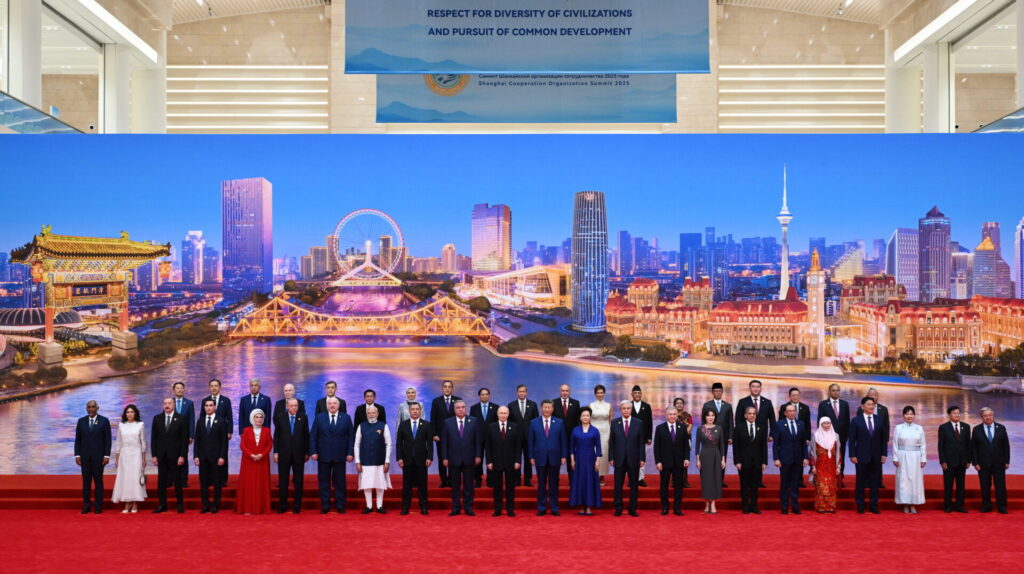
Beyond Xi, Putin and Modi, other leaders represented the seven other member states: Belarus, Iran, Kazakhstan, Kyrgyzstan, Pakistan, Tajikistan, and Uzbekistan. The event also drew non-member participants from across Asia and the Middle East—including Azerbaijan, Turkey, Egypt, Indonesia, and Vietnam—highlighting the SCO’s expanding diplomatic reach.
UN Secretary-General António Guterres also traveled to the region and addressed the gathering, emphasizing peace and security, sustainable development and finance, climate action, and digital cooperation. On climate, he urged G20 leadership.
The Tianjin Declaration:
Signed by all attending member states at the end of the Summit, the Tianjin Declaration laid out policy goals, especially on development, energy and climate.
Combining both development and geopolitics, the declaration proposed the Beijing-led SCO Development Bank, that would lend in non-US dollar currencies to spur regional growth. While de-dollarization has been a policy goal for China and other emerging markets for years, this could represent the largest grouping of countries seeking to engage in large-scale lending efforts without the US dollar. It’s also unclear how this bank will interact with the (BRICS) New Development Bank, which also (limitedly) uses local currencies.
On energy, the SCO summit saw a just transition championed in the official text even as a pipeline deal was signed on the sidelines. On one hand, the declaration seeks to stabilize energy markets through a “just energy transition,” and to expand cooperation on sustainable energy and development. On the other hand, Russia’s Gazprom reportedly signed an agreement to build the Power of Siberia 2 gas pipeline to China through Mongolia, offering a direct confrontation between climate and fossil fuel goals.
Lastly, on climate: The declaration sets out two planned SCO-climate summits: a Regional Climate Summit in the Republic of Kazakhstan in 2026, and a high-level SCO-Latin America and the Caribbean (LAC) meeting on Climate Change and Sustainable Energy this October. These two planned climate summits display the growing role climate diplomacy plays in the SCO, especially when connecting with regions outside Eurasia (and notably, in the US’s backyard).
Looking ahead:
With UNGA around the corner, the SCO Summit provided its members an opportunity to publicly display their goals for the rest of the year and beyond. Given the strong overlap of membership, the SCO is also another chance for BRICS+ countries (who often tout themselves as the voice of the global south) to show unity in the face of evolving geopolitical priorities. With climate change a topic that most people worldwide think that governments should prioritize (especially so in South America, India and the Pacific), it’s also a topic area that SCO countries can build bi- and multilateral relationships on.
Yet divisions remain. Even as the Tianjin Declaration announced new climate initiatives, Gazprom’s pipeline deal highlighted enduring reliance on fossil fuels. If completed, the project could deliver 50bcm of gas annually for 30 years—raising questions about how long-term fossil fuel infrastructure aligns with China’s decarbonization efforts and green tech objectives. While binding on paper, the deal also serves as a signaling tool, emphasizing the Russo–Chinese partnership at a time when Chinese imports of U.S. LNG have halted since March. Moreover, SCO members face uneven climate risks: Central Asian states contend with water stress and desertification, while Russia remains focused on hydrocarbon exports, complicating collective commitments.
As the world’s attention turns to important global platforms including the Africa Climate Summit and UNGA, the extent to which SCO members (especially China and India) align—or diverge—on climate will provide a signal of how international blocs balance geopolitical objectives with climate commitments in the run-up to COP. Whether these leaders deliver robust climate leadership through existing and new commitments will be a key indicator of whether geopolitical tensions can coexist with global progress on decarbonization.