
The stakes are high ahead of the 2026 European Semester Spring Package, expected on 3 June. The European Commission will use its annual set of economic policy recommendations as a basis to inform the National and Regional Partnership Plans (NRPPs), the new performance-based national strategies through which member states will access almost half of the next long-term EU budget in exchange for implementing agreed reforms and investments.
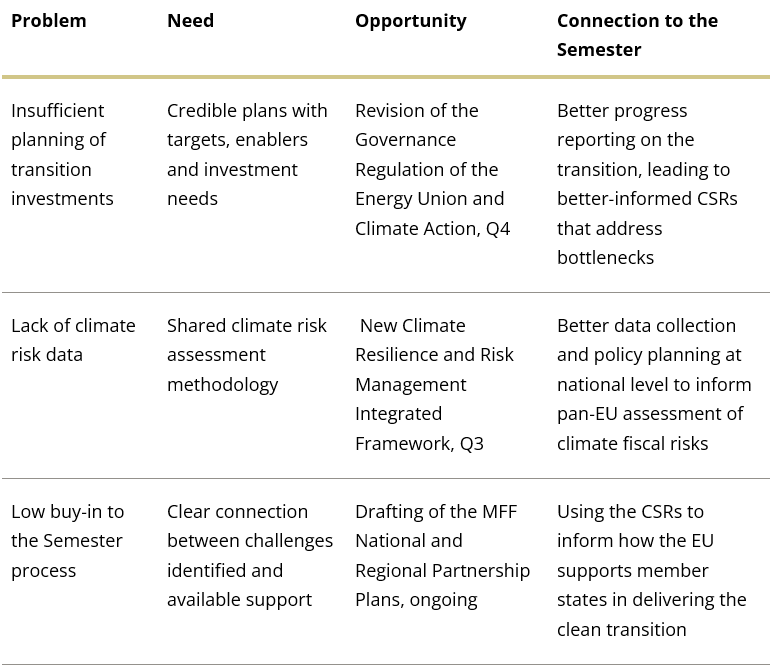
With this direct link set to become a regular feature, country-specific recommendations should reflect the growing consensus around the macroeconomic relevance of climate risks and opportunities. The EU’s busy 2026’s legislative agenda offers three opportunities to update the Semester.
The macroeconomic opportunities offered by decarbonisation are increasingly shaping the economic policy consensus, as reflected in the Draghi report. Clean energy accounted for nearly a third of EU GDP growth in 2023, and clean technologies, energy efficiency and circular business models are widely understood to contribute to the EU’s economic performance. However, member states continue to exhibit significant divergences in their capacity to capture these opportunities, affecting investment attractiveness and innovation capacity.
E3G’s previous research has highlighted climate change as a macroeconomic risk multiplier, and climate risks creating significant implications for private and public balance sheets. The Commission, European Central Bank (ECB) and the European supervisory authorities have significantly expanded their analytical and empirical work on climate-related risks. In reaction to the most recent energy price surge, ECB executive board member Frank Elderson explicitly stated that the EU’s fossil fuel dependency makes price stability harder for the ECB to achieve. The 2024 amendments to the EU fiscal rules now require member states to assess and disclose climate-related fiscal risks, though analytical integration remains in its early stages in many countries due to data and institutional capacity gaps. As a result, the ‘climate-fiscal timebomb’ remains insufficiently reflected in national and EU debt sustainability modelling.
Established in 2010 as a mechanism for coordinating fiscal, economic, and later social policies, the first decade of the European Semester and its country-specific recommendations (CSRs) was associated with austerity injunctions and fiscal consolidation during the euro area debt crisis. From 2020, the introduction of the European Green Deal led to a broadened ‘sustainable competitiveness’ remit, with more climate and energy analysis feeding into the country reports and a growing number of CSRs addressing climate, energy, and environment policies. Nevertheless, governance remains fractured and the Commission retains a large amount of discretion as to how it identifies challenges for competitiveness and macroeconomic stability, with imbalanced and inconsistent results depending on the year or the member state.
The EU should systematically integrate both climate opportunity and risk dimensions into its economic governance. As a first step, the Commission and member states should formalise exchanges of information on transition investment bottlenecks and climate risks through greater integration of National Energy and Climate Plans (NECPs) and national adaptation strategies in the European Semester. Secondly, the Commission should incorporate these reflections into its CSRs by continuing to strengthen a broader understanding of macroeconomic performance that goes beyond debt and deficit levels, while ensuring EU funds are allocated to implementing these recommendations through the new NRPPs.
Pending a more structural reform of the Stability and Growth Pact that would create more space for green-growth-oriented public spending, 2026 offers three opportunities to update the Semester:
- The 2026 revision of the Governance Regulation of the Energy Union and Climate Action, which sets the contents of NECPs, offers an opportunity to streamline planning and reporting, develop shared indicators, and break down siloes between climate and economic governance, helping to close the information gap around transition investment needs.
- The forthcoming Climate Resilience and Risk Management Framework proposal could improve data collection by establishing a central climate scenario and reporting standards for national measures.
- Finally, matching reform needs with technical and financial support in the NRPPs could create the foundation for a new era of policy cooperation, based on a whole-of-government, multilevel delivery towards shared climate goals.