
Around the world, governments are at risk of being sued if they enact climate policies that may affect fossil fuel companies’ profits. The culprit is ISDS – a provision present in over 2,500 investment treaties between countries. We explain what ISDS is, and why it must be reformed to allow faster progress on the energy transition.
What is ISDS?
Investment treaties are agreements between two or more countries that set binding rules for how foreign investments must be treated in each other’s territory.
Most investment treaties contain investor–state dispute settlement (ISDS) provisions, which allow foreign investors to sue host governments in private international arbitration tribunals if they believe the host government has breached the treaty.
Why is ISDS controversial?
ISDS has faced global scrutiny as it undermines governments’ ability to regulate in the public interest, particularly climate policies. ISDS was originally designed to protect foreign investors from government arbitrary treatment, such as seizure of private property without due compensation. However, investors have increasingly used ISDS to challenge legitimate government measures that affect their expected profits.
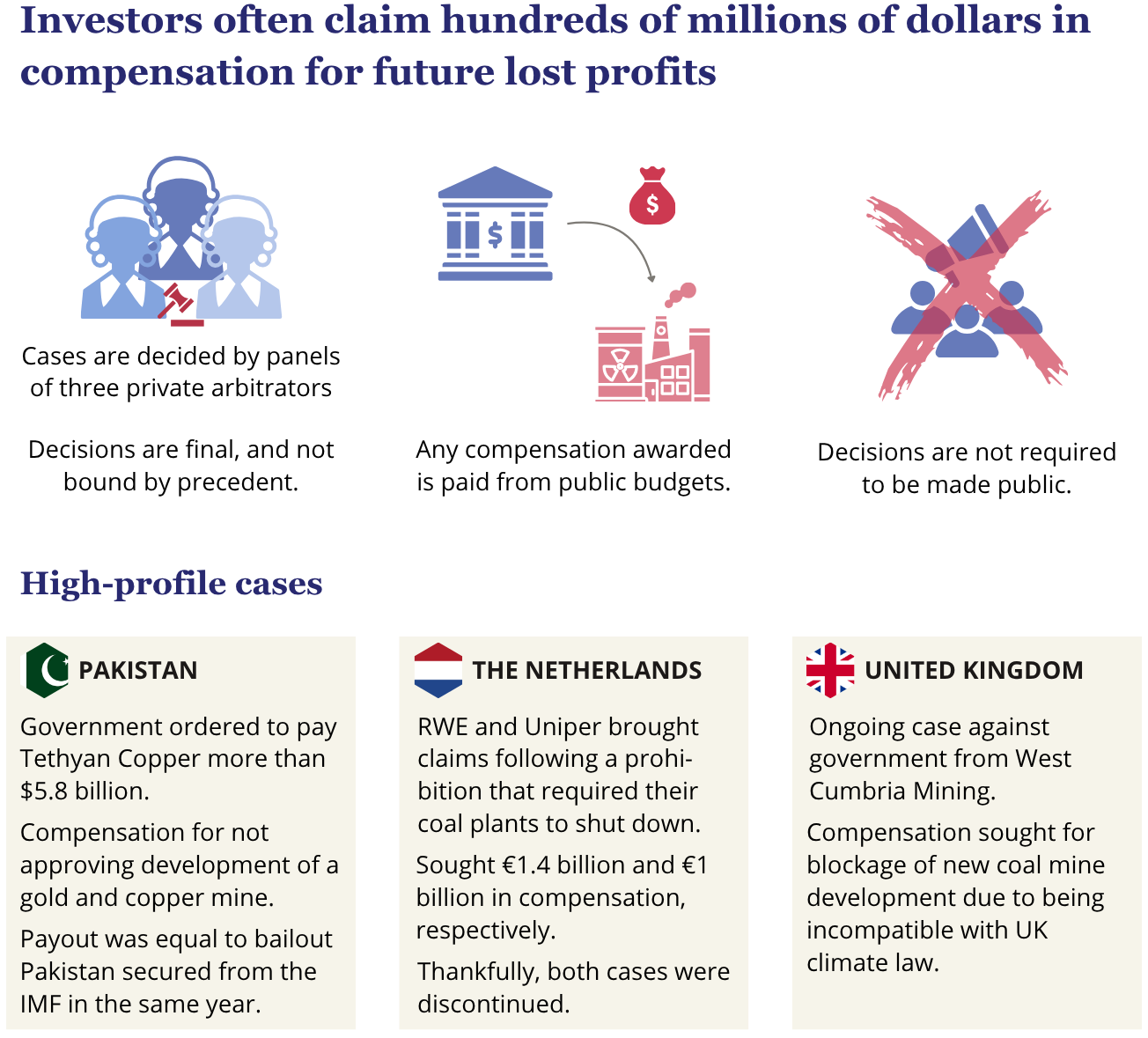
Investors often claim hundreds of millions of dollars in compensation for lost future profits, with successful claims paid from public budgets. Arbitration proceedings have also been widely criticised for being untransparent as decisions and proceedings are not required to be made public. Arbitral proceedings are also not bound by legal precedent, and decisions are final. Arbitrators are not required to possess expertise on climate change or other public policy areas.
Why is ISDS a barrier to climate action?
Fossil fuel investors have increasingly used ISDS to seek compensation when governments enact coal phase-outs, oil and gas extraction bans, and other environmental measures.
The fossil fuel sector is the most litigious in terms of ISDS claims. By 2023, at least 349 known fossil fuel-related ISDS cases had been filed, through which fossil fuel industry had secured approximately US$83 billion in compensation, though not all cases were specifically in response to climate-related measures. The true figures may be higher, as not all cases are made public.
The scale of the problem is global as there are more than 2,500 investment agreements in force, most containing ISDS.
ISDS provisions create legal and financial risks for governments, which can delay or deter a just energy transition by:
- Making the public pay for fossil fuel investors’ risk: ISDS functions like a form of state-backed insurance, allowing investors to attempt to shift business risks onto the public when climate policies reduce their expected profits.
- Creating regulatory chill: Governments may delay or be deterred from taking climate action sooner due to legal risks.
- Reducing countries’ fiscal space to respond to climate change: Even one claim can significantly reduce fiscal space for public services, particularly for developing economies.
ISDS is a barrier to ongoing energy transition initiatives
At COP28, all countries agreed to transition away from fossil fuels. Many countries have made further commitments in their Nationally Determined Contributions (NDCs): the vast majority of countries that published new NDCs in 2025 (84%1) mentioned plans to reduce the overall share of fossil fuels in their electricity mix.
Yet the presence of ISDS poses a significant barrier to these countries’ stated intentions. Some of the most prominent countries that are leading global initiatives face particular risks from ISDS. Examples include the Netherlands and Colombia – both vocal in organising global energy transition efforts including co-hosting the First Conference on Transitioning Away from Fossil Fuels in April 2026. In these countries, respectively 87% and 56% of fossil fuel assets have at least one investor who can access ISDS.
Global reform is needed
Despite the significant barriers ISDS poses to the energy transition, progress has been slow due to challenging political dynamics.
- Lock-in from existing treaties. With over 2,500 treaties in force, it requires lots of administrative effort to renegotiate or terminate. Even when treaties are terminated, many include sunset clauses that continue to extend ISDS protection for years or even decades. However, mutual termination can neutralise these sunset clauses.
- Siloing of investment and climate agendas. Investment treaty policy often sits within governments’ wider trade agendas and is rarely treated as a primary climate issue despite the significant implications.
- Fear of reducing investor confidence. While conclusive evidence that investment treaties facilitate investment flows is lacking, countries may worry about signalling investment uncertainty if they act alone in opposing ISDS.
- Asymmetric incentives between capital-exporting and capital-receiving countries. Countries with large stocks of outward fossil fuel investment, most often in the Global North, are more likely to have investors who benefit from ISDS, while capital-receiving countries are more likely to be at risk of claims. This asymmetry means countries may seek to remove ISDS strategically from treaties where they face legal risks, while maintaining it where their investors will benefit abroad.
Despite these challenges, some countries have begun to move away from ISDS, for example:
- Australia has taken a principled stance against ISDS since 2022, committing to exclude ISDS from any new treaties and renegotiating existing treaties to remove ISDS.
- Colombia announced its plans to withdraw from the international ISDS system in April 2026.
- Since 2022, the EU and more than ten European countries have left the Energy Charter Treaty, citing the agreement’s protection of fossil fuel assets via ISDS as a key reason.
- Several other countries, including South Africa, Bolivia, New Zealand, Indonesia, and India, have also taken measures to move away from or limit ISDS.
The First Conference on Transitioning Away from Fossil Fuels in April 2026 is the first dedicated international climate discussion to focus specifically on the intersection of ISDS and climate change. Going forward, countries critical of ISDS, such as COP31 President of Negotiations Australia, can leverage their global position to mobilise broader political support for reform.
Recommendations for policymakers
To overcome the dynamics set out above and meet the demands of the energy transition, reform is best achieved by countries working together on coordinated solutions and mobilising political support.
- Review existing treaties with the aim of reforming or removing ISDS and commit to not including ISDS in new treaties.
- Use discussions where ISDS is a key agenda item, such as the Colombia- and Netherlands-led First Conference on Transitioning Away from Fossil Fuels in April 2026, to mobilise political support for reform.
- COP31 co-hosts Australia and Türkiye can pursue plurilateral action at COP31 to mobilise a collective of countries committed to jointly reforming ISDS.
Footnotes
- Unpublished update to the E3G NDC Energy Commitments Tracker ↩︎