

The Brazilian COP30 Presidency has proposed the launch of a new ‘Integrated Forum on Climate Change and Trade’ (IFCCT) in Belém. The IFCCT could bridge the divide between climate and trade communities at the UNFCCC and the World Trade Organisation (WTO), offering a fresh approach based on rebuilding trust. Participation from developing economies most affected by unilateral measures, and crucially also the developed economies introducing them – such as the EU and the UK – will be key to the IFCCT’s success.
Mounting multilateral pressures
Trade is not a new topic in international climate negotiations. Article 3.5 of the UNFCCC states that “measures taken to combat climate change, including unilateral ones, should not constitute a means of arbitrary or unjustifiable discrimination or a disguised restriction on international trade”. But as countries have increasingly made use of cross-border decarbonisation measures in recent years, trade tensions at the UNFCCC have escalated.
The BASIC group of countries first tabled a proposal to include unilateral measures on the UNFCCC agenda at COP28 in 2023. The cross-border impact of climate policies has received increasing attention since then, particularly from developing countries who face a disproportionate impact due to high administrative costs and limited resources to decarbonise. The debate intensified at Bonn SB62 earlier this year, with a proposal from LMDCs underlining the adverse effects of “trade-restrictive” measures and calling for multilateral cooperation as the most effective and just response to climate change.
Existing multilateral initiatives and international diplomacy efforts have so far struggled to address these concerns. Amid wider trade tensions and worsening climate impacts, now is the time to look at alternative pathways for progress.
Seizing the opportunity to do things differently with the IFCCT
The IFCCT is built on the principle that trade can be a key lever for turning climate ambition into action. In his address to the WTO Public Forum in September, COP30 President, Ambassador André Corrêa do Lago stated that “Belém’s trade priority is to see past our differences and act on what we share”. By breaking down the silos in which trade and climate issues are typically addressed, the IFCCT aims to generate new ideas, rebuild trust, gather a critical mass behind mutually empowering solutions, and ultimately help countries figure out how to cooperate again.
Brazil’s proposal recommends a new method of facilitating cooperation between countries, through a venue that is formally endorsed by both the UNFCCC and WTO but institutionally independent, therefore not subject to the same legal restrictions or facing the external pressure of delivering binding outcomes.
Brazil is uniquely positioned to lead such an initiative, setting the IFCCT apart from existing groupings in this space, such as the Climate Club (launched by the G7). As an influential emerging economy with ambitious climate goals, Brazil has the convening power to bring both developed and developing country partners together to advocate for bold, collaborative solutions.
Overcoming challenges and building solutions with the EU, UK and Brazil
The IFCCT will not achieve its desired aims without the support of a diverse group of countries, including both supporters and sceptics. The IFCCT’s priority should be to elevate the voices of developing countries, but developed economies (particularly those implementing unilateral measures such as Carbon Border Adjustment Mechanisms) must also have a role in these conversations.
This table sets out current concerns over the framing of the IFCCT, with proposals for how the EU and UK could work with Brazil and other partners to overcome them.
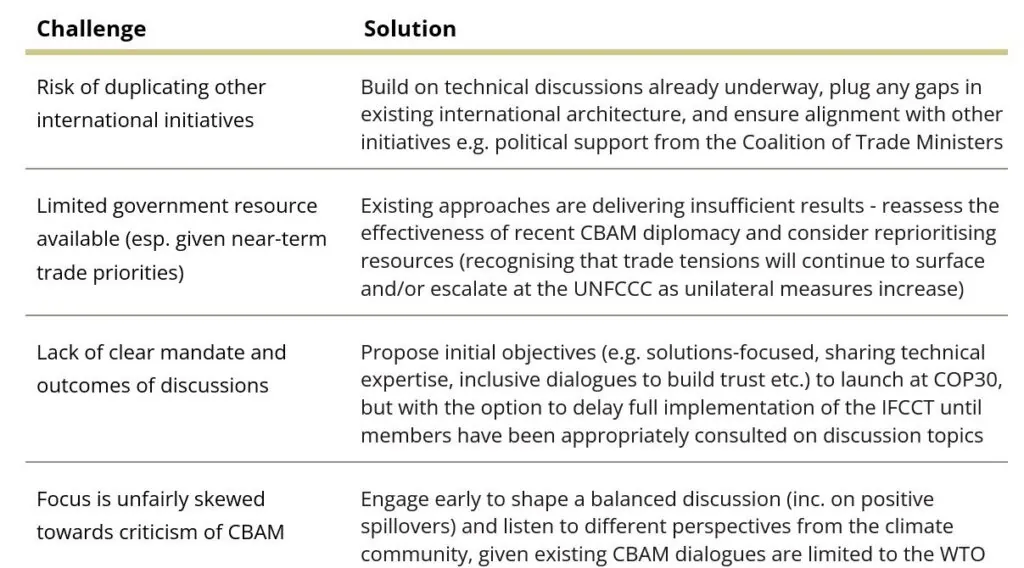
Participating in the IFCCT could also deliver wider geopolitical benefits for the EU and the UK. Reaffirming a commitment to multilateralism would instil confidence when the rules-based order is under increasing strain. Using this opportunity to reset the CBAM narrative would be a proactive and progressive way to advance carbon pricing diplomacy and defend a key pillar of industrial decarbonisation.
Key principles for success
Alongside securing membership from a wide range of countries, the IFCCT should:
Trade tensions at the UNFCCC might not be dispelled immediately at COP30 – finding solutions to complex global problems will take time. But strengthening the foundation for cooperation in the meantime would be a valuable contribution to advancing multilateral progress.
Advancing technical discussions, with the support of a diverse and unbiased panel of experts, will help to identify practical solutions. The IFCCT must find a way to detoxify the debate, without ignoring the contentious issues.
Champion the successes of other international initiatives in this space rather than proposing an alternative. This should include building on the work of the WTO Committee on Trade and Environment and the Climate Club’s recently published voluntary principles to address the spillover effects of climate policies.
At a time of increasing trade and geopolitical tensions, the launch of the IFCCT sends an important signal: working together is better than going it alone. If this new forum is successful, it could serve as a test-case for the unifying potential of multilateral cooperation – with wide-reaching benefits for the future of global climate action.