The modern economy runs on steel, but steel production is responsible for 7–9% of the world’s greenhouse gas emissions. The most emissions-intensive stage of steel production is iron ore reduction. Businesses, policymakers and civil society organisations are increasingly focused on “green iron” as key to reducing emissions, supporting industrial development and economic security. But current policies will not support investment at scale.
Multiple studies have shown that green iron trade can reduce costs for steelmakers and trigger industrial development in prospective ironmaking regions. Our report builds on these by showing why governments must act to realise these benefits, and how. This practical guide for governments is based on extensive interviews with actors across the iron and steel value chain, and original political analysis.
Green iron projects will not succeed at scale, or benefit countries, without government support
E3G spoke to supply chain actors already committing capital and resources to green iron – many of whom are confident in its potential. But the interviews highlighted the challenges in building an investable case for a new green iron project.
Green iron production is untested at scale and requires significant infrastructure, finance and resources. Production costs are driven by access to abundant, low-cost renewable electricity, so production depends more heavily on trade between countries, including new supply chain entrants. Markets alone cannot manage these challenges. Nor can markets translate projects into development and resilience for countries in the supply chain.
The single most important thing a government can do is establish an objective for green iron trade which links steel supply chain outcomes to the country’s industrial strategy.
This is a precursor to governments being the partner that businesses need, because it provides a single vision to coordinate disparate branches of government. Multiple institutions can provide a single interface with governments – interviewees said this was critical wherever projects have been successful.
Without this overarching objective, governments cannot manage the risks posed by supply chain transformation. International financiers cannot distinguish between overseas projects that diversify supply for domestic steelmakers and those that undermine them. Power system planners cannot prioritise supply to projects that support industrial development over those that extract resources. The result is public sector paralysis.
Recommendations for governments
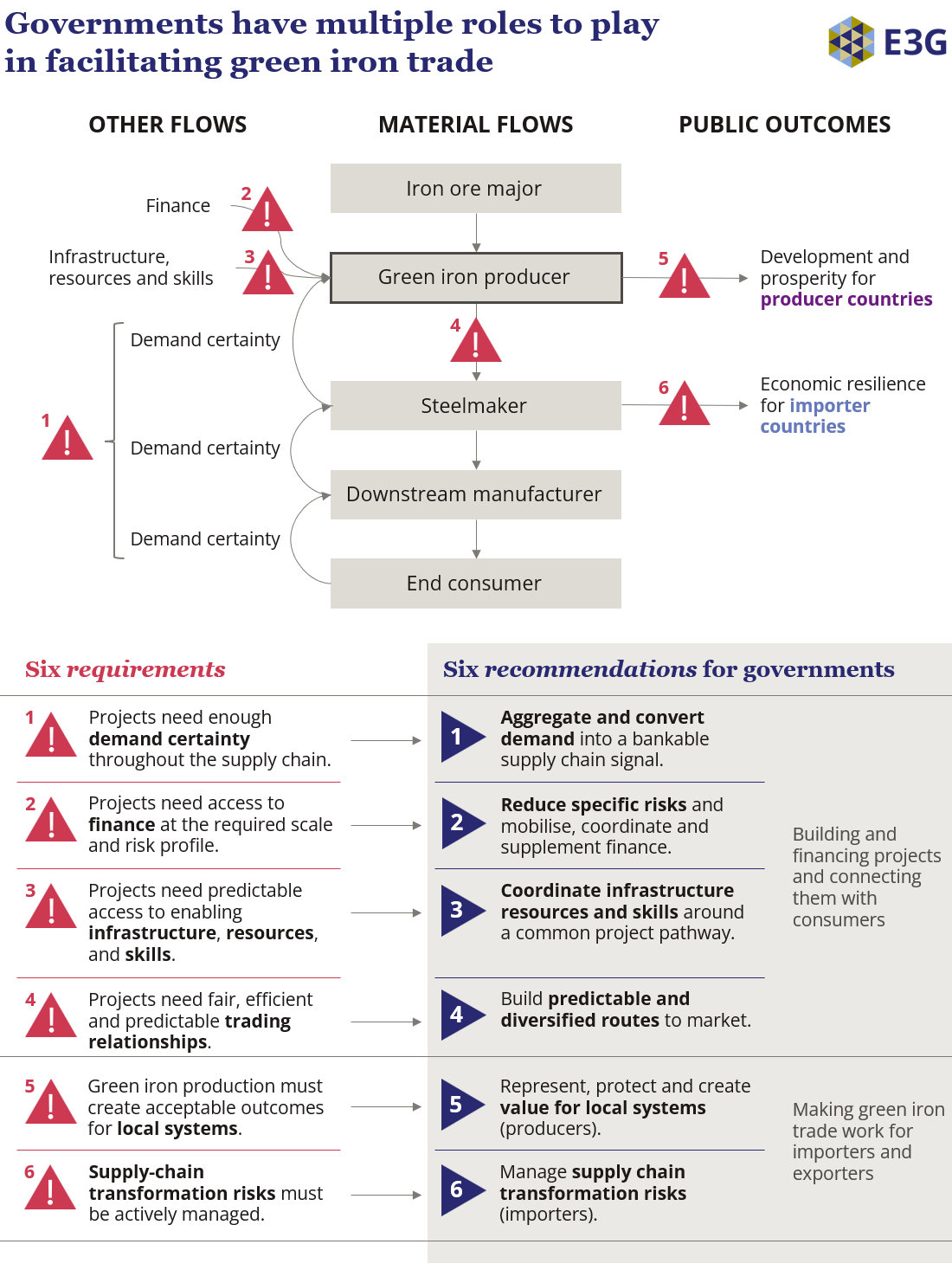
We have identified six roles that governments need to play to ensure that green iron projects can be launched, and that green iron trade will support national objectives. These roles translate into size recommendations:
- Aggregate and convert demand into a bankable supply chain signal.
- Reduce specific risks and mobilise, coordinate and supplement finance.
- Coordinate infrastructure resources and skills around a common project pathway.
- Build predictable and diversified routes to market.
- Represent, protect and create value for local systems (producer governments).
- Manage supply chain transformation risks (importer governments).
International cooperation makes public intervention easier and more effective – when it connects functioning domestic systems
Strong domestic organisation can support the business case for green iron projects, but scaling green iron trade and reaping the benefits involves investment in a value chain that sits across borders. International collaboration becomes essential. It is not a substitute for national policy or project delivery – it provides a mechanism through which domestic systems can address dependencies that sit beyond their borders where industrial objectives align.
Four key areas for cross-border cooperation:
- Aggregate demand and make standards work across borders.
- Coordinate project finance across national and international institutions.
- Connect finance to infrastructure and national development plans.
- Build trade partnerships around market access, resilience and fair value.