
Across the EU, new industrial projects are waiting for the opportunity to connect to the grid – sometimes for years. The stalled investments are a threat to Europe’s competitiveness, while the connection bottlenecks are slowing progress on what is in the long term the most cost- and energy-efficient pathway to industrial decarbonisation. Tackling this challenge is high on the EU’s agenda, but it is member states who can unblock the bottlenecks by effectively implementing existing EU regulations.
In countries across the EU, the lack of available grid capacity is leading to delays and cancellations affecting thousands of businesses. The delays are causing billions in investment to go unrealised – €60bn in Spain alone in 2024 according to utilities association Aelec. This issue is increasingly recognised, though not yet well characterised: Europe-wide comprehensive data on demand connection queues is not available.
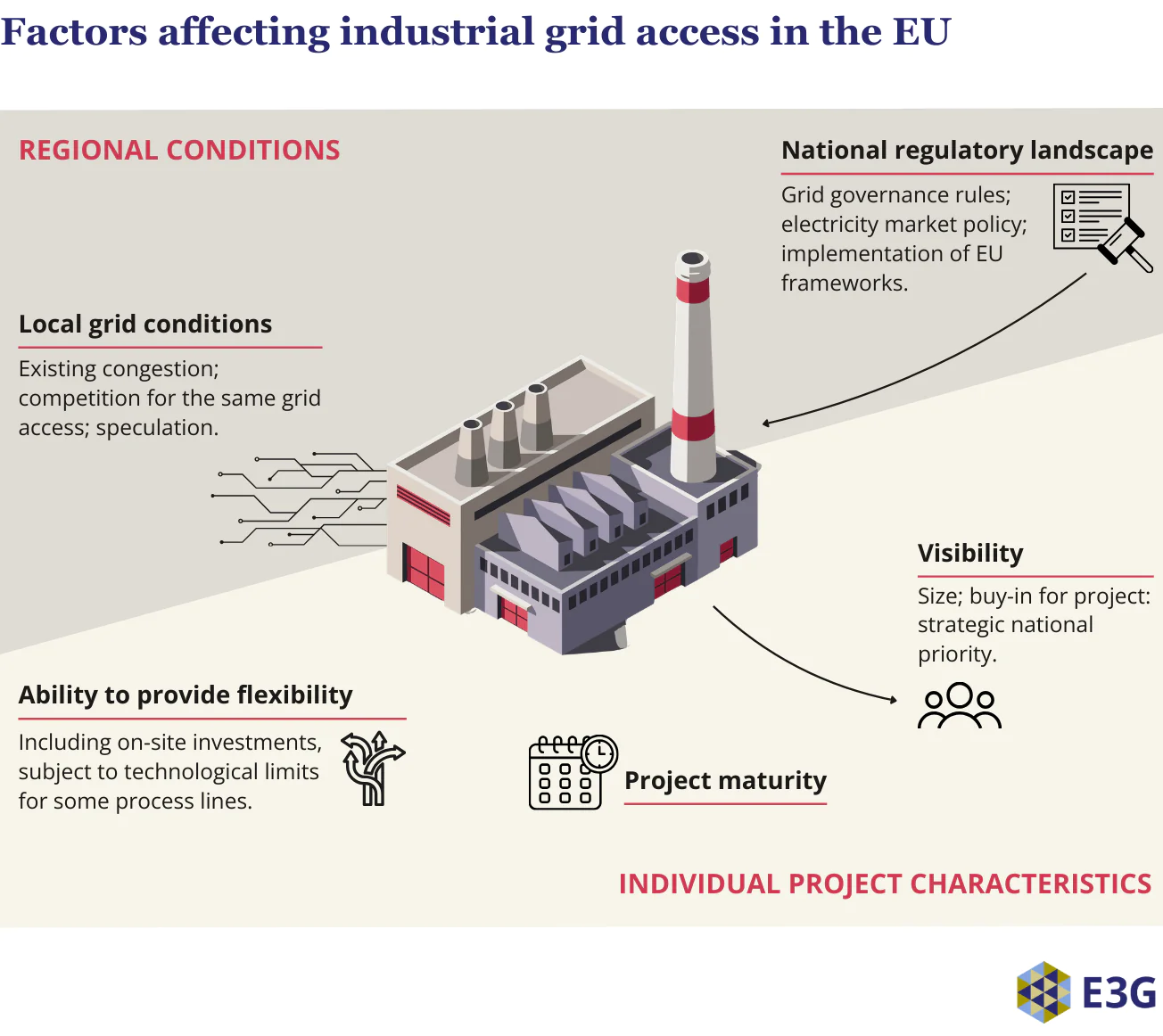
From interviews with industry representatives, we have learnt that regional conditions and individual project characteristics together shape whether an industrial project can secure access to the grid. A particular factor is the ability of an industrial installation to reduce load on the network through flexible electricity usage.
Our findings underscore that only effective national implementation of EU regulations can unlock stalled investment and enable future projects. Member states, network operators and national regulatory authorities need to robustly and speedily implement the Electricity Market Directive and the Grid Package, including the Guidance on efficient and timely grid connections.
Recommended actions for member states
- Urgently implement the Electricity Market Directive to improve incentives for industrial flexibility provision and data transparency on grid connection queues.
- Design state aid schemes to de-risk capital investments into non-fossil fuel flexibility technologies for industry, based on the rules set out in the Clean Industrial State Aid Framework.
- Implement the Guidance on efficient and timely grid connections, in particular through adopting best practices from other member states, as well as considering including social or economic criteria.
- Ramp up investments in grids and plan grid updates to meet forecasted industrial demand and enable economic policy objectives. Do so through linking up inter-institutional mechanisms to align spatial energy plans with projected industrial energy needs. Report on electrification and required grid reinforcement in National Energy and Climate Plans (NECPs).