
The first decade of the Paris Agreement is now behind us. The next must deliver implementation and greater ambition, including on adaptation and resilience. This is essential to ensuring the Paris Agreement delivers real world safety and protects livelihoods around the globe. Did 2025 mark a turning point for resilience, and what political winds will shape delivery in 2026?
Across 2025, and at COP30 in particular, adaptation was elevated on the global stage, marking a crucial inflection point in efforts to closing the ambition gap across energy, adaptation, nature and finance. Vulnerable countries and the COP30 Presidency set clear expectations that success in meeting rising resilience needs would be a real test of commitment to climate action and to multilateralism in this new era of implementation. While geopolitical turbulence and the fragmented partnerships continue to constrain ambition, the year still delivered important outcomes that now need to be translated into action.
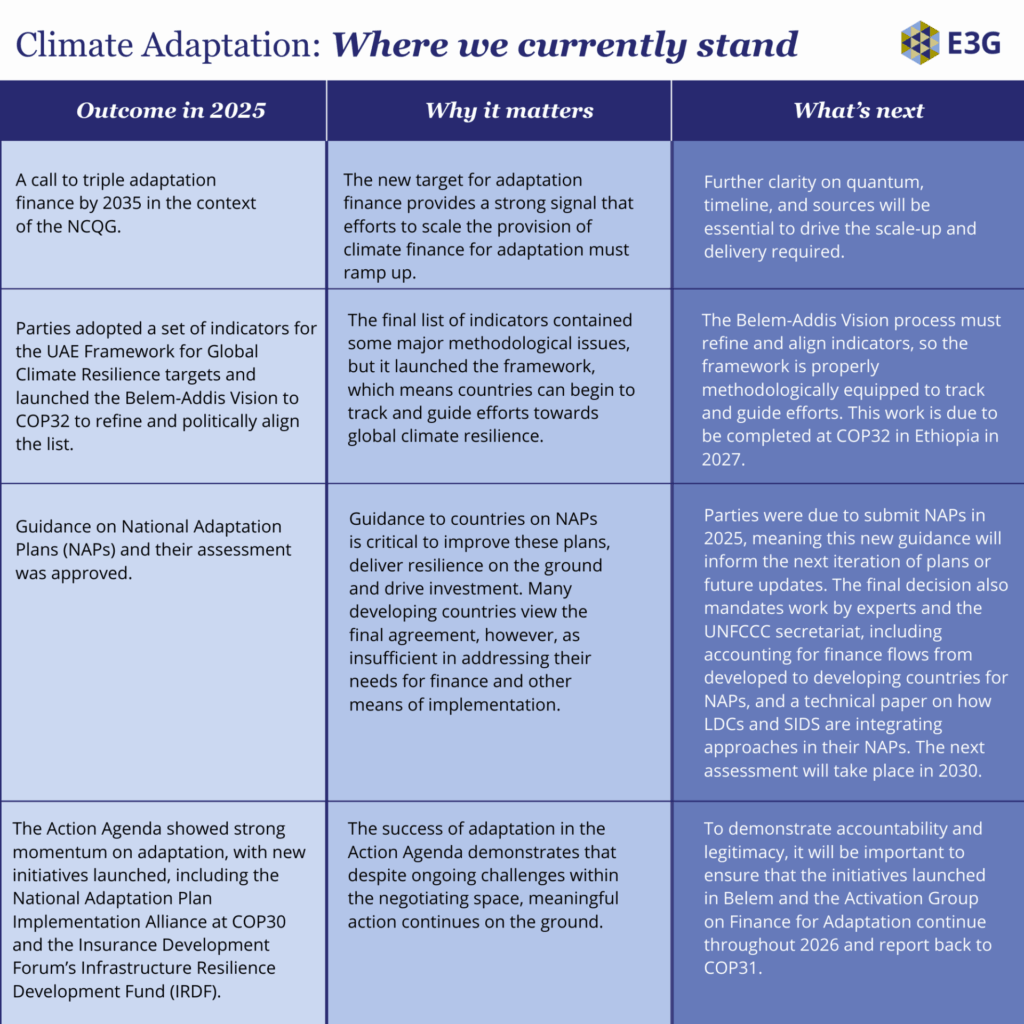
Drawing on key moments from 2025, adaptation outcomes following COP30 highlight where progress has been made and what needs to come next. The table below summarises the main developments of COP30 and their implications for 2026.
Attention now turns to a set of political dynamics that will shape whether progress made in 2025 translates into meaningful delivery of adaptation and resilience in 2026.
1. New champions and alliances are needed to keep adaptation at the centre of the climate agenda
- Moving beyond zero-sum games towards a framing of shared resilience for global prosperity: In this era of unprecedented geopolitical change, political agreements and alliances are in flux. Competing priorities and interests are also creating misalignments within blocks, deepening divisions, and exacerbating frustration. These dynamics were evident at COP30 resulting in contentious trade-offs. However, as we saw in Davos earlier this month, many leaders are increasingly arguing that a world order based on collaboration and shared resilience is safer and more prosperous for everyone. The path forward for climate adaptation will require governments to embrace this new narrative, navigating tensions with greater strategic discipline and forming new and stronger coalitions that can bridge divides and deliver real climate action.
- Leveraging the full diplomatic calendar of 2026: Leveraging the diplomatic convenings of 2026 to align and coordinate early could prevent last minute tensions observed in the last couple of years, demonstrating leadership and developing fruitful partnerships on climate resilience. Pre-COP in the Pacific could be positioned as a major political moment to launch new coalitions of the willing, build consensus around the resilience agenda, enhancing impact and underscoring the vital link between adaptation and economic stability and security.
2. Building confidence by delivering on existing commitments with accountability
- Demonstrating that finance is flowing at scale: The COP30 agreement to call for efforts to triple adaptation finance ($120 billion a year) by 2035 will require sustained effort across actors including the MBDs, bilateral donors, and the private sector. Multilateral Development Banks forecast they will provide $42 billion in adaptation finance by 2030, creating a vital foundation of this delivery. New innovative sources of finance are also emerging, providing a promising sign that significant new grant finance could become available. Donor countries must use the forthcoming finance deliver y reports to demonstrate that all these efforts are delivering finance at scale, providing tangible examples of good practices and transformational impact. Demonstrating shortened access timelines and increased concesionality could also deliver confidence in the ongoing institutional reforms of the Vertical Climate and Environment Funds.
- Addressing methodological gaps and increasing accountability: Demonstrating delivery of finance will also require improved transparency and accountability. The Biannual Transparency Reports (BTRs) provide a foundation for reporting on finance, but the lack of a common climate finance taxonomy, the complex nature of measuring adaptation-specific project finance, as well as lack of visibility on private flows of finance for resilience, pose serious methodological and accountability barriers. With the newly adopted indicator on finance in the GGA, political space must be made for further discussion on this matter.
3. Implementation will require an integrated approach beyond the UNFCCC
- Political momentum must extend beyond the UNFCCC: including through the French G7 Presidency, India’s BRICS Presidency, and region-specific summits. Adaptation must also feature more prominently in bilateral relationships, as demonstrated by the EU and China or the France and China statements in 2025, which identified resilience building as key areas of cooperation.
- Operationalising political commitments in on-the-ground contexts: Implementation of adaptation will require a whole economy integrated approach as showcased by the COP30 Action Agenda which included initiatives spanning adapting industries, cities, and infrastructure to climate-smart agriculture and finance mechanisms such as country platforms. Providing space in multilateral negotiations for locally led country owned approaches would help ensure that international agreements reflect local need and are fit for purpose. Moreover, it is vital to ensure that climate and development agendas are integrated and mutually reenforcing: neither can succeed without the other. With international budgets tightening, climate risks escalating, and demands rising across both agendas, closer coordination can support delivery of the Paris Agreement and the Sustainable Development Goals, as well as wider economic, security and development goals.
The next decade offers real potential to accelerate the implementation of resilience measures. Countries have NDCs and NAPs that outline concrete steps, finance goals to send signals for scaling up investment, and the processes and mechanisms for transitioning away from fossil fuels, forest protection, just transition and resilience are taking shape. Adaptation outcomes at COP30, while imperfect, mark some of the most consequential advances seen in recent years and cement adaptation’s position as a core pillar of the Paris Agreement.
Realising this potential and ensuring that economic and social gains are protected from escalating climate risks, will require sustained political leadership, new coalitions, demonstrated delivery, and a deliberate effort to align climate and development objectives. If governments can use the political winds now emerging to mobilise finance, deepen cooperation and turn frameworks into tangible action, the world can begin to close the resilience gap and secure a safer future for the most vulnerable.